








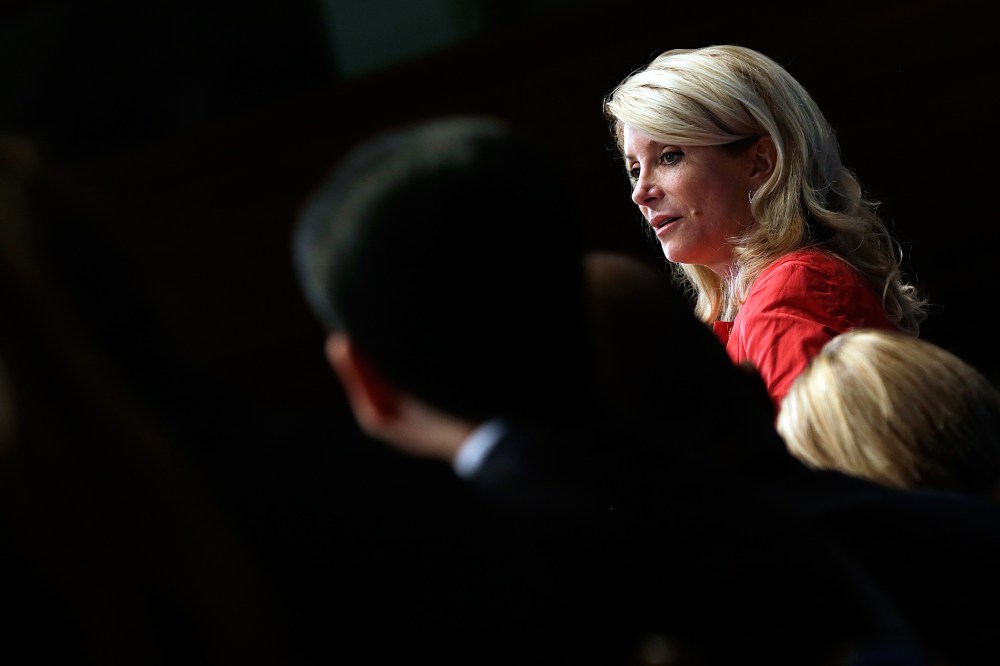
The last time Justice Anthony Kennedy voted on an abortion restriction, he was swayed by the testimonies of women who regretted their procedures. This time around, as the court prepares to hear a major abortion case known as Whole Woman’s Health v. Cole, advocates of abortion rights are making sure he hears from women who say ending their pregnancies was the best choice for them. The best-known among the storytellers: former Texas state lawmaker Wendy Davis, who filibustered the law in question for nearly 13 hours.
RELATED: The sign that anti-abortion clinics say tramples their religious liberty
“While we find no reliable data to measure the phenomenon, it seems unexceptionable to conclude some women come to regret their choice to abort the infant life they once created and sustained,” Kennedy wrote in his 2007 majority opinion for Gonzales v. Carhart, citing an amicus brief, or friend-of-the-court brief, from anti-abortion women. “Severe depression and loss of esteem can follow.”
In fact, a task force by the American Psychological Association reviewing the actual research found that adult women who have abortions are at no greater risk of mental health problems than if they chose to give birth. That reasoning, used by Kennedy to uphold the federal Partial-Birth Abortion Ban, infuriated women’s health advocates, including Ruth Bader Ginsburg, who in her dissent accused Kennedy of relying on sexist and outdated notions of women.
Several amicus briefs filed in support of the clinics challenging Texas’s abortion restrictions this week seem aimed at showing Kennedy that women have all kinds of feelings about abortion. Technically, women’s feelings about abortion have little to do with the stated rationale of the law in question. Texas says it wants abortions to only happen in massive ambulatory surgical centers by doctors who have admitting privileges at hospitals within 30 miles of them because it wants to protect women’s physical health. But such a rationale neatly builds on the broader idea that women need to be protected from abortion providers for their own good.
That’s why supporters of abortion rights have recruited women of all walks of life to tell their stories in amicus briefs. The justices have paid close attention to these first-person-narrative briefs in the past. For example, in oral argument for Obergefell v. Hodges, the same-sex marriage ban case last term, Kennedy and Justice Antonin Scalia both pointed out conflicting briefs that sought to represent children raised by gay or lesbian parents. More recently, in Fisher v. Texas, an affirmative action case, Scalia made headlines for citing an amicus brief arguing, in his words, that black students were better off in “lesser schools.”
RELATED: Texas abortion providers make their case to SCOTUS
Given the relative silence that cloaks abortion, such stories may be even more important in this case. “I heard all these stories that just fit your scenario, and I respect that,” one of the signatories to the amicus brief, Ohio State Rep. Teresa Fedor, famously said during a March 2015 debate on a different abortion restriction. “But you don’t respect my reason. My rape. My abortion. And I guarantee you there are other women who should stand up with me and be courageous enough to speak that voice.”
The brief signed by Davis, Fedor, former Nevada legislator Lucy Flores, and former Seattle City Councilwoman Judy Nicastro acknowledges that “social stigma and fears of backlash discourage all but a select few from recounting their stories in a public forum. As a result, false stereotypes persist in society and in state legislatures regarding women who exercise their right to choose. The reality is that approximately one out of every three women in this country has had an abortion in her lifetime. The women who have had abortions are both single and married. They are young and middle-aged. They are rich and poor. They are of every faith and every walk of life. Many are already parents trying to support their families.”
The women in that particular brief are likely to be recognizable to the justices, having held public office. Their stories are often tragic: Davis had an ectopic pregnancy and, separately, her fetus was diagnosed with a fatal condition in her second trimester. Nicastro also faced a life-threatening condition late in her pregnancy. Fedor is an Air Force veteran who was raped, resulting in pregnancy. Flores first publicly told her abortion story during a legislative debate over sex education in schools, describing how it helped her overcome a troubled youth. (The brief describes her as having been an “unwed teenager.”)
But even with their current relative privilege, the brief notes, these women have faced backlash: “Senator Davis has been mocked as ‘Abortion Barbie.’ While attending a political event in Los Angeles, she was greeted by life-sized posters throughout the city of “Abortion Barbie Wendy Davis” dolls holding scissors in their hands with plastic fetuses in their uteruses. Additionally, to this day, whenever Senator Davis posts a message on Twitter, regardless of the topic, she gets responses accusing her of ‘murdering babies.’” The brief also notes that when Fedor told her story on the Ohio House floor, some male lawmakers laughed, and that “Assemblywoman Flores got vitriolic messages calling her a ‘vile human being’ and warning that she would soon ‘meet her maker.’”
RELATED: Home abortions rise after Texas law closes clinics That’s just one of the briefs made up of first-person stories. Another is made up entirely of legal professionals who have had an abortion. Still another says the women who signed it are “successful professionals and educators; conscientious, moral and caring people; and valued members of communities large and small which have benefited from [their] fulfillment of their aspirations.” An organization that filed another brief, Advocates for Youth, is a pro-choice group that has since 2011 been running a campaign known as “1 in 3,” for the approximate number of women who will have abortions in their lifetime. More than 900 women have contributed so far, their brief said. It takes care to match stories to each of the prongs of the court’s traditional reasoning on abortion. For example, the court has said states can’t put a “substantial obstacle” in the way of women; several women tell stories of how they struggled to afford or arrange their abortions, often having to travel out of state to do so. “All in all: two trips from West Virginia to Maryland, about 1000 dollars with car costs and such, a new OBGYN, and a great sense of relief,” writes Rachel Barnes in the Advocates for Youth brief. “But it shouldn’t be that way.” Another woman writes of having an abortion in Tijuana in 1965, before the Supreme Court made abortion legal throughout the United States. “I was the world’s expert on my own life,” Anne Hopkins writes of her decision to have an abortion at 19. “When I made that decision, I was prepared to risk death.” The brief goes on to say, “The effect of legal restrictions that create such obstacles goes beyond mere inconvenience and, when the realities of women’s daily lives are taken into account, can in a ‘real sense deprive women of the ultimate decision.’” The quoted words are Kennedy’s. Texas’s own brief defending its law is due to the court Jan. 27, and amicus briefs in support of its position are due Feb. 3.
Irin Carmon Recommended


