








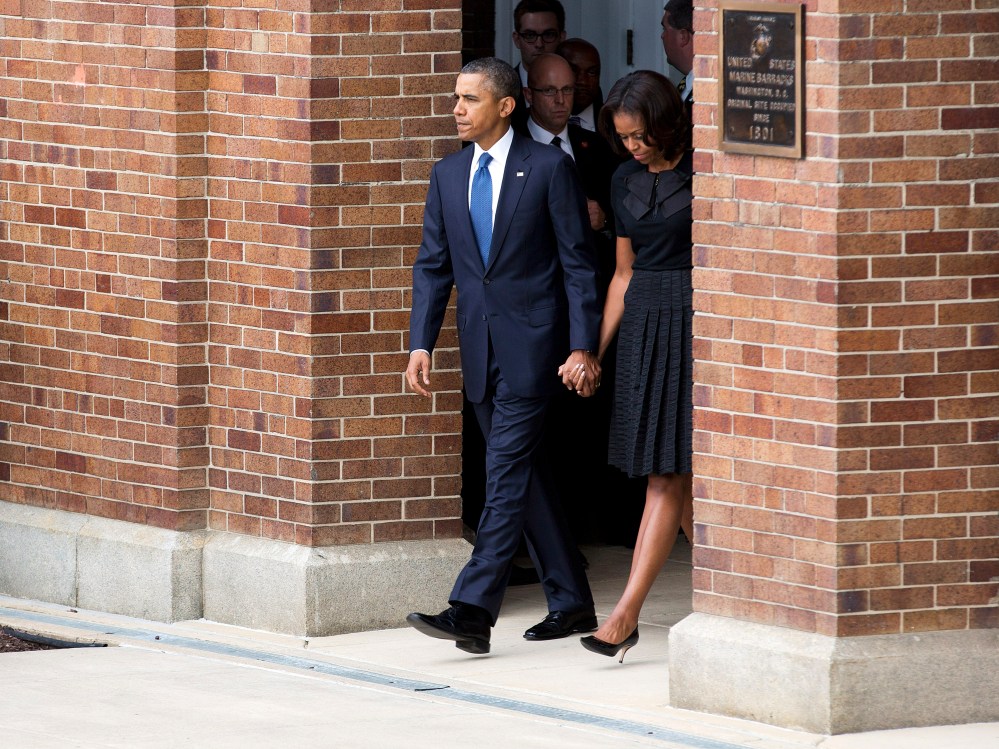
Just nine months ago, President Barack Obama stood before the families of 20 school children who were shot down in a Connecticut classroom and said, “We can’t tolerate this anymore.”
He read from a list of grief-stricken American towns marred by previous mass shootings: Tucson. Aurora. Oak Creek.
And then the names of the children killed at Sandy Hook Elementary School: Charlotte. Daniel. Olivia. Josephine. And so on.
Obama promised to use the power of the presidency to do whatever he could to try to engage lawmakers and the public to prevent such tragedies. But in the months since that cold day in December, not much has changed in the way of federal gun laws. In fact, in many states it is easier to get a gun now than before the Sandy Hook killings.
On Sunday, Obama stood just blocks from the Washington Navy Yard, the scene of yet another mass shooting, the fifth in almost as many years. In a halting speech delivered during a memorial service for the 12 people killed in last Monday’s shooting, a profoundly frustrated president deplored what he fears is a “creeping resignation” to gun violence in America.
Once more we come together to mourn, he said. Once more we pay tribute. Once more our hearts are broken. Obama lamented how easy it is to get a gun in America and the country’s apparent unwillingness to change that.
“It ought to be a shock to us all as a nation and as a people. It ought to obsess us. It ought to lead to some sort of transformation,” Obama said. “And yet, here in the United States, after round-the-clock coverage on cable news, after the heartbreaking interviews with families, after all the speeches and all the punditry and all the commentary, nothing happens. Alongside the anguish of these American families, alongside the accumulated outrage so many of us feel, sometimes I fear there’s a creeping resignation that these tragedies are just somehow the way it is, that this is somehow the new normal.”
“We can’t accept this,” he said.
But gun violence is normal in America. People continue to be shot where they attend school, where they work, worship and play. In many urban communities the crackle of gunfire and bloodshed is every day and unrelenting, but often draws only local attention.
Just days after the Washington Navy Yard shooting, gunmen opened fire on 13 people at a playground in Chicago with an assault rifle. No one was killed but among the wounded were three children, the youngest just 3 years old. Over the weekend another 11 people were shot in Chicago, five of them fatally.
Last week, Congresswoman Robin Kelly of Chicago brought parents of children killed by gun violence to the Capitol to lobby lawmakers for common sense gun laws. Kelly’s group of Chicago parents joined Newtown families to meet with members of the House and Senate.
“Two hundred and seventy children have been killed by guns in Chicago since 2007, and as you can see, there are many parents here with pictures of their beautiful children that they will not see anymore. And they want you to know they don’t want any other parent to go through what they have gone through,” Rep. Kelly told WBBM radio.
During Obama’s keynote speech on Saturday at the Congressional Black Caucus’s annual awards dinner, Obama said that “we can’t rest until all of our children can go to school or walk down the street free from the fear that they will be struck down by a stray bullet.”
Obama told the group that he’d be meeting and mourning with the families of the Navy Yard shooting the next day, “who now know the same unspeakable grief of families in Newtown, and Aurora, and Tucson, and Chicago, and New Orleans, and all across the country–people whose loved ones were torn from them without headlines sometimes, or public outcry.”
“But it’s happening every single day,” Obama said. “We fought a good fight earlier this year, but we came up short.”
“The politics are difficult, as we saw again this spring,” he said. “And that’s sometimes where the resignation comes from–the sense that our politics are frozen and that nothing will change.”
The momentum behind gun control that Obama and the Democrats had called for after Sandy Hook has long since faded, pushed aside for myriad budget and health care concerns. Conservatives and gun rights groups like the National Rifle Association stymied efforts to pass a stripped-down gun package that included universal background checks on all gun purchases. Sen. Majority Leader Harry Reid, a Democrat from Nevada, has said that another vote on background checks will happen no sooner than 2014 ahead of the mid-term elections. Meanwhile, the backlash against those who support gun control is already being felt. In Colorado, two state lawmakers who supported tougher gun restrictions were stripped of their seats in recall elections. The recalls were seen as a victory for the National Rifle Association. Colorado, the scene of two of the most recent mass shootings— at Columbine High School in 1999 and at a movie theater in Aurora last year— had bolstered its gun laws in the wake of Sandy Hook. The Democratic-led legislature passed tough new measures, drawing the praise of President Obama who said “there doesn’t have to be a conflict between protecting our citizens and protecting our Second Amendment rights.” But gun rights groups launched recall campaigns, money for the effort poured in and two of the four lawmakers they targeted were forced from office. Wayne LaPierre, the executive vice president of the NRA, says that more laws aren’t the answer to the country’s gun violence issues, rather, more guns might be. On Meet the Press on Sunday, LaPierre said “there weren’t enough good guys with guns” to confront Aaron Alexis–the Navy Yard shooter–a troubled defense contractor with a recent history of mental health issues and violence. “When the good guys with guns got there, it stopped,” he said. As President Obama gave his fifth speech after the fifth mass killing to take place during his presidency, he seemed weary at the prospect of prolonged gridlock and the inevitability of more gun violence. But he told the 4,000 or so service members and victims’ families gathered for the memorial service that he believed a compromise was in reach. “I do not accept that we cannot find a commonsense way to preserve our traditions, including our basic Second Amendment freedoms and the rights of law-abiding gun owners, while at the same time reducing the gun violence that unleashes so much mayhem on a regular basis,” Obama said. “Do we care enough to keep standing up for the country that we know is possible, even if it’s hard, and even if it’s politically uncomfortable? Do we care enough to sustain the passion and the pressure to make our communities safer and our country safer? Do we care enough to do everything we can to spare other families the pain that is felt here today?” “Our tears are not enough,” he said. “Our words and our prayers are not enough.”
Trymaine Lee
Trymaine Lee is an NBC News correspondent. Recommended


