








The right is working to have a key provision of the Voting Rights Act declared unconstitutional. But voting rights advocates say a harsh new voter ID bill pushed by Republicans in Virginia is the latest example of why it’s still needed.
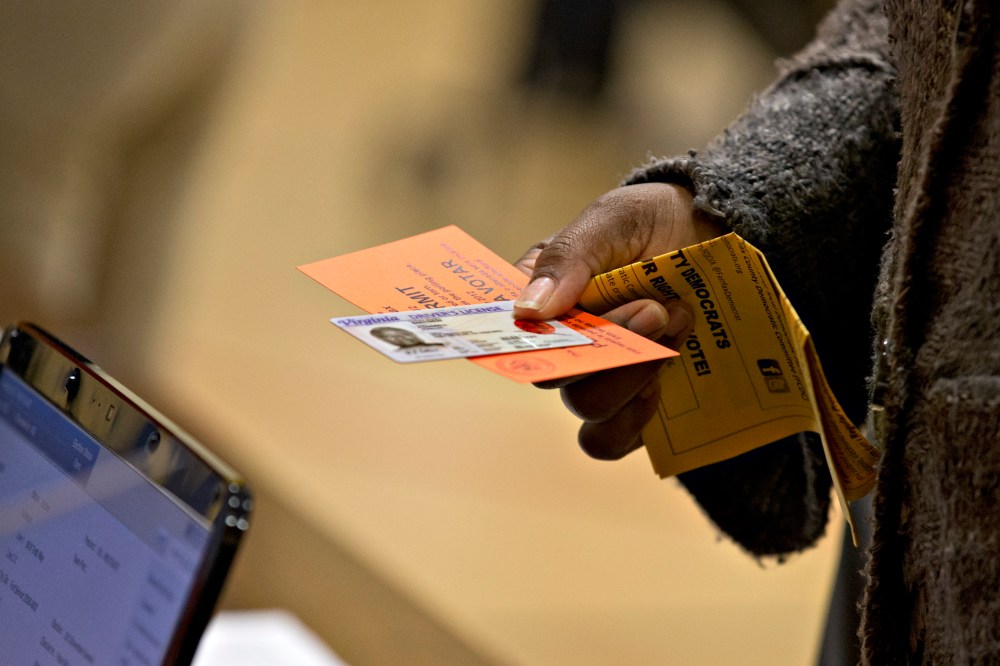
Last week, both houses of Virginia’s legislature passed a bill that removes utility bills, paychecks, bank statements, and Social Security cards as acceptable forms of voter ID. The bill would continue to allow concealed weapons permits to be used as ID. After a conference committee, it’s expected to be signed by Gov. Bob McDonnell, a Republican.
The forms of ID that would be banned under the bill—which were specifically approved for use by voting in a law the state passed just last year—are predominantly used by poor and minority voters who are more likely than white voters to lack a driver’s license.
And as a result, voting-rights experts say if it goes into effect, the law will probably be quashed under Section 5 of the 1965 Voting Rights Act.
“Virginia’s voter ID bill, if enacted, will likely be rejected by DOJ and/or the DC Court,” Gerry Hebert, a veteran election lawyer and the former acting head of the Voting Section of the Justice Department’s Civil Rights Division, told msnbc.com via email.
Under Section 5, most southern states, including Virginia, are required to submit any proposed changes to their election systems to the Justice Department, so it can make sure they don’t have the effect of hurting minority voters. To block the changes, Justice doesn’t have to find that the intention was to discriminate—only that there turned out to be a discriminatory impact. And the burden would be on Virginia to show that the law doesn’t have such an impact.
Recent prior cases suggest the Virginia bill wouldn’t pass muster. Last year, under Section 5, the Obama Justice Department blocked Texas and South Carolina laws that would have required voters to show a photo ID, and federal courts sided with DoJ. In the Texas case, the court found, among other things, that the cost of obtaining a photo ID would fall most heavily on racial minorities.
“This is the same kind of restrictive ID provision that [the Justice Department] rejected in Texas and South Carolina because it had a racially discriminatory impact,” Brenda Wright, a voting rights expert at Demos told msnbc.com via email, refrring to Virginia’s proposed law. “It’s simply inviting a Section 5 objection.”
As we reported earlier this month, a scheme pushed by Virginia Republicans to change how the state allocates its electoral votes likely also would have been blocked under Section 5, because it dilutes the power of the minority vote. But in a few months’ time, Section 5 might no longer exist. An Alabama county, backed by a powerful array of conservative interests, is arguing that it unconstitutionally singles out southern jurisdictions for special scrutiny, and that, given the progress the south has made on civil rights since the 1960s, it’s no longer necessary. The Supreme Court is set to hear arguments in the case later this month, and a ruling will likely be announced in June. The Roberts Court has generally not been friendly to voting rights, and many observers think Section 5 could well be struck down. To some voting rights advocates, Virginia’s new bill, coming on the heels of other recent efforts to make voting harder, both in the south and elsewhere, show why Section 5 is still crucial. “The fact that so many covered states seem determined to go backwards on voting rights only underscores why Section 5 is still needed,” Wright said.
Zachary Roth Recommended


