








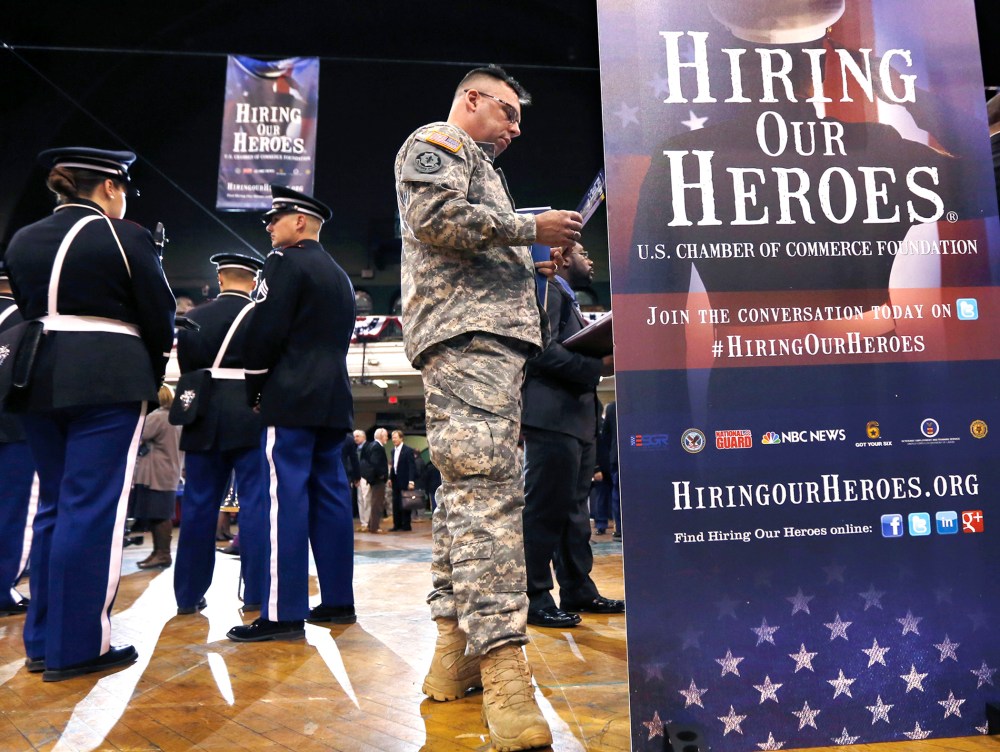
It was like the whole world had moved on without Elizabeth Perez. At an age when her peers had finished college and begun building their careers, she was underemployed and on her own with a baby to care for.
The only difference was, she had spent the last eight and a half years serving her country.
As an aviation logistics specialist in the Navy, Perez managed the transporting of fuel and critical aviation to her squad and fleet in the Middle East and the Mediterranean.
“It was kind of like the E.R. of the Navy,” she told msnbc. “I kept the heart pumping.”
But she says nothing prepared her for leaving the military and entering the civilian workforce. “There were a lot of factors I didn’t account for,” Perez said. She soon landed a job as a construction wholesale supplier in the renewable energy sector. But even with a bachelor’s degree, it was hard to match her military salary, with its built-in medical benefits, housing allowance, and child care, childcare, which had been covered by the base’s family service center. With just one week of military training dedicated to her transition back into the civilian world, Perez said she was overwhelmed and underprepared to start her new life.
“I was on the brink of homelessness,” she said.
While the unemployment rate among veterans is traditionally lower than the national average, veterans of the wars in Afghanistan and Iraq have been worse off. One in 10 post-9/11 veterans were unemployed last month, same as October 2012.
Col. David Sutherland worked with the Chairman of the Joint Chiefs of Staff on efforts to support the military community, and he’s continuing that work with Kimberly Mitchell, a 17-year veteran of the Navy. Their organization, the Dixon Center, helps communities support members of the military, veterans and their families, especially as they transition back to civilian life.
“Military families are trained to not ask for help,” Mitchell explained in an interview with msnbc. “When a military service member goes through boot camp, or indoctrination, you’re trained to figure it out. And then you’re trained to help everyone else around you. Everybody is reliant on everybody else. So you’re trained to not say, “Hey, I can’t figure this out. Help me out.”
Perez said that mindset, along with the loss of the built-in community that she had relied on, were major roadblocks in her transition out of the Navy.
“When I got out, I had to invent that myself,” Perez said. “I was working a full-time job, so I didn’t really have the time to reach out to anybody… I forced myself to create my own community.”
Today, she is the founder and CEO of a general contracting firm focused on renewable energy that provides training and outreach for transitioning jobless or under-employed veterans. She gets the word out by attending hiring events, working her contacts on military bases, and speaking with service members as a TAP (Transition Assistance Program) specialist about five times a year. She was honored at the White House last week along with a dozen other veterans for advancing clean energy and climate security.
Veteran unemployment has been a focus of the Obama administration’s agenda, and a cornerstone of first lady Michelle Obama’s public outeach through the “Joining Forces” initiative. AT&T is one of the companies committed to hiring 100,000 vets and their family members in the next five years as part of the White hose initiative.
“We started to find [that] veterans were having a hard time understanding how their skills in the military matched up to our skills in the civilian workspace,” AT&T Talent Attraction Manager Jennifer Terry said in an interview with msnbc. “Let’s say somebody managed a fleet or a convoy. They don’t necessarily translate that into ‘that might be a good supply chain manager for us.”
To that end, the company uses military occupational translators to make it easier for veterans to find jobs that fit their military classifications. They also pair applicants with veteran advisers who already work for AT&T. “It gives then an instant connection and community in the company when they’re hired,” Terry said. Other peer-to-peer support networks established by companies like JP Morgan Chase, UBS, and Verizon work to appeal to military families by helping spouses find work and including support for children, for example by providing scholarships, Sutherland said. Zach Iscol is a former Marine Office who served two tours in Iraq as well as assignments in Africa, the Middle East, and Central Asia. He’s also the founder of Hire Purpose, a tech start-up focused on connecting veterans with the job opportunities that suit them best. “The military represents the best of a generation,” Iscol said, nothing that all military veterans meet exceptionally high recruiting standards, while only 25% of their civilian counterparts do. “Seventy-five percent of 18-25 year olds are not eligible to join the military because they’re not smart enough, they’re not fit enough, they’re not educated enough, have criminal records, a history of drug use – so companies recognize, this is the best of a generation.” But he said that with such a small fraction of the U.S. population serving in the military since the attacks of September 11, 2001, a disconnect has developed between service members and civilians. “That manifests itself when it comes to jobs,” Iscol said. Perez said that the dedication and integrity of military service members drives her work to connect them with the right job opportunities. “If they say something, they mean it, and they’re going to follow through,” Perez said. “Because of the things I went through, especially as a woman vet and a mother, I thought I could be a voice for other women,” she told msnbc.
Erin Delmore Recommended


