








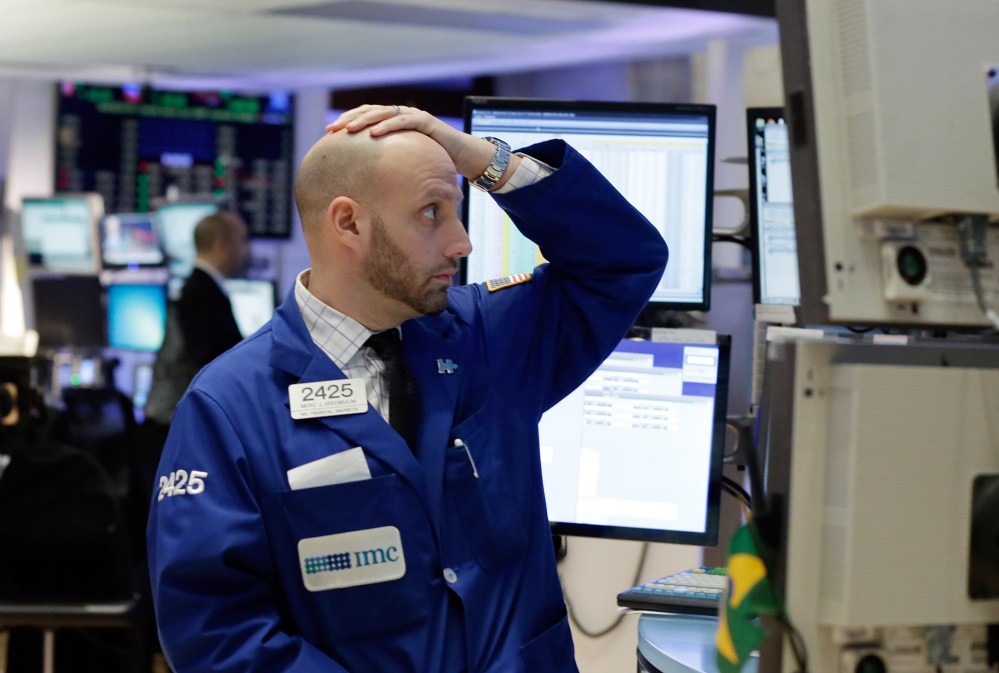
New data on Chinese factory activity sent a wave of financial concern across the Pacific Monday on the first day of stock trading in the new year, sending major U.S. indices sharply lower. The Dow Jones industrial average closed down about 275 points, or nearly 1.6 percent of its total value.
All major U.S. stock exchanges and indexes plunged before opening on news that Chinese factory activity shrank sharply in December, and remained well in the red throughout the day. Middle East tensions, which briefly pushed up oil prices, added to the angst on Wall Street.
The Dow closed down 274.31 points, or 1.57 percent, according to preliminary figures published by Reuters. Earlier, it was briefly down more than 450 points, or more than 2.5 percent — a percentage decline that would have made it the worst opening day of trading since 1932, in the midst of the Great Depression — before mounting a late recovery.
As it was, it finished down 1.58 percent, the worst beginning to a trading year since Jan. 2, 2008, when the Dow fell 1.66 percent.
The Standard & Poor’s 500 and Nasdaq composite both also were hammered Monday, with the former losing 30.88 points, or 1.51 percent, and the latter shedding 104.32 points, or 2.08 percent, at the close, according to Reuters.
U.S. data reaffirmed concerns about overall global manufacturing. The Institute for Supply Management says its index of U.S. factory activity contracted in December at the fastest pace in more than six years as factories cut jobs and new orders shrank. The index fell to 48.2 from 48.6 in November, below the markets’ expectations. Any reading under 50 signals contraction.
The figures suggest that the troubles weighing on manufacturers last year — slow overseas growth, a strong dollar and low oil prices — will likely continue into 2016.
Adding to the downward pressure on the markets were questions of how frequently the Fed will raise rates. There’s also the unexpected sharpening of tensions between Iran and Saudi Arabia over the weekend, following Saudi Arabia’s execution of a Shia cleric.
Iranian protesters burned and attacked the Saudi embassy in Tehran, and Saudi Arabia cut off diplomatic relations with Iran. Benchmark Brent crude oil prices initially rose 1.5 percent Monday as a result, until tumbling stock markets erased the gains. By midday on the East Coast, Brent prices were down 20 cents, or 0.5 percent, at $37.08 a barrel. “It’s is a wake-up call to the growing geopolitical and economic uncertainties around the globe,” said Sam Stovall, chief equity strategist at S&P/Capital IQ. Gold jumped more than 1 percent as investors fled to the safe-haven metal. U.S. stocks ended trading for 2015 on Thursday, with the S&P 500 logging a marginal loss for the year. CNBC’s Evelyn Cheng, the Associated Press and Reuters contributed to this report. This article originally appeared on NBCNews.com.Recommended



Mike Brunker