When liberals complain about the 35-year rise in income inequality, conservatives sometimes answer that unequal outcomes are the price America has to pay for bounteous economic opportunity. That argument has gotten harder to make in recent years, as it turns out the U.S. lags most comparable nations—including France, Germany, and even Canada — when it comes to social mobility. The Horatio Alger ideal of young bootblacks (or their latter-day equivalents) rising to become captains of industry had much more plausibility during Alger’s lifetime (1832-1899) than it does today.
Some conservatives, though, have lately determined to challenge the evidence on social mobility and reassert that the U.S. really is an example for the world when it comes to racing up the income scale. Writing in the April 14 New York Times, Mark R. Rank, professor of social welfare at Washington University, claims to have evidence that “casts serious doubt on the notion of a rigid class structure in the United States based upon income.” Mark J. Perry of the right-leaning American Enterprise Institute reports, based on Rank’s piece and something that the conservative economist Thomas Sowell wrote 14 years ago, that “there is dynamic movement up and down the income quintiles throughout most Americans’ lifetimes.” And Benjamin Domenech, publisher of The Federalist and a senior fellow at the Heartland Institute, writes in The Wall Street Journal’s new “Think Tank” blog that “U.S. economic mobility is very good.” (Full disclosure: I contribute to the same blog.)
So, does the U.S. have lots of social mobility, or very little? Alas, the conservative revisionists have it wrong. Social mobility in the U.S. is stagnant, and has been for some time.
Conservatives make two arguments to bolster their claim that the U.S. has a lot of social mobility.
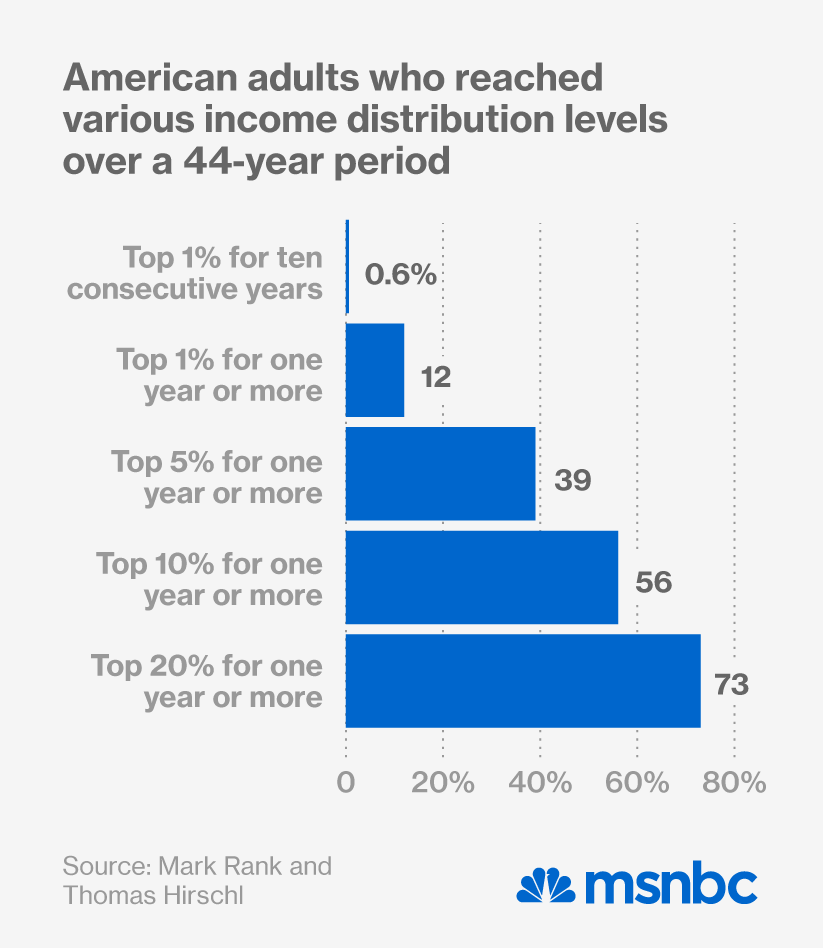
The first argument is that the much-discussed 1% is not a static category; people move with considerable frequency into and out of the 1% (currently defined as any household earning in excess of $394,000). Twelve percent of the population will, over the course of a lifetime, make it at least once into the 1%.
But as the Nobel Prize-winning economist Paul Krugman pointed out way back in 1992, “much of the movement up and down represents fluctuations around a fairly fixed long-term distribution. Joel Slemrod of the University of Michigan has provided a useful indicator that suggests how persistent high incomes tend to be: the average income of families whose income exceeded $100,000 in 1983 was $176,000 in that year; their average income over the seven-year period ending in 1985 was $153,000.”
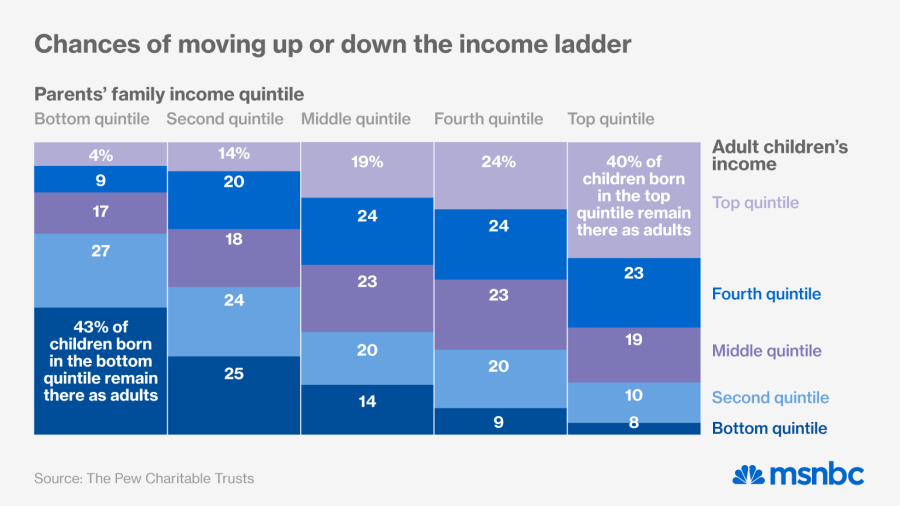
In plain English (Krugman was not yet a New York Times columnist): Yes, people’s place in the income distribution will change over time, but very seldom will you see anybody zoom — even over the course of an entire lifetime — from one end of the economic distribution to the other. Only 6% of all Americans born in the bottom 20% (currently, households earning up to $20,000) will ever make it to the top 20% (currently, households earning more than $104,000). The onetime millionaire living on Skid Row and the onetime pauper lighting cigars with $100 bills are even rarer birds. That’s why you’ve probably never met one.
The second argument conservatives make is that, over time, a person’s income is pretty likely to go up. “Nearly 60 percent of households in the bottom quintile [i.e., the bottom 20 percent] were in a higher quintile in 2007,” writes the Tax Foundation’s Robert Carroll. (Note that he doesn’t say how much higher.) Much the same point was made in a study released by the Bush Treasury Department back in 2007. But to say that people make more money as they get older is merely to say that most of us experience a fairly predictable life cycle in earnings. You start out as a college student or as a novice making nothing or next to nothing. You acquire experience and you get paid a bit more. You hit an income plateau in middle age. Then, after you retire, your income likely goes down. This pattern prevails, to a greater or lesser extent, no matter how healthy the economy is. It prevailed during the Great Depression!
%22f%20you%20want%20to%20travel%20from%20the%20bottom%20to%20the%20top%2C%20try%20being%20born%20in%20western%20Europe.%22′ The only meaningful way to measure mobility, economists tend to agree, is to look at intergenerational changes. You take a snapshot of where a person fits in the income distribution and then you compare it to where that person’s parents, at a comparable stage in life, fit in the income distribution of their era. Such intergenerational mobility is what an impoverished immigrant means when she says she’d like to see her children live a better life. She doesn’t mean merely that she wishes they make more money. They probably will! She means that she wishes they occupy a higher station—that instead of being a shopkeeper, for instance, they become doctors or lawyers. Intergenerational mobility is the metric by which the United States lags most comparable nations. This is a relatively recent discovery. Previously, economists believed that mobility in the U.S. was fairly robust. (That’s why Krugman wrote, in the 23 year-old article quoted above, “There is considerable income mobility in the U.S.” That’s what everybody thought at the time.) But the belief that the U.S. enjoyed an enviable amount of economic mobility was based on weak data. In 1992, economist Gary Solon, working off much better, newly-available longitudinal data, revealed that the “heritability” of parental income was, on average, about 40%. Other estimates put it at 50 or even 60%. One researcher concluded that, for males, income was more “heritable” than height or weight. Although the discovery of America’s low mobility, compared to similar countries, is relatively new, it turns out that mobility’s been low for some time. A January study by Harvard economist Raj Chetty found that people who entered the workforce in the 1970s had about as much chance of moving up as people entering the workforce today. There was more mobility for people entering the workforce in the 1950s, and a lot more for people entering the workforce at the turn of the 20th century. To summarize: Yes, in the United States you will very likely enjoy a higher income when you’re 45 than when you’re 25. But you won’t likely move from poverty to riches. If you want to travel from the bottom to the top, try being born in western Europe. Merely wishing it were otherwise won’t make it so.
Timothy Noah Recommended