Why do Democratic candidates seem to have such a hard time in midterm elections? Simply put, their voters are more likely to stay home when the presidency isn’t on the line. Today’s NBC News national exit poll found that 2014 is no different, especially when looking at the generational composition of the electorate.
RELATED: Did young voters show up in Georgia?
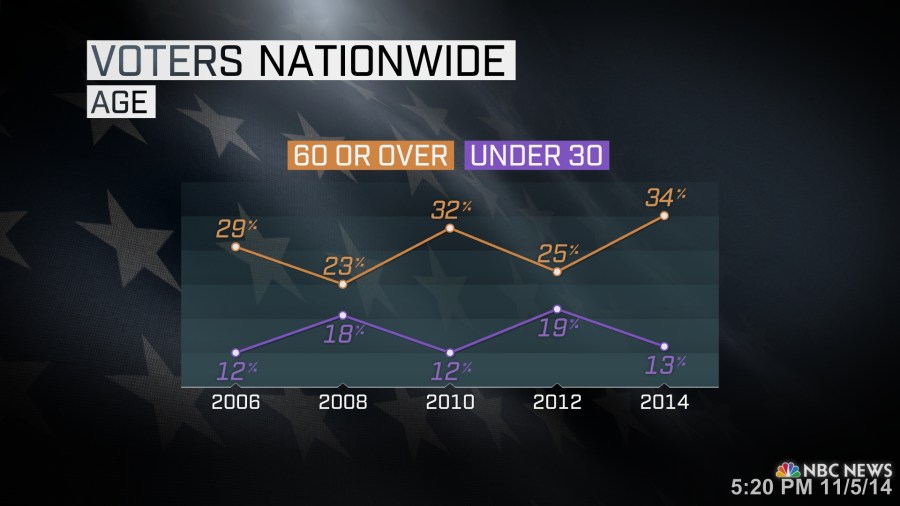
The electorate in midterm elections is much older than in presidential years, with those age 60 and older generally outnumbering those under 30 by more than 2-to-1 margins. For example, in the 2012 presidential election, 25% of voters were age 60 and older, while 19% were under 30 years old. That 6-point difference between the oldest and youngest voters’ share of the electorate is similar to the 5- to 9-point gap registered in the prior three presidential elections.
In today’s midterms, 34% of voters are over the age of 60, but only 13% are under 30 years old. This 21-point difference is larger than the 16- to 20-point age gap seen in the last three midterms.
There was a time when this midterm age gap would have little effect on an election’s outcome, but that suddenly changed 10 years ago when young voters became decidedly more Democratic than their older counterparts.
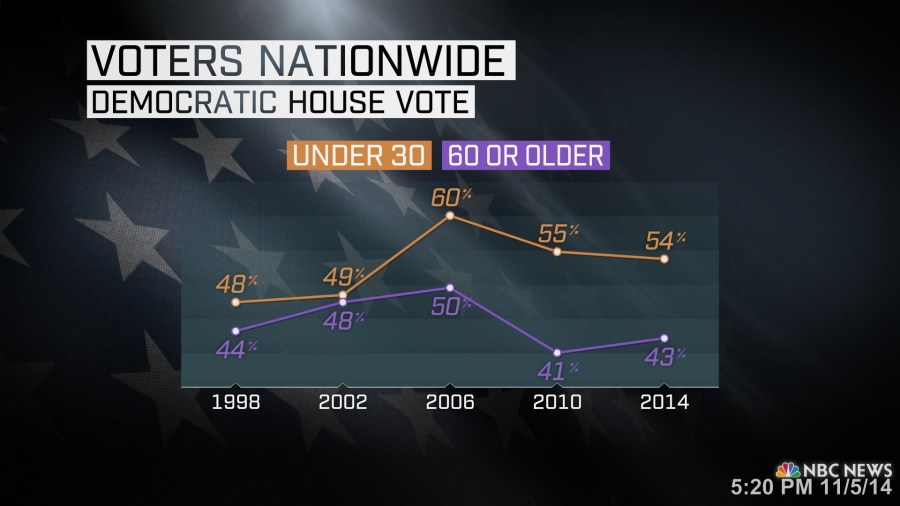
Throughout the 1990s, the youngest and oldest voters tended to vote the same way. For example, in the 1994 election which resulted in a Republican takeover of the House of Representatives, 48% of voters under 30 voted for the Democratic candidate for Congress and an identical 48% of voter age 60 and older did the same. This trend continued through the 2002, when 49% of young voters and 48% of older voters cast Democratic House ballots.
RELATED: College students on Election Day: ‘Reverse the tide’
This parallel voting track suddenly diverged in the 2004 election, when a 55% majority of young voters went with the Democrats while only 46% of older voters did the same. That disparity continued into the 2006 midterm, widening to a 14-point gap in by 2010 when 55% of voters under age 30 voted for the Democratic candidate in their House district and only 41% of those age 60 and older supported the Democrat. The age-based partisan gap in this election is nearly as wide as it was in 2010. Fully 54% of young voters cast Democratic ballots for Congress compared to just 43% of older voters who did the same. Non-white voters, who lean Democratic on the whole, are another group that usually makes up a smaller share of the midterm electorate than they do in presidential years. The numbers for that group are still preliminary as the 2014 results roll in, but taken together, these trends amount to an uphill climb for Democrats in the midterms. Visit NBC News Decision 2014 for more exit poll results and election returns.
NBC News Election Unit Recommended