








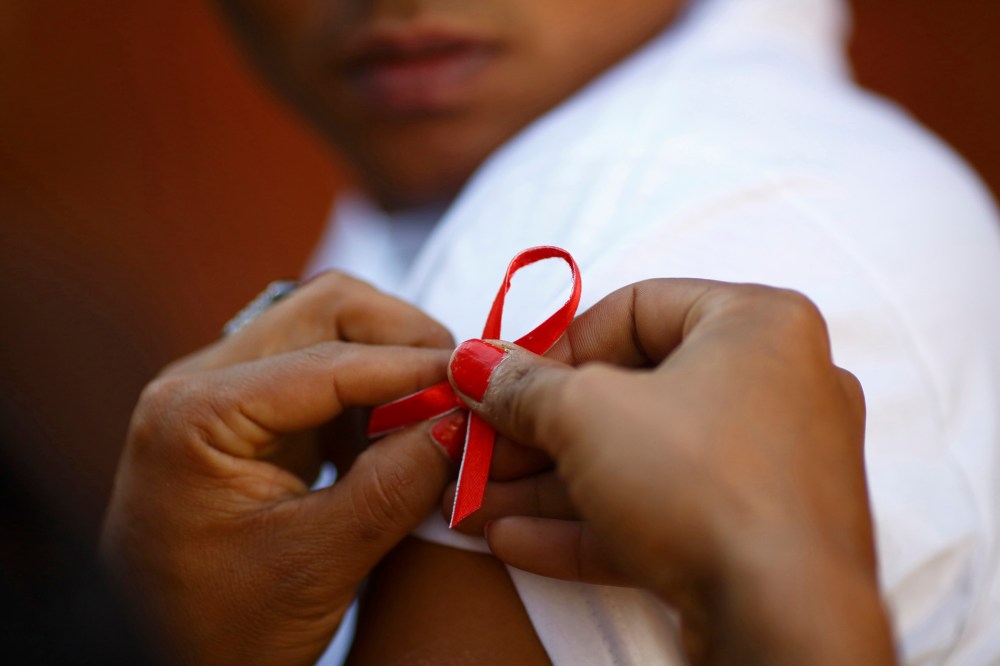
The world is on its way to ending the AIDS epidemic by 2030, asserted a panel of heads of states and dignitaries on the eve of the start of the 70th United Nations General Assembly on Sunday.
“We are here, in a way, to celebrate,” said Michel Sidibe, the director of UNAIDS. “A few years back, we could not even dream that we would have this meeting.”
.@CharlizeAfrica: "Stigma and a lack of support are impacting an entire generation." http://t.co/btZe3FuFfU w/@CTAOP pic.twitter.com/P3peSJT9FM
— UNAIDS (@UNAIDS) September 27, 2015“Today, we are 15 million people on treatment. Today, we have been able to break the trajectory of this infection,” Sidibe said, pointing to Cuba’s recent success as the first country to eliminate mother-to-child transmission of HIV.
But while the adoption of the new and ambitious Global Goals for sustainable development this weekend by the 193 members of the United Nations provides the opportunity needed to “quicken the pace of action” to stop AIDS, the epidemic won’t be stopped unless world leaders put adolescents, especially young girls, front and center in the fight, Sidibe said.
Fifty-one percent of adults living with HIV are women, according to UNAIDS estimates. And young women, especially those living in sub-Saharan Africa, are disproportionately affected; 58% of infections among those 15-24 years old in 2014 were female. In other words, young women are eight times more likely to acquire the virus that causes AIDS than their male counterparts.
RELATED: Alicia Keys: To end HIV/AIDS, we must empower our youth
UN Messenger of Peace Charlize Theron, who grew up in South Africa during the terrifying early days of the HIV/AIDS crisis, acknowledged that for some, things haven’t changed in spite of the passing of more than three decades. Stigma remains the chief obstacle in squashing new HIV infections.
“That’s the reason why I’m here today,” the Academy Award-winning actress said. “Stigma, lack of power and support, are impacting an entire generation of young people who are trying so hard to take control of their future.”
%22Stigma%2C%20lack%20of%20power%20and%20support%2C%20are%20impacting%20an%20entire%20generation%20of%20young%20people%20who%20are%20trying%20so%20hard%20to%20take%20control%20of%20their%20future.%22′
Present from the African nation of Kenya was 12-year-old Elijah, a young HIV/AIDS activist who showed the power of one voice when speaking before his own president.
“We need to stop stigma,” Elijah also said. “My dream is that by the time I am 27 years old, there will be no more stigma, and I will be pursuing my doctorate.”
.@MichelSidibe: "We need to put adolescents at the center of the AIDS response." #UNGA #GlobalGoals pic.twitter.com/ZANlaDIpdT
— UNAIDS (@UNAIDS) September 28, 2015Elijah, who described the discrimination he faces on a daily basis from peers, further laid out his hope for all other HIV-positive children the world over: “We must make sure that all the children living with HIV are on medication for their entire life.”
“Please keep your promise,” he begged Kenyan President Uhuru Kenyatta, before receiving a standing ovation from a packed room.
Earlier Sunday at the United Nations, President Obama announced an expansion of PEPFAR, his emergency plan for AIDS relief, which would provide support to 12.9 million people living with HIV by 2017. For the first time, the program outlined specific goals for averting new HIV infections among young women. By the end of 2017, PEPFAR targets a 40% reduction in new infections in females aged 15- to 24-year-old in 10 sub-Saharan African countries.
RELATED: Ending AIDS, changing the world — and how you can help Theron acknowledged that while the AIDS epidemic is at a tipping point, an AIDS-free generation is not something that can be created. Young people must be empowered to not only survive but to thrive, she said Brave Elijah from Kenya speaking at the #UNGA tonight about children living with HIV. @UNAIDS pic.twitter.com/7uzQUMpnEb “There is a generation in jeopardy. Young people are falling through the cracks in our fight to end this epidemic,” Theron warned in the evening’s most emotional moment. “But we have reason to have hope to reach our goal of ending AIDS by 2030, because we know what works: empowering young people to take control of their health.” Thirty million new HIV infections and eight million deaths have been stopped in their tracks in the last 15 years, UN AIDS outlined in a new report called “Action: Implementation.” But in order for the AIDS epidemic to be stopped in the next 15 years, implementation is needed, and the global response required to identify new HIV infections, link patients to life-saving treatment, and suppress their viral load, must be fast-tracked over the next half decade. RELATED: United Nations: We can end AIDS by 2030 In order to hasten the speed of the global response, UNAIDS says the following must be achieved. First, those living with and at risk of transmitting HIV must be empowered to realize their full human rights. This includes stopping sexual violence among women and girls and de-criminalizing HIV and sexual orientation. Second, the response must be community-focused, which allows gaps in reaching marginalized people and health services to be closed. Third, diagnostic and preventative tools, as well as life-saving anti-retrovirals must be made affordable to all people. %22We%20have%20reason%20to%20have%20hope%20to%20reach%20our%20goal%20of%20ending%20AIDS%20by%202030%2C%20because%20we%20know%20what%20works%3A%20empowering%20young%20people%20to%20take%20control%20of%20their%20health.%22′ Fourth, nations must invest in new technology that makes it simpler to use preventative measures like condoms and pre-exposure prophylaxis, allow people to be informed of their status, and to access to life-saving medications. Fifth, funding to meet crucial milestones must be increased and shared among governments and the private sector. Finally, the world must approach the epidemic through a new lens that targets concentrated, at-risk populations.
Joseph Neese Recommended


