








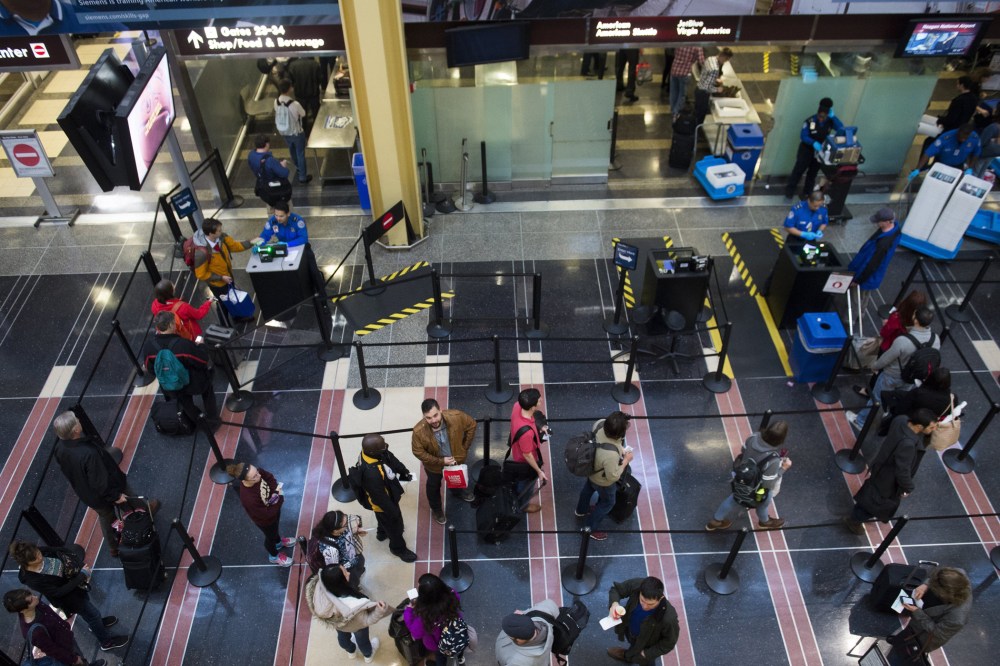
After the insensitive and time-consuming airport screening of a transgender traveler made national headlines earlier this year, the Transportation Security Administration confirmed to The Advocate on Wednesday it had chosen a new word for screening agents to use whenever imaging machines encounter a person whose anatomy does not conform to the male/female binary.
Now, instead of using the word “anomaly” when screening transgender travelers, TSA agents will use “alarm” — a term that still involves additional screening procedures, which many transgender rights advocates find offensive.
Now it's "alarm". ALARM! RED ALERT! A BODY THAT DOESN'T FIT CISSEXIST IDEOLOGY! And they'll still treat you the same https://t.co/Ye8ordjsUm
— Erika Sorensen (@eiridescent) December 24, 2015#TravelingWhileTrans used to mean my body was an "anomaly" but now it'll be an "alarm." Just a new indignity, @TSA. https://t.co/wFaJhEDrzz
— Rae Angelo Tutera (@handsomefmnst) December 24, 2015You know what, @TSA? It was never about a word iIt is about respect, and treating transgender people like people. https://t.co/Ipkhjjhtpk
— Gwendolyn Ann Smith (@gwenners) December 24, 2015As far as screening procedures go, the difference between “anomaly” and “alarm” appears to be scant. “If there is an alarm,” states TSA’s website, “TSA officers are trained to clear the alarm, not the individual.” However, the very next sentence states: “Additional screening is conducted to determine whether a prohibited item is present.”
The “additional screening” process is essentially unchanged. If someone “alarms” the screening equipment, which is programmed to only accept bodies that can be classified as “male” or “female,” that person may have to undergo a pat-down procedure, which is often a source of extreme discomfort and, in some case, delays for transgender travelers.
Such was the experience of Shadi Petosky, a transgender person who in September was subjected to a 40-minute screening that included two full-body pat-downs and a luggage dissembling because the imaging machine detected an “anomaly.”
I am being held by the TSA in Orlando because of an "anomaly" (my penis) I am through. It was about 40 minutes, 2 full body pat downs, fully disassembled luggage. I missed my flight. pic.twitter.com/wLTvP3md9W Earlier this week, Petosky issued a public plea to the TSA that she be allowed to travel on Christmas without any significant disruption. Dear @tsa, I am flying on Christmas Day because my Grandfather is dying. Please don't take me to a room and touch me — down there.
Emma Margolin
Emma Margolin is a reporter at MSNBC.com. Recommended


