








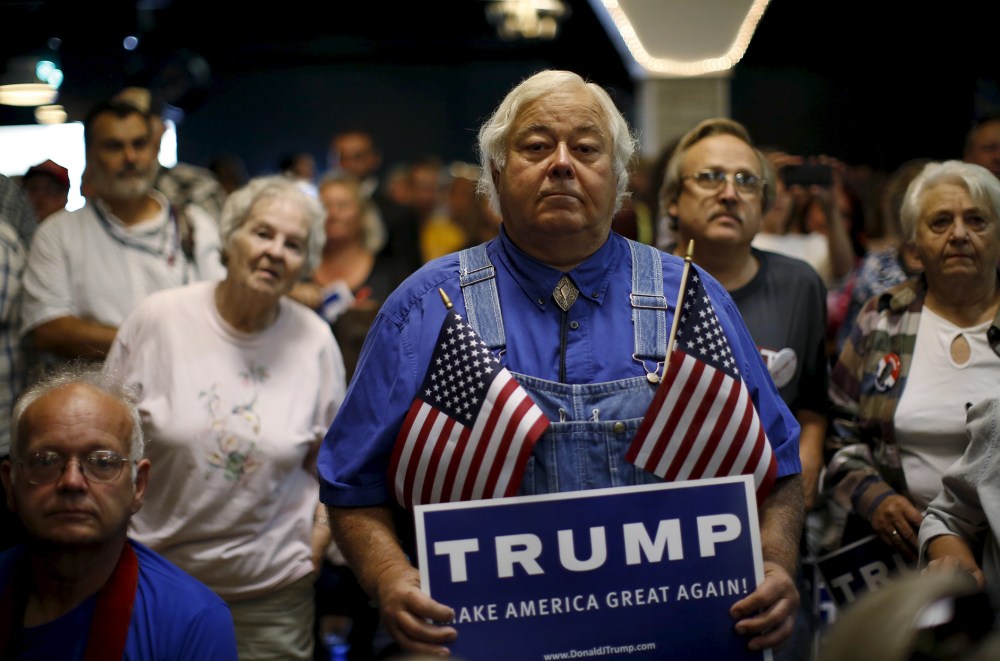
Donald Trump, as many people on the left and even some on the right agree, is undoubtedly and intentionally making controversial remarks on cultural, racial and religious issues.
But what’s emerged as the more complicated question is whether Trump’s supporters agree with all of his remarks. Are at least some of Trump’s backers, as many liberals argue, racist or intolerant? In interviews, Trump supporters often say they like the mogul’s blunt approach, that he “tells it like it is,” without always detailing what “it is” that Trump is explaining so clearly.
In some ways, the Trump question is an extension of the debate over the last seven years about what drives the intense opposition on the right to President Obama. Some liberals, particularly at the height of the Tea Party’s influence in 2009 and 2010, argued that conservative movement was a reaction to the election of a black president.
Members of the Tea Party angrily rebutted these charges, arguing they disagreed with Obama’s policies and were not motivated by racial animus.
RELATED: Reporter with disabilities disputes Trump’s claim
Pollsters, while not directly querying Trump supporters about their views on racial issues, have asked a number of questions over the last few months that help explain the perspectives of Trump’s base. Here’s what they’ve found:
1. Trump supporters are nearly all white, like the supporters of the other GOP candidates
Most national polls and polls in Iowa and New Hampshire of the GOP field don’t even include breakdowns of voters by race. Why? About 90% of Republicans are white, as are more than 90% of people in Iowa and New Hampshire, the two states where much of the polling of the GOP field is done.
Trump supporters are overwhelmingly white, but this does not distinguish them at all from Republicans who back other GOP candidates.
2. Trump supporters, more than other Republicans, want to deport undocumented immigrants
In a Pew poll in September, Republican voters were asked if they were “more likely” or “less likely” to back a candidate “who wants to deport all immigrants who are currently in the country illegally.”
Among those who were “more likely” to back such a candidate, 34% of respondents favored Trump, compared to 16 percent who favored retired neurosurgeon Ben Carson and 5% who backed Florida Sen. Marco Rubio. Among those who were “less likely” to back such a candidate, 17% favored Carson, 13% Trump, 10% Rubio.
According to a Washington Post-ABC News poll released this week, 59% of Republicans support deporting undocumented immigrants currently living in the United States. Trump has 46% of the vote among Republicans who support mass deportation, much higher than his support overall.
3. Many Republican voters view Islam unfavorably
Trump’s immigration remarks have defined his campaign, but of late, he has drawn more attention for controversial comments about potentially investigating mosques and creating a “database” of Muslims.
Most polls have not broken down Trump supporters and examined their views specifically on Islam. But a recent survey conducted by the non-partisan Public Religion Research Institute found deep reservations about Islam, particularly from conservative-leaning parts of the electorate. According to the survey, 56% of Americans overall agreed with the statement that, “The values of Islam are at odds with American values and way of life.”
The majority of self-described Democrats disagreed with the statement, but 76% of Republicans agreed with it, as did 73% of white evangelical Christians and 77% of people who consider themselves part of the Tea Party movement.
What this data illustrates is that a large number of conservative Republican voters, a group that includes some Trump supporters but also those who back other GOP candidates, are wary of Islam and its influence on American culture.
RELATED: The GOP plots to topple Trump campaign
4. The vast majority of Republicans, including Trump supporters, oppose bringing Syrian refugees to the U.S.
A recent Bloomberg News poll found that 69% of Republicans opposed bringing the refugees here, with another 11% arguing only Christians should be accepted. The Post-ABC poll also found about 70% of Republicans opposed refugees resettling in the U.S.
In the Post-ABC poll, Trump had 40% of the vote among the anti-refugee Republicans, but just 13% support among the much smaller group of Republicans who wanted to accept refugees.
That breakdown may illustrate that opposition to Trump is stronger among Republicans who are particularly pro-immigrant.
The Post-ABC News poll showed among Republicans who both want to deport the undocumented and oppose letting refugees from Syria into the U.S, Trump had 51% of the GOP primary vote, much higher than his overall standing.
The coalition of those most concerned about immigration
Overall, poll data since he launched his campaign suggest that Trump supporters are likely to be white, favor deporting undocumented immigrants and opposing resettling Syrian refugees in the U.S.. But many Republican voters, particularly those who back conservative candidates like Carson and Cruz, hold similar views. So is Trump’s particular emphasis on these issues of culture and ethnicity driving voters to him? The evidence suggests yes, with three important caveats. “Before Trump announced his candidacy back in June, opinions about immigration had little influence on support for him. But after his first speech as a presidential candidate harshly criticized Mexican immigrants, voters who believed immigration was important flocked to him,” wrote Michael Tesler, a University of California, Irvine political science professor who studies how race and culture shape political opinions, in a Washington Post op-ed this week. “Although his support has increased among other Republicans as well, those who prioritize immigration continue to be his strongest supporters,” Tesler added. But Trump is not personally driving Republicans to care intensely about immigration. They already did. The real-estate mogul regularly suggests that immigration would not be a subject in the Republican primary if he were not in the race. In fact, in 2008, John McCain had to backtrack from his strong support of comprehensive immigration reform to win the GOP nomination, and Mitt Romney won in 2012 in part by hammering Rick Perry as too liberal on immigration issues. In 2013, strong opposition from the conservative grassroots to creating a pathway to citizenship for the undocumented stopped the GOP-controlled House from taking up legislation on the issue. The Senate had overwhelmingly passed a fairly liberal immigration bill with backing from both Democrats and key Republicans like Rubio. Because of the passion of the anti-illegal immigration forces in the GOP electorate, it was inevitable that some Republican presidential candidates emphasized the issue. Trump just arrived at that point with the bluntest message. RELATED: Anti-Muslim panic threatens to cause lasting damage Secondly, Trump is not just a unique candidate because of his immigration positions. He is a huge celebrity who used to host a prime-time television network show and is one of the most famous people in America now running as an anti-illegal immigration presidential candidate. It’s not clear Rick Santorum or Mike Huckabee, who have also ran to the right on immigration during this campaign, could have taken this approach and surged in polls as Trump has. Third, this data also offers a very limited picture of the views of Trump backers, leaving lots of questions unanswered. For example, what do Trump supporters think of the “Black Lives Matter” movement, compared to other Republican voters? (At a Trump rally in Birmingham, Alabama last week, a Black Lives Matter activist was punched and kicked by a few Trump supporters. But several GOP candidates, particularly New Jersey Gov. Chris Christie, have criticized the movement as well, suggesting it is unpopular with most Republican voters, not just Trump backers.) Would Trump supporters back deportation of people under 30 whose parents brought them to the U.S. illegally as children? Are they uniquely concerned about Muslims or the practice of Islam in the United States? Could they ever back a candidate, like Rubio, who in the past supported creating a path to citizenship for undocumented immigrants? Most intriguingly, social scientists like Tesler have tried to closely examine over the last seven years how much Obama’s race affects voters’ perceptions about him, without asking direct questions like “would you vote for a black candidate” that tend not to yield candid responses. Trump’s primary competitors are Carson, who is black, and Cruz and Rubio, who are both Cuban-American. It would be interesting, if perhaps impossible, to assess if among Trump supporters, the mogul will always be a more credible messenger on immigration issues than two Latino candidates, no matter how often Cruz and Rubio say they oppose illegal immigration.
Perry Bacon Recommended


