








The Oath with Chuck Rosenberg
2. Preet Bharara: Doing Justice
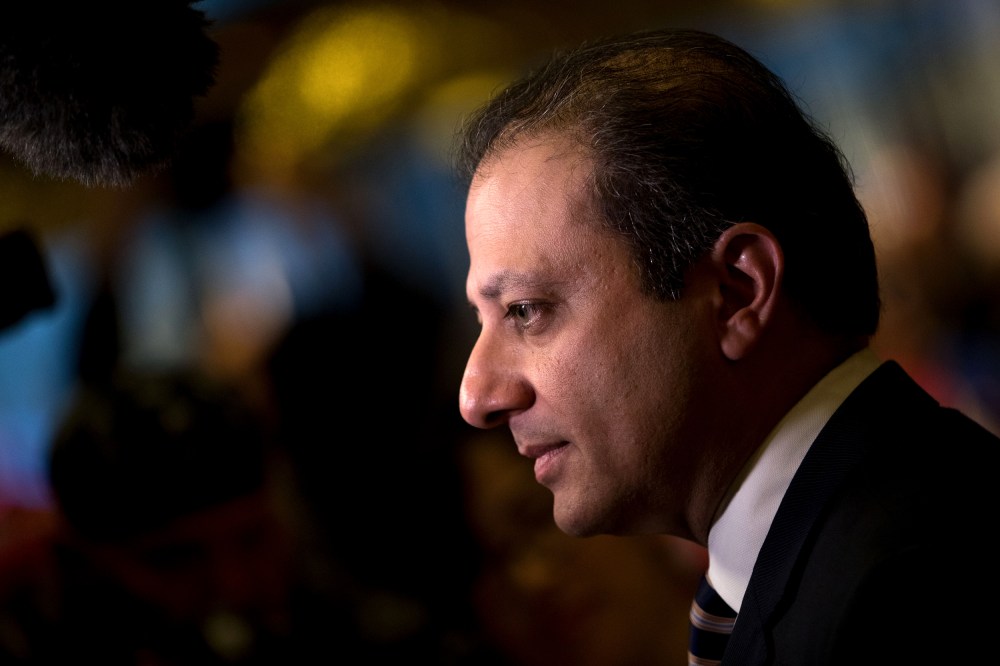
Chuck Rosenberg: Welcome to The Oath. I’m Chuck Rosenberg and I’m honored to be your host for a series of Compelling Conversations with interesting people from the world of government service. All of my guests share one thing: an oath mandated by Congress to support the Constitution of the United States and defend it against enemies both foreign and domestic. Today my guest is Preet Bharara. Preet has had a remarkable career in public service, starting as an assistant United States attorney in the Southern District of New York. He later served as counsel on the Senate Judiciary Committee. President Barack Obama nominated him to serve as the United States attorney for the Southern District of New York the very same district where he started his career as a line federal prosecutor. Today, he is the host of the popular podcast “Stay Tuned” and recently a brand new author. His book “Doing Justice: A Prosecutor’s Thoughts on Crime, Punishment, and the Rule of Law” gives an important insider’s perspective on how our system of justice works and the philosophies that guide it. Preet, welcome. Thank you so much for doing this.
Preet Bharara: Absolutely it’s my pleasure.
Rosenberg: It’s nice to see you. I really enjoyed your book. I thought it was terrific.
Bharara: You can say that again.
Rosenberg: I really enjoyed your book. I thought it was terrific.
Bharara: Thank you.
Rosenberg: But I have some questions.
Bharara: OK.
Rosenberg: One of the things you write about, and you write about it throughout, is the rule of law and the rule of law is obviously a construct. It’s not like the law of gravity. It’s not immutable. It’s subject to the good faith and good work of men and women who ensure its foundations. Do you worry about the rule of law?
Bharara: I always have to worry about the rule of law. That’s why you talk about it. That’s why you write about it, like I did in the book. That’s why, as you know, when you were the U.S. attorney and you want to put into the minds of the men and women who are responsible for carrying out the mission of the rule of law certain ideas, such as, your only job is to do the right thing in the right way for the right reasons. That they’re supposed to put biased to the side. They’re supposed to bring cases and conduct investigations without fear or favour. You worry about all sorts of freedoms that we have in the country and you’re worried about the rule of law because those things are precious and they can be ephemeral. I think it’s a little harder to undermine those kinds of things in America because of some structural safeguards we have than it is in a place like Turkey, which I also described in the book. They can go down a terrible path much more quickly. But given recent events and given the questioning of a lot of things in the country that I know you care about also, you have to worry about it.
Rosenberg: You write in your book that there is a creeping contempt for truth and expertise, meaning that this is different than other times. You always have to be careful but it seems like we have to be more careful now and in that context: do you worry about your old office? Do you worry about the Southern District of New York? Do you worry about U.S. attorneys offices generally being susceptible to this creeping contempt?
Bharara: There have always been attacks on the rule of law. There have always been people who don’t like to be investigated. What’s different is the person in this case, with respect to the Bob Mueller’s investigation and the special counsel’s work, has the largest megaphone on Earth. And when you have the largest megaphone on Earth, it used to be the case that you wield it with some sobriety, and propriety, and care, and you let other people say the things that they say. And because a president has by definition some significant percentage of the country basically believing what he says and he has a particular penchant and talent for having his supporters believe what he says, careless attacks on Bob Mueller, who you and I both know well, careless and false descriptions of documents that come out, whether they’re exonerating or not exonerating, all those kinds of things they add up. And when you have people around the person with the biggest megaphone in the country saying things like, with a straight face, there are alternative facts or my predecessor and our former colleague Rudy Giuliani saying things like, truth isn’t truth, those things matter more than when it’s a garden variety person who just looks like they’re being churlish because they’ve been investigated.
Rosenberg: And so could those things, these differences, actually affect the work of the men and women of the Department of Justice including in your old office?
Bharara: Look, I think it depends on what kind of influence you’re talking about. What I worry about is something that’s hard to detect. Is there some generalized reluctance in the face of an attack by the president, or the president’s lawyers, if you took some action? That that might stay your hand and cause you to pull some punch, which in ordinary times you wouldn’t do. That’s really hard to detect. That’s really hard to see. Is an office going to be mildly less aggressive or reluctant to look at something because of an expected backlash? Yeah, I would worry about that a little bit. I don’t think that the people that I know, many of whom I hired, would be reluctant in that way. But it’s something that you have to worry about because there’s so much pressure being brought to bear. On the other end of the spectrum the kind of thing that I worry about less, is a situation in which the other district or some other office, your former office for example, is basically on the cusp of bringing an indictment to the grand jury to have them vote on it that relates to the president or some associate of the president or relative of the president. And it’s brought in good faith and there’s substantial evidence and reasonable people would say this is a case that needs to be brought. And then on that eve of getting the indictment approved by the grand jury someone from Main Justice, the Attorney General Barr or somebody, reaches in because they’ve been briefed at the last minute, hypothetically, and says “No, don’t bring that case” and they don’t have good reasons and they’re acting in bad faith. I think then you have a bit of a crisis and then you will depend on the strength and character and spine of the people in the southern district. And I think they would have one of two choices at that point, if they thought they were bringing the case in good faith. One: to thank you very much for your input. We’re going to the grand jury and we’re doing it anyway, which would be an act of defiance.
Rosenberg: Which is a really hard thing to do in our culture.
Bharara: It is. And the second thing to do is, here’s why I think this is appropriate and I’m going to resign. And then the question is how noisy can you be about your resignation in a way that is not violating six E, that everyone talks about these days, or grand jury secrecy? And I don’t know the answer to that question. I never had to face that, but I think that becomes a real flashpoint for a lot of people including Congress.
Rosenberg: There’s probably also a non-zero risk that you would be more aggressive in order to show that you weren’t being influenced. Either of those outcomes are less than ideal.
Bharara: Yeah, I think that’s right. Look I had skirmishes, maybe that’s too strong a word or depending on your perspective too weak a word, with Main Justice. You may have also.
Rosenberg: We all have.
Bharara: I got reamed out a few times, unfairly, every time of course. But I would sometimes say are you asking me to do “X” and it was my position that I don’t think was appropriate for me to defy a directive, if I thought it was inappropriate, but rather to resign. So I never got a directive that I thought would be cause for resignation. I think that on some things that were on the margins you know you work it out, whether it’s language in a document that you’re filing in court, on a couple of occasions, or it’s a particular charging decision that you’re making. I mean mostly, we were left alone.
Rosenberg: But I’m presuming Preet, that these differences of opinion were never from an effort by someone to undermine your work or do something nefarious.
Bharara: Correct. Yeah look, people have different points of view. Look, I’ll give an example which I think is okay to talk about. An area of frustration for me, but they were in good faith in the sense that they were differential policy considerations. So you know our view in the Southern District, which people have joked has its own foreign policy, was that if the law and the facts collaborated in a way to make a charge appropriate against someone in another country, as we have done for centuries and other officers have done, you bring the case and State Department considerations about how it might affect some treaty negotiation should fall by the wayside in favor of rule of law and law and order. And from time to time her folks in the Justice Department in Washington, who a little bit I thought and I’m going to be mildly controversial on this podcast, looked like they were carrying the water of these other interests, the State Department interests, and I thought well the Justice Department should be standing up for the rule of law and for holding people accountable. And if there’s another national interest the State Department can make those arguments and then some other arbiter can oversee through an interagency process. And there are legitimate reasons why you have to be concerned about those kinds of things. I thought from time to time that my counterparts were a little overly concerned about the State Department’s issues. And so we would argue about that and we would argue about language, we argue about timing, and I didn’t like that very much. But those were not arguments about the basics of whether or not it was appropriate or right or political or nonpolitical to be doing the things we were doing. Those were differences of opinion about what the role of the government was.
Rosenberg: And who at any given time takes responsibility for furthering our national interests? In many cases it might be the Justice Department, and others legitimately so, the State Department.
Bharara: Yeah and in all those instances was all based on a good faith belief in what was best for the country. In other words, it’s the same debate that raged over where Khalid Sheikh Mohammed should be tried. It should come as no surprise that people who are prosecutors, including your successor Neil McBride in the Eastern District of Virginia and I, were in favor of prosecutions in Article 3 courts and people who were in the position of overseeing military commissions were in favor of that. You know there’s a home field bias and so I thought.
Rosenberg: But not bad faith…
Bharara: Not bad faith. No, no. Look, I did not begrudge people in the State Department. I would sometimes make fun of them because their interest was always in trying not to cause any upheaval in a relationship with another country. I disagreed with that. Most of the time, I thought there were larger interests of rule of law and holding people accountable, but their interest from a State Department perspective was we don’t want to upset a treaty obligation. We’re in the midst of trying to get this country, where you’re trying to arrest somebody that’s going to cause some upheaval, we’re trying to get them to come along on this other, you know, international effort. And I always thought, you know there’s always gonna be some reason why if the State Department diehards had their druthers, they would never want any human being arrested anywhere in the world by United States cause it’s always going to upset something. But that’s not how the system works. But again I don’t think it was in bad faith at all.
Rosenberg: Right. But I wonder, out loud, if the interjection of bad faith into these debates makes it even more perilous for the rule of law?
Bharara: Yeah it may. I think so. Look, the theme of the book is that it doesn’t matter necessarily how good your laws are and certainly you know even less mandatory provisions like guidelines and norms if the people who are responsible for making the decisions don’t act in good faith it doesn’t work. In all these junctures when you’re talking about concern for the rule of law, and will people do the right thing, it’s always going to depend on that sort of thing.
Rosenberg: It always has.
Bharara: It always has. And my sense is there are enough good, strong willed, institutionalist people at all these places, including at the FBI, that they have limits. And I think sometimes it’s clear the president understands that there are people who have those limits. But he tests those limits and you know, if there is more time and there’s more change of personnel and where there’s another term, you know what has been wrong in two years can become something much worse in the course of six years.
Rosenberg: You know I think I share both your concern and your optimism. The system has held against all sorts of threats and challenges for hundreds of years. It’s hard for me to imagine, maybe this is just my confirmation bias, it crumbling in one term of one president.
Bharara: I hope that that’s true. You can’t normalize some of this conduct and when the President of the United States says, even flippantly, you know maybe we should get rid of the judges. That’s a crazy comment. He’s not able to get rid of the judges. When he says you know, we should change the libel laws. Well, that’s not an easy thing to do. You know some things are empty threats, but it does suggest what the president would do if he had his druthers. Now there may be there’s these bulwarks against it and he can’t do what President Erdogan has been able to do in Turkey, you know, with the stroke of a pen. But man, he gets right up to the edge. And then he’s able to say through spokespeople, when he says astonishing things that cause, I think, reasonable people like you, to be concerned about the rule of law, he said well those were just jokes.
Rosenberg: I was kidding.
Bharara: I was kidding.
Rosenberg: In fact that’s what he said when he condoned, in my view, police violence, telling officers they shouldn’t be so kind or gentle when helping defendants, suspects into police cars. Why would we protect their heads? And then he said he was just joking.
Bharara: He or someone else says they’re just joking when the backlash happens, and it happened more recently in the last couple of weeks. Again, I’m skeptical of news reports also and I tend not to comment on them until there’s been some matching of the story by some other news outlet, which I think is important.
Rosenberg: I think that’s wise.
Bharara: But he reportedly said to the head of Customs Border Protection, shut off the border and if you have legal trouble don’t worry about it, I’ll just pardon you. Whether it’s a joke or not, there’s a friend of mine often says, there’s no such thing as a full joke.
Rosenberg: Right. It could be that I don’t really care whether or not you break the law. Whether or not I actually pardon you as a whole separate matter.
Bharara: Yeah, but it is in my mind. But like, you know what, I got your back because I’m autocratic. He’s always riled up about these blockages, you know, to him doing what he wants to do. Whether it’s building a wall, whether it’s diverting money from one place to another, whether it’s banning all Muslims from coming into the country, whether it’s immediately removing anyone who’s transgender from the military, all these things. He’s frustrated because he has, I think in the positive way, you could say he has the inclinations of you know a family held business CEO but on other hand a maybe aspirational despotic tendency. Those things are not necessarily too far apart from each other but usually the first type doesn’t become the President of the United States.
Rosenberg: And they’re not mutually exclusive.
Bharara: They’re not.
Rosenberg: At least historically pardons and commutations were an act of presidential mercy and compassion. They were not a way to project power into the policymaking sphere.
Bharara: Or to cause, you know, the base to be appeased which I think was done in the case of Dinesh D’Souza.
Rosenberg: Let me shift gears with you a little bit. You have a remarkable highly credentialed academic background Harvard and Columbia Law School. Many people who travel that path can make lots and lots of money in private practice and do it relatively quickly and you chose a different one. When did you figure out you wanted to be a federal prosecutor and how did that happen to you?
Bharara: Pretty early. I was in private practice for a few years because as you know many U.S. attorneys offices including the ones in New York will not hire you out of law school or out of a clerkship. So I worked for a while until I got my application to be I think as strong as I could possibly make it to apply to SDNY and got in.
Rosenberg: But did you know when you were in law school that this is what you wanted to do?
Bharara: Yeah, a hundred percent. I mean I think I knew before, I think I knew I wanted to become a lawyer at some point in… do they call it middle school now? We used to call it junior high, showing my age a little bit, from things I read. But when I was in law school, what really clinched it for me, I took a course in trial practice and referred to it in the book, with then Judge Michael B. Mukasey who later became the Attorney General and another person who was an AUSA the time Dan Nardello who now runs an investigative agency, and was given a nice plug right there you’re welcome Dan, and it was the most exhilarating class I took in of law school. And I will tell a secret and that is that I didn’t always go to class, but the one class I went to every every single one was trial practice. And the idea of, not just a regular member of the faculty, but a sitting federal district court judge and a sitting Assistant United States attorney critiquing your opening statements and your summations and your cross examinations and going through every phase of the trial. Man, that got the blood going and I thought well how could I do anything but this?
Rosenberg: You know Preet, it’s funny I had a similar experience. There was a United States magistrate judge in Charlottesville Virginia who taught a trial practice class that I took and there are lots of other classes where my attendance was less than perfect. But I never missed one of his classes. Judge Kriegler. It was terrific and I loved it. And just the thought of being able to stand up on behalf of the United States, of course then it was just practice, but to subsequently stand up on behalf of the United States and articulate facts and argue the law to the court and to advance the interests of the Department of Justice.
That’s an extraordinary feeling.
Bharara: And it’s something that you don’t spend a lot of time doing in law school. You do a lot of reading of cases and you write a bit I guess. You write exams and I guess you’d moot court but you try to figure out how to get information out of a witness in a way that doesn’t put everyone to sleep. That’s totally new and very hard to come by. And then when you think you have a little bit of skill at that, then that totally reinforces your idea that that’s what you want to do.
Rosenberg: When you became an assistant U.S. attorney you took for the first time the oath of office.
Bharara: I’ll never forget it. The most significant professional day of my life. It was February 28th of the year 2000 and I raised my right hand in the library at once in Andrews Plaza. And Mary Jo White the sitting US Attorney administered the oath. And I felt incredibly privileged and my life has never been the same.
Rosenberg: And then you in turn have administered that oath to many others.
Bharara: I think I’ve administered that oath about 180 times. We once had nine inductees and I had an accomplished violinist prosecutor in the office play some, I think it was Bach, while I swore them in for some great fanfare. I don’t know what the process was in the in the Eastern District of Virginia.
Rosenberg: We did not have a violinist. We would invite people to typically the courtroom where a judge would administer it and other assistant U.S. attorneys and support staff in the office would gather around to witness it, to impress upon the inductees the gravity of it.
Bharara: In part you do the ceremony for the assistant U.S. attorney who is being pressed into service and have them understand the weight of the responsibility and the privilege that they have to be serving there. But as you say also, we would invite all the staff who could welcome a new colleague and it is a sign of collegiality. And it was also, most of the time, an occasion for me to say some things in a non unnatural context about the importance of their service and the importance we were trying to do, in a very sober but also joyful occasion, of welcoming into the office somebody whose life would also change in whose life, because it was changing, would have an impact in changing so many other people’s lives.
Rosenberg: Welcoming them both into the office and into the culture.
Bharara: Correct.
Rosenberg: I want to turn to your book because there are some themes that you touch upon in your book that I think are both fascinating and really important. One of them is confirmation bias. Explain what that is and then talk about it in the context of Brandon Mayfield.
Bharara: I mean confirmation bias is basically what people refer to when they say that once the decision has been made about something, which your mind has been made up about something, or someone who is associated with you who you respect, draws a conclusion then you’re likely to agree with that conclusion and then later even when facts come to the floor that should cause you to doubt the first conclusion, you don’t.
Rosenberg: Meaning we filter subsequent information into the buckets of belief we’ve already formed.
Bharara: Yeah, and that happens when lawyers have legal arguments that they make. It happens also I believe when doctors make their first diagnoses of patients. Everyone faces it. It’s not necessarily about race. It’s not necessarily about class or gender but it’s a it’s a real thing that people have to be worried about. You have to really be worried about it in investigations.
Rosenberg: And so this guy Brandon Mayfield, which people may not know about unless they read your book, which they should, was a lawyer living in Oregon, a recent convert to Islam.
Bharara: Yeah, but at the time that that the story starts nobody knew that. So there were these these bombings in Madrid, March 11th, 2004, a hundred ninety one people died. It was a huge terrorist attack. Devastating to the country and felt around the world. And the Spanish national police went about investigating. They found a bag, a blue bag with detonators in it. They lifted fingerprints, they found one fingerprint, laden fingerprint 17. They couldn’t find a match. They sent it to the FBI. First guy who takes a look at it finds a match between latent fingerprint 17 and this other person Brandon Mayfield. The second FBI examiner does, a third FBI examiner does and at the time that they made that match they had no idea, I think, what the name of the person was because you’re just looking literally at the fingerprint evidence. And so they thought, well this is the guy. If your fingerprint is actually on the detonators in Madrid where the trains exploded, you’re probably guilty of the crime. So then they found this white lawyer named Brandon Mayfield living in Oregon and it didn’t make a lot of sense because what’s that guy doing involved in what was expected was a jihadist terrorist attack in Madrid. And then here’s where enters these other things that confirmed their initial erroneous…
Rosenberg: We just had a fingerprint identified at that point to Brandon Mayfield.
Bharara: So the point that we’ll get to in a second which is, it was not in the way that people might presume that they were trying to find somebody who was an American Muslim who they could tag with this crime. They had no idea about that. But when it became apparent that the person was Brandon Mayfield, this lawyer living in Portland Oregon and it seemed weird, after a while they developed information about him and they understood that he had converted to Islam. What does that tell you in the minds of some people? Not only that, he that he had married an Egyptian woman who was Muslim and not only that, he had represented in a child custody matter a person who had been accused of material support of Al-Qaeda and the Taliban. Three strikes and you’re out. So they didn’t know those things when they made the match. But according to the inspector general report that came out later, even though there were reasons to think that the match may not have been perfect and shouldn’t have been assessed in the way it was, these other facts caused them not to reconsider their fingerprint match because it seemed to make a little bit more sense. OK, well now it makes sense because we think it was Islamic terrorists who did this in Spain. He’s converted. Looks like he’s had some sympathy at least in a professional representation of somebody who’s been accused of material support for terrorism. So we probably got our guy. And that was wrong because it turns out as the Spanish National Police after some time discovered fingerprint 17 actually matched to a guy named Daoud who they ultimately pursued in connection with the terror attack. And but for that better match that Spanish National Police found it’s unclear what the fate of Brandon Mayfield would have been.
Rosenberg: The FBI made two mistakes. One was a misidentification. But the other was permitting confirmation bias to seep into their work. And so I presume Preet, that you write about this for two reasons: one, to talk about Brandon Mayfield but two, to make a much larger and more important point about our work in the Justice Department.
Bharara: Yeah absolutely. I conclude the chapter by quoting from Cromwell, I beseech you think that you may be wrong and it’s incredibly important for people to worry every day. Are they doing it right? Are they being exacting? Are they being rigorous? Are they following the best procedures and practices or are they deviating from them? As I say in the book maybe mildly dramatically, when accountability is spread as thin as morning frost it becomes difficult sometimes to avoid bad results. And so in the case of Brandon Mayfield there’s not a lot of evidence that people had anti-Muslim bias in their hearts or that they were really incompetent or that they were trying to do the wrong thing. There are people of good faith who worked pretty hard who were pretty good at their jobs many of whom in combination deviate a little bit from best practices and that led to this bad result.
Rosenberg: Brandon Mayfield ends up getting a public apology from the Department of Justice.
Bharara: Very rare.
Rosenberg: Which is very rare but wholly appropriate here.
Bharara: Yeah. And two million dollar settlement.
Rosenberg: You were an assistant U.S. attorney in the Southern District of New York but became the U.S. attorney in the office in which you once worked.
Bharara: I did.
Rosenberg: I had that privilege too. But that’s a little bit odd because now you are in charge of not just the office but your friends
Bharara: my gap between being just a regular old line assistant and becoming the US attorney was only four and a half years. When I came back, I had leapfrogged over, you know, several several layers of supervision. And yeah, I was in the position to supervise my friends so I can be odd. If you conduct yourself in a certain way I think and you prove yourself to folks that I think it works out fine. It’s a really great thing to work with your friends who you trust and respect and who trust you and respect you and believe in you. My first appointment was one of my oldest and dearest friends, Roy Johnson, and he was very distinguished in the office and had been the chief of international narcotics trafficking and also the chief of public corruption and was in the midst of a very excellent career. And here I was coming in over him and said you know, is it going to be okay for us to work together? And he said yes and it was and one of the reasons why I think it works out OK is of mutual respect. Sometimes, it’s only your friend who’s able to tell you, may I use an impolitic phrase, sometimes it’s only your friend who can tell you that your head is up your ass.
Rosenberg: You laugh but that’s an incredibly important thing for you to hear.
Bharara: It really is and you know it didn’t happen right away. So at first I showed up and there are people who were my age who knew a lot of my foibles and maybe saw my first trial and maybe didn’t think quite that much of me. But pretty quickly people realize you’re the United States attorney and you’re presidentially appointed and you call the shots and you make the promotions and you move people around and you make the assignments and you speak for the office. Now there were people who were incredibly self-possessed and strong and smart and they would come in the office and they would be nervous. And I’m pretty approachable guy, I think. And every once in a while you know an agent would come in and talk about a case and they seemed fine they would shake their hand on the way out and their hands were dripping with sweat. Did I, did I cause that?
Rosenberg: Well there’s two yous. There’s Preet and then there’s Preet the United States attorney.
Bharara: Regular Preet doesn’t make anyone sweat ever.
Rosenberg: But the United States attorney might.
Bharara: It took me a while to get that. And so that’s why it’s really important to have all around you who knew you when you weren’t such a you know important figure, then they know you still to be kind of an idiot and a dope and someone who sometimes needs to be set straight. You need to have people around you who not only have the good judgment but also who have the courage to tell you.
Rosenberg: One of the things that you write about in this context in your book, which people should read, is the imposter syndrome. And we’re nibbling at the edges of it. And these are your words on page 70. It’s a bit of a paradox at the intersection of insecurity and arrogance. It’s like why would anyone listen to me? How did I get this job? I hope nobody realizes that I’m a fraud or that I’m an imposter. But it’s actually a healthy thing.
Bharara: I think so. Look, I’ve heard Jim Comey talk about it.
Rosenberg: Eloquently.
Bharara: Eloquently. When he was U.S. attorney. I watched him say it and it made an impression on me because when he said it when he was U.S. attorney of the Southern District of New York and I was a lowly line assistant. It never occurred to me that I would be that guy. The idea that that I would one day be standing from the office the way he did was so distant in my mind that that is what gave a lot of content to my own imposter syndrome. And the other thing I remember I’d have heard Jim say, which gets a laugh out of people is, everyone should have some imposter syndrome. And if you don’t then boy are you unbearable because humility is an incredibly important thing. I thought that every day and also look, I had the honor and privilege of becoming the U.S. attorney in the office where I longed to be just a line assistant. To me that was the dream.
Rosenberg: It’s funny you say that Preet, because the reason I went to law school was to become an assistant U.S. attorney. If anyone ever said to me ever that you could be the U.S. attorney one day I would have thought they were nuts.
Bharara: Yeah, I said to my office all the time a version of what other U.S. attorneys have said that you know, the best day of my professional life was not the day I got sworn in as United States attorney. I would have lived a full and productive and great life, great family. I had met with you know a good amount of success in law practice and I went and worked in the Senate and my life would’ve been fine. The best day of my professional life was when I got sworn in as an assistant U.S. attorney because that set me on a particular path. And that was the kind of service I wanted to do. And then when I came in as U.S. attorney at 40, you heard through the grapevine who believed that you would do a good job and who thought you were in over your head and that does not help you to resist imposter syndrome. You know, that sits with you until you have no time and occasion to do a good job and prove yourself. On the eighth floor of that building on St. Andrew’s Plaza, which is a terrible building, no offense to the builder, but they have one hundred years of U.S. Attorney portraits literally along the wall leading to the office of the U.S. attorney.
Rosenberg: And they’re all staring at you.
Bharara: They’re all looking at me and I go, I don’t know if this kid can handle this job and it’s very intimidating. It’s an incredibly intimidating thing. You don’t want to blow it for your family. You don’t want to blow it for the people in the office and you especially want to blow it for the reputation of that place.
Rosenberg: Or may I add for the concept of justice and the work that we do.
Bharara: Most importantly. Right. And so people always ask me you know what are you most proud of or what do you want to be said about you, and they always think of it in terms of a case, you know. But the real thing is the end of your tenure you have left the place in as good or better condition as you received it. If the if the reputation of the place is good, if the morale of the people is high that’s all you can ask for.
Rosenberg: Ironically too Preet, when I think back about my time in public service the thing I miss the most is being an assistant United States Attorney.
Bharara: Mary Jo White who hired me would said all the time. You know it’s funny when I became U.S. attorney I had things that I said that I hoped would inspire people and make people feel good about their jobs and feel appreciated. And you wonder if it goes in one ear and out the other, if it sounds too corny. And I realize that. Hopefully they don’t because I remember the things that were said to me, we talked about Jim a moment ago. You know, Mary Jo White, she would say look I have the second best job in the world. You have the best job because you’re the ones you get to try the cases and do the work. Look it’s a little distancing when you’re the U.S. attorney. My daughter, when she was younger, when she’s like you know 10 or 11 she says you know what, so what do you do? I said well what do you mean? So when somebody is maybe believed to be guilty of a crime do you go and arrest the person? I said no. OK. Well, when they do get arrested and they have their trial do you go and make the arguments for why they’re guilty. I said no. Well, then I return to my original question, what do you do? I said I guess I have a lot of meetings. You have a lot of meetings? And my recollection is, she turned around and walked away very disappointed.
Rosenberg: But the people who do those things work for you and are inspired by you and are supported by you.
Bharara: Well I was inspired by them. I mean it’s a mutual feedback loop.
Rosenberg: 100 percent. In fact I often was astonished at the work that was done in my name that I had almost nothing to do with it.
Bharara: Yeah. Look your name goes on. Look, I remember Jim saying this also in front of a whole office and it got a laugh. He said you know you need to be very rigorous and do your best work always because my name goes on everything. And that freaks me out because I don’t know what you’re saying in all these documents and briefs, but my name goes on it. He was making the point that you know, the reputation of the office matters and everyone needs to do a good job.
Rosenberg: I think I heard Jim describe it once as giving everybody in the office his checkbook and asking each of them not to overdraw his account.
Bharara: That’s a good metaphor.
Rosenberg: I want to talk about some of the cases that you write about in your book because I think they illustrate some important aspects of our work but they’re also really interesting. One of them involved the murder of a Rikers Island inmate named Ronald Speer in December of 2012. And you used that story to illustrate how difficult it can be to work with cooperating witnesses. I don’t like the term snitches, but you also talk about how we approach the people who cooperate and how we communicate with people who have done things that are pretty awful. What happened?
Bharara: We believed that a correction officer basically kicked to death this inmate Ronald Spear, who had not been convicted of anything by the way, who was pending trial at Rikers Island.
Rosenberg: For people who don’t know what Rikers Island is, it’s the main jail facility for New York City.
Bharara: Yeah. Correct. And mostly hold people who have not been convicted of anything you know, where you are incarcerated pending trial and sometimes for minor offenses and where you know, in a separate action we brought on the civil side, sued the Correctional Authority and the city for undue violence against adolescents. So it was hard to crack the case, like there are lots of cases, and you had a dead inmate and reason to believe that he was essentially murdered after it he’d already stopped resisting in connection with an altercation on the cold hard steel floor of Rikers Island. And there was an investigator who followed the principles that you follow if you’re trying to get someone to tell you something that they don’t want to tell. You you learn everything you can about them you do a lot of homework and you learn also all the facts around the case and you also make it seem like you know more than you actually know. And you figure out not you know, a brutalist approach where you threaten and and harass but you talk to somebody.
Rosenberg: In fact, our approach in federal law enforcement in the United States was all predicated on knowing the facts and building rapport, not on coercion.
Bharara: Not on coercion or enhanced interrogation techniques or bravado. And none of that works. There was an investigator Jimmy Motto, great guy, former NYPD cop who in the debate over whether or not the FBI should be recording interrogations there was a debate some years ago about that. He said, I don’t know how I feel about that, I’m not sure that’s a great idea. And you might think that the reason he was saying that is because he was worried that you know a juror eventually one day would be taken aback at the harsh treatment of the person being interrogated was that it was exact opposite. It’s like if we had a defendant who was on trial who had, you know, blown up a building or engaged in a terrorist act or supported terrorist act, I don’t want them to see me offering him a sandwich and getting him coffee and being nice to him and talking about his family and asking what sports he likes. But that’s how you get information.
Rosenberg: Because rapport building is hard, it takes time, you have to invest in knowing the facts, you have to be patient, you have to be kind. You have to be civil but by the way it’s incredibly effective. Bharara: It works. And the alternative doesn’t work. I never found a person, both in my own experience and going back and writing the book, who said yeah that time I like threatened to punch the guy he’s spilled his guts. It doesn’t happen in this case, it’s a great investigator in my office Steve Brusini, figured out that there was one person who seemed to be involved in the cover up of the murder. Rosenberg: This is a fellow named Anthony Torres. Bharara: Officer Torres. He just said, look he seems to be a good guy. Seems to be a family guy. And sometimes people like that get caught up in things. So that’s the guy I want to approach and he and a couple other folks set out to talk to Officer Torres and they met at a diner. Sat him at a booth and then didn’t start right away about the case you know, talked about his family, talked about his job, got him comfortable and just engaged in a conversation with the guy. And at some point you know started talking about the case in a way that he thought would make an impression on Anthony Torres, who he felt because he was in the moment and he was assessing the person, and he was having a conversation, was carrying the weight around of having been part of this horrible incident where you know, he didn’t do the kicking. He didn’t do the beating. He didn’t commit the homicide but he was part of it and he’d helped to cover it up, that something just broke. And he tells the story about how Officer Torres is a pretty macho guy, sort of breaking down and crying and the proprietor of the diner… Rosenberg: Sobbing in the diner. Bharara: Said you know, do we need to call the police? Bursini said, we are the police. I have another story about a person who a police detective thought had evidence about an unsolved homicide and he did a lot of research about the guy and he went and engaged him in conversation and for various reasons understood that he was a religious person and based on his religiosity and his kinship with his faith talked about the homicide in a particular way that in a second case caused the witness to start to cry. And in that moment had a change of heart and said an astonishing thing. You know, I need a Bible if you bring me a Bible, I will tell you. And that came from an investigator, a detective, really trying to do you know, I hate to say this because there’s movies about this and it gets sort of sensationalized, but he was essentially doing a psychological profile of him to figure out what button to push. You know people say over and over again and they mentioned in the book… Rosenberg: Which is part of the report building approach. Bharara: 100 percent. You know it’s like anything else in the conversation you have to understand what someone’s about if you want to draw them out. Everyone is a person and everyone has a button to push, not everyone, but most people have some button to push. And another officer said it this way once, you know a lot of people think that the thing that causes someone to confess or give me information is the badge and the gun. Those two things get in the way. And so when I have them I try to get them to forget that I have a gun and I have a badge. I want them to think that I’m their friend. Rosenberg: I’m really glad you wrote about that because I think it is fundamentally misperceived Hollywood and television sort of dramatizes how we get information but the way we get information is by forging relationships with other human beings. By asking them questions and by having them tell us the truth. And that can be a long painstaking process and it doesn’t always work, but when it does work it’s because we’ve forged relationships. Bharara: And part of the reason I think there’s some disagreement with that and it’s usually on the part of people who don’t know anything and never been in the field, is they think there’s something soft in the approach. It bothers them. Someone has planted a bomb in Times Square and wanted to kill a lot of people. And it’s not just that they think erroneously that a tough guy brutalist approach would be more effective, which they’re wrong about. It’s also it offends some sensibility I think on the part of some folks who can’t trade in their toughness for effectiveness, right, and think well it must be the case if they’ve done harm that they need to be beaten up in order to get information out of them. And that’s just not how it works. Rosenberg: Couldn’t agree more. There’s another case you write about which illustrates another dilemma of our work. I found it fascinating but there was a New York State Assemblyman named Nelson Castro and he was important to an ongoing investigation involving the corruption of other members of the state Assembly, including a guy named Eric Stevenson. And your office had a really difficult decision to make about when to take down this case and whether Castro could be, should be, allowed to stand for re-election in his district. Bharara: There’s a lot of examples of difficult decisions and quandaries relating to cooperating witnesses. Rosenberg: Happens all the time. Bharara: It happens all the time. You know the interesting thing about our current modern civic education is that lots of thoughtful people in the country are getting their education about cooperating witnesses and flipping through the prism of this extraordinary series of events occasioned by the special counsel. And so you know a lot of what people know about it is how Michael Cohen conducted himself, how Paul Manafort tried to conduct himself and what the president and others say about folks who cooperate. But this is bread and butter stuff. I mean every day you know every office in the country does it. And so sometimes you have particular quandaries like the one you just described. Out of the blue one day the Bronx D.A. called me and he was aware of the fact that we were something of a juggernaut against public corruption. They had, I think, under seal gotten a guilty plea on one or more counts of perjury on the part of a sitting state assemblyman Nelson Castro and said can we work together because we’re not sure that we can build this into some larger case. I said sure, and I connected his corruption folks to my corruption folks and pretty soon they were building a case involving among other things a group of Russian businessmen who wanted some laws passed to help protect their adult daycare centers and give them a monopoly on it in a particular section of New York City. Rosenberg: And found some assemblyman who would do their bidding. Bharara: Correct. So this was a powerful thing in the fight against corruption but to have a sitting Assemblyman prepared to wire up, prepared to provide testimony, not only against you know third parties but also potentially against fellow members of the assembly. I also, as I say in the book, was not lost on me. The deterrence force when it would become known one day, that assembly members and state Senate members would have to be careful about what they do because maybe the person they’re confiding in or maybe the person that they’re talking about a conspiracy with, could be wearing a wire for the government. That’s incredibly powerful stuff especially when you’re talking about people who should know better and have some facility and cost benefit analysis. What could be better from the perspective of trying to crack down on public corruption? So all is well and good as the case is unfolding and then we get to the point where there’s an election coming in state assemblyman are elected every two years and sometimes it takes a little bit longer to make the case. And the dilemma was do we allow this state assemblyman whose cooperation was secret and his guilty plea was sealed… Rosenberg: Castro. Bharara: Castro, to stand for election or not. And the considerations were substantial on both sides. In favor of continuing was, you know we weren’t quite there yet with being able to charge other folks and if you think about the utilitarian explanation for why you do things but for the election I think almost everyone would say you continue with the secret cooperation and if at the end of the day four or five additional people are able to be held accountable, including a fellow Assemblyman, you have done a great service to the community and to the state. On the other hand you have this intervening election and it would be not an exaggeration to say that in some ways our office in the Bronx DA’s office were complicit in allowing someone who we knew to be a criminal who we also knew there was almost no likely to serving out his term and so there have to be a special election at some point. Do we let him get re-elected? Rosenberg: Which means permitting someone else to be defeated in that election. Bharara: Correct. Some months later in April the following year after the election a number of other individuals were arrested and convicted. And so, so much you could say it was a job well done. And it was a small price to pay and they got a new representative who was you know fully clean and not convicted of a crime. But I take the point. I think reasonable people can differ about whether or not they should have proceeded or not. And I’ve had some people say you know it was a bit of pulling the wool over the eyes of the citizenry and a different person might have done it a different way. But my view was, and the team’s view was, overall we’re hopefully doing a service to democracy in the medium term as opposed to in the fully immediate term. Rosenberg: And so in part it depends upon your timeframe, but you ask this really important question on page 119 of your book. Simply stated but a complex question. Did we defraud the public or do a public service? And maybe it’s not binary. Maybe you did both. Bharara: You do both, maybe you did one in service of the other. I mean, I think overall it was the right move. Although, look hindsight is 20 20. Now imagine, remember at the time we decided to proceed we did not know with 100 percent certainty that there would be any further arrests because you’re still building the case, right? You can’t prejudge it. The ultimate outcome could’ve been different. We could have been in a situation where some months later the case falls apart and we can’t make a case and then we would have to reveal the cooperation was at a conclusion. We let him get re-elected and we have nothing else to show for it. Probably there would’ve been a lot more criticism even though our intentions and our good faith part of the election was the same. And on the other hand you could imagine because this was true and it didn’t pan out. Some of the cases panned out but we had you know we had a lot of irons in the fire with respect to this corporate witness Nelson Castro and we thought there could be some other blockbuster cases that would’ve been made a few months later. Now imagine that we just didn’t arrest these few folks but we actually had a big blockbuster case. Then I think the criticism would’ve been less. But you don’t know, at the time you have to make the decision pre-election, which of those results is going to happen. Rosenberg: It illustrates two things. One is that our work in justice is art, not science. There’s no equation. There’s nothing you can pull off the shelf to tell you how to handle these situations because frankly they’re often unique. And the second hindsight is actually not 20/20 because 20/20 still means there’s some limitation on your vision. Hindsight is actually perfect and there’s no way to be perfect in predicting events. Bharara: Yeah, I think that’s absolutely true and like I tried to tell stories of closed questions because that’s where were the interesting debate lies and reasonable people can differ. Look some questions are easy in one direction or the other charge or not charge. Let the person get re-elected or don’t let the person get re-elected and some questions are close as the whole country you know probably has a diversity of opinions on whether or not Bob Mueller should himself have made the decision on obstruction. Sounds like that was a close question and he was not in a position like he was on conspiracy to decide it. And you know you and I have been in positions to have to deal with close questions too. Rosenberg: One of the things I really liked about your book is that you actually talked about hard cases. Easy cases are sometimes interesting but the hard cases are almost always interesting. Bharara: There’s there’s a bunch of great cases that are really interesting in terms what the facts were and what the crimes were that I started writing about and then discarded because they were they were kind of clear, there’s not lessons to be drawn from them. Rosenberg: You write about a woman named Sue Ann, and I found this incredibly moving, who is a drug addicted prostitute. She had eleven thousand dollars stolen from her by a guy named Bam. Now putting aside the fact that I don’t even see at least immediately how you have federal jurisdiction, tell me the story of Sue Ann because I think it’s really important. Bharara: So what’s funny about the book is, to take one step back, is I wrote a lot of about cases that were in the newspaper and the people know about and then I had a lot of personal oversight. And every time I met with an assistant U.S. attorney or an investigator about a case that I wanted to ask him about whether was a public corruption figure something else I also said, hey was there anything else you experienced in SDNY that you think made a big impression on you? Anything is meaningful and that I should know about? And I just took a lot of notes from a lot of people and when I was talking to Tatiana Martinez she told me the story of Sue Ann. And then months later when I was working on the section called Judgment I was thinking about victims and I was thinking how you think about them. I just accidentally was going through my notes and I came upon the notes I took with my conversation with Tatiana and then I realized not only is this really good and important but it should be its own chapter. Rosenberg: It illustrates so nicely the work we do and why we do it. Bharara: Prosecutors have to make decisions about the viability of a case sometimes because of the precariousness of the victim. And you’d like to think not only is no one above the law but we also like to think that every victim no matter what their social standing, their occupation, that they can be vindicated in court too. And this case illustrated it perfectly. Rosenberg: You’re right that we wanted to show her that in America a person like her could get justice. How did she get justice? Bharara: So she was somebody who, as you pointed out, had a lot of issues. She had personality issues, she had physical maladies, and she was a working prostitute and the money they been stolen from her was her sex work money from somebody who I write probably thought that the last person in the world who would be believed and who could hold him accountable was someone like Sue Ann. And people like Sue Ann are not usually in federal court, at least star witnesses. She had been robbed and she had been assaulted in her apartment. Eleven thousand dollars taken. A detective with the NYPD worked on the case. They took the case to the Bronx D.A.’s office and for reasons that were not inappropriate because Sue Ann made one misidentification of the cohort of Bam that they thought they couldn’t proceed in the grand jury did not indict. So they decided they couldn’t proceed with the case against Bam. That’s not an illegitimate decision. It’s tough. And there were credibility issues with Sue Ann, but the detective was very intrepid and really believed in her. And so I credit him a lot. He brought the case to the feds. Rosenberg: And that happens where locals bring it to the feds if they can’t for whatever reason have it prosecuted at the local level. Bharara: And so Tatiana Martinez and another young assistant U.S. attorney Kanawaday, they believe in the story that Sue Ann told and they believed in the passion of the detective and they decided to take on the case even though is a bit of an uphill battle. There was no direct I.D. Sue Ann identified based on the voice because she knew him for some other reasons prior to the robbery. And then they also got G.P.S. information from Bam’s cell phone moving in a direction towards Sue Ann’s apartment, in a way from Sue Ann’s apartment consistent with what her testimony is of what happened that day. That’s not a slam dunk but they decide they’re going to take their shot. Rosenberg: That’s a hard case. Bharara: It’s a hard case and it was a hard case but credit to them for taking on a hard case because they thought was worthwhile and they believe in the truthfulness of the allegation. So one of the pieces of evidence that Tatiana and Kahn had was they had dumped Bam’s phone and they got some pictures that were downloaded onto the phone including pictures of money. So they had not the idea of asking Sue Ann, you know it seems crazy but why not ask, do you have any pictures of money that you might have received from your clients. And that would prove something because if you could show that the serial numbers of money that Sue Ann had in her apartment match serial numbers of money that maybe Bam took pictures of afterwards really hard to explain how he was in possession of money that used to be in the possession of Sue Ann and it was a great question. And it turns out, oddly as I say in the book, that Sue Ann had taken pictures of money. And the reason why it would tell you everything you need to know about the spirit of this woman, she was sort of an independent contractor in her sex work. And one day someone decided to try to come in as her pimp and she was very prideful about it and wanted to make the point that I don’t need anyone to be my pimp, that I’m my own best pimp, in her words. And in order to show the person that she was financially capable she spread a bunch of her money based on her work on a bedspread. Took pictures of it, sent it to the to the guy who wanted to go into business with her. Rosenberg: Remarkably you had pictures of Sue Ann’s money. Bharara: We had pictures of Sue Ann money with pictures of Bam’s money and it looked like maybe a lightning strike. And they looked and looked and looked and they couldn’t find a match between the pictures. Then fast forward to the eve of trial and they were thinking about these questions and then someone remembered that at the time Bam was arrested, he had a wallet and there was cash in the wallet. And that arrest happened four weeks after the robbery and that wallet was at that moment resting comfortably in a vault at the ATF. And so they dispatched the agent to go get the wallet. It comes back. Eleven hundred dollars and change in the wallet. And would you believe it, on the eve of trial they found matches between I think several of the hundred dollar notes that were in Bam’s wallet after the robbery compared to the pictures that Sue Ann had taken of her own money. So now all of a sudden you really do have fantastic evidence. Rosenberg: Fantastic evidence a little bit of luck and a persistent belief in your victim. Bharara: I think a combination of all of those things and then the sort of question was, what do you do? There was no ethical obligation to connect the dots so to speak for the defense. They had pictures of all the things that were taken. They had all the same evidence but sometimes in those circumstances you want to sort of sketch it out for them and spoon feed them because maybe that will cause them to convince their client to plead guilty and avoid the expensive trial and the necessity of having to put someone on the stand. But in this case Sue Ann wanted to testify. She wanted to go to trial. She wanted to be believed. She wanted to have, as the chapter title indicates, her day in court and Bam was convicted. Rosenberg: You write, when the verdict came guilty Sue Ann fell to her knees on the ground, crying. In her thanks to the prosecution team she said quote “No one has ever taken me seriously.” On that same page, 227, you write “in lines of work where pain and drama are common, there lurks the danger that ordinary people who suffer harm will recede in importance, become part of the occupational furniture, rather than flesh and blood human beings. There is a risk that the professionals charged with helping them will become inured and desensitized to their particular pain.” I thought that was incredibly well stated. Bharara: Sometimes people become so good at their jobs that they’re thinking about how to prove the elements of the crime, they’re thinking about the evidence, they’re thinking about how the exhibits need to be in proper order, they’re thinking about the arguments you’re gonna make to the jury. Rosenberg: The points of law… Bharara: The points of law they’re going to argue that are all you know in the service of the vindication of the victim and the doing of justice. But sometimes you can elevate the prosecution of the crime over empathy for the victim. I draw an analogy to something that Oliver Sacks the famed neurologist said in his book about medicine. You have to make sure that you’re not just treating the disease but you know the life and blood person in whom the disease resides. You know it’s not a perfect parallel but it’s a little bit of parallel. It is true that you want to have some distance from the victim. You can’t get too passionate about things and no oncologists can get so vested in fighting on behalf of the patient who has the disease of cancer that they don’t see clearly and they don’t treat the disease properly. Rosenberg: The verdict in Sue Ann’s case was appropriate and moving and obviously to her an extraordinary day in her life. But you’re right more generally about verdicts. And I love the way you did it. Because for those who haven’t been in a courtroom, for those who haven’t actually seen a federal jury return a verdict, that’s an extraordinary moment. Bharara: It is. Rosenberg: Talk a little bit about how it feels to be in that courtroom on that day. Bharara: I wrote about that and I think there are myths about how things unfold and how prosecutors feel or how they’re supposed to feel. And I thought it was important for people understand what goes on at that moment because it’s an incredibly sobering moment. I write that you know, I have been present during the votes on two Supreme Court justice nominations. Rosenberg: When you when you worked on the Senate Judiciary Committee for Senator Schumer. Bharara: Correct, in 2005 and 2006. And that’s a pretty austere and momentous moment in democracy. And that doesn’t come close to the feeling in a courtroom when a jury’s coming out and about to pronounce a verdict. It’s twelve ordinary people. And one of the points I wanted to make was everyone is nervous in the courtroom. Obviously the consequence for the person on trial, for the defendant, is much greater than for the prosecutor. But I say the prosecutors pace too because even if the case was well tried and even if you think you have overwhelming evidence you never really know what a jury is going to find. And I’ve been surprised, as everyone has stories of surprise, at cases that came in with a quick conviction and also cases that came back with an acquittal and you don’t quite get it. And then second I wanted to make the point that at the moment of conviction and this was stated to me when I started as an assistant I didn’t quite understand it at the time. The well thinking and grounded prosecutor does not experience a feeling of elation when the foreperson pronounces a verdict of guilty. That would seem wrong. You know it is true that you can have at some point professional gratification and that justice was done. But it’s an awful thing because it means that you know society so imperfect that someone did something to violate the rights of someone else who transgressed and then broke some law and maybe there’s a identifiable victim who needs to be vindicated. But that you had to convene together in a compulsory process twelve ordinary citizens to pass judgment on another ordinary citizen. That’s an awful thing to have to happen. And the work of prosecutors and police officers and others you have to acknowledge that we only exist because there are people who do bad things. Rosenberg: All the verdicts I received as a line federal prosecutor I felt gratification. I felt relief. I was often exhausted but I don’t think I ever felt joy. Bharara: And you shouldn’t, if you ever were in a courtroom and you see prosecutors high five each other… Rosenberg: By the way, which I have never seen. Bharara: I mean maybe it happened somewhere but if you ever see that worry about those prosecutors. It’s very sad. You know even if it’s the right thing for that person to be convicted there are other people in the courtroom we didn’t do anything wrong. You know, maybe the person’s wife or husband or son or cousin who now are gonna be affected because of the thing that this person did. And then the point about unpredictability that’s a feature of the American jury system I know there are problems. But generally speaking the feeling of angst and uncertainty in the courtroom is a bit of proof that the thing is not rigged. And that’s important. Rosenberg: As you write unpredictable verdicts. What a luxury. I think it was Justice Gorsuch who said during his confirmation hearings, echoing perhaps a professor he had in law school, that we live in a country in the United States of America where our government can lose in its own courts. Right. That probably doesn’t happen in China. Probably doesn’t happen in Russia but in the United States of America, the United States government can lose. I’m living proof of that. I’ve lost trials. I’ve won many more than I’ve lost. But there is no certain outcome. And that is a gift. And as you say a luxury. Bharara: It definitely is. Rosenberg: I want to ask you about baby Carlina. It’s an entire chapter in your book and it raises so many interesting issues about punishment and justice. After all, that’s what your book is about about, doing justice. Baby Carlina was kidnapped from Harlem Hospital on her 20th day of life. She was born there and her mother returned her there because she had a high fever and then somebody by the name of Ann Pettway abducted her who was a stranger abduction and took her first to Connecticut and then to Georgia where Carlina was raised under a different name, Natura Pettway and many years later as a young adult Carlina figured out that she was a kidnapped child. She contacted the National Center for Missing and Exploited Children and they helped her make that connection and find her birth mother. It’s an extraordinary story even if we stop there. Bharara: It’s it’s an extraordinary story because she was the sleuth who figured out she didn’t belong to the person who had raised her and who she loved. It’s also, by the way, you know they don’t get enough credit. I think the National Center for Missing and Exploited Children, Nick Mick, is really an amazing facility in resource and are able to do lots of different things to help lots of other abducted and missing children find their birth parents. Rosenberg: They’re based in Alexandria Virginia. It’s a place I have visited on a couple of occasions and they are remarkable in what they do. Bharara: But the baby Carlina case I’m given to understand is one of the reasons why for years and years and years, one the most heavily protected places on earth is the maternity ward at an American hospital, so that those kinds of kidnappings don’t happen. It shouldn’t have been as easy as it was. So now the question presented before us given the circumstances was not so much whether Ann Pettway could be proven guilty. It’s a longer story. But there was circumstantial evidence that she had kidnapped the child and there was a partial confession to the FBI agent who went and interviewed her. So the question here and the dilemma here, unlike in other circumstances that we’ve been talking about, is what’s the proper punishment. And the particular statute with which we charged and Pettway as an initial matter was one that carried with it a mandatory minimum sentence of 20 years. It fit the facts is that the law. It seemed appropriate it was a heinous crime. Rosenberg: And that means that the judge at sentencing has no discretion but to sentence the defendant to that amount of time cause established by Congress. Bharara: And you know some people have a problem with mandatory minimums and there are legitimate reasons to have those problems and say the prosecutors have too much power not only as the people who try to prove guilt but also as the ones who tie the hands of judges by charging statutes that carry mandatory minimums. But if ever there was a case where it seemed appropriate that seemed one. Now fast forward to discussions in negotiations with the defense and understand also there are multiple kinds of victims in a kidnapping case. You had the biological parents who were devastated by the loss. Never got over it but another victim obviously was baby Carlina herself. Now the biological parents were very biblical in their desires. We didn’t have our daughter for 23 years. Maybe Ann Pettway we should go to jail for 23 years. Eye for an eye. It’s not what we’d follow in our system. But there’s some moral force to that. On the other hand you have baby Carlina who was raised by this woman who loves her doesn’t want her to go to prison. And there’s another sibling who would be collateral damage if Ann Pettway went to jail for a long time. And so we struggled with this dilemma because the defense lawyer said look my client the kidnapper is not prepared to plead guilty to the mandatory minimum statute. If you let her plead guilty to the general kidnapping statute you can argue the judge but we’ll leave it to the judge. And it could be 20, it could be more than 20, could be less than 20. Rosenberg: But you could have said no, required a trial, but that has its own costs too for the victims. Bharara: Yeah so there’s lots of things to consider when you when you’re talking about justice it’s not just accountability. It’s what price are you prepared to pay to get that accountability and if someone is insisting on going to trial. One of the things that probably would have had to happen was that Carlina herself would have had to testify. And so A. just in terms of empathy and morality that was not great because in some ways it be re traumatizing her re victimizing her and then B. strategically it’s not great to have a witness who is not loving her role in the trial. We do that from time to time but at some point during these talks Carlina stopped speaking with the prosecution because you know, she was upset. She was trying to rekindle some relationship with her birth parents but she didn’t want her mother to go to jail and that was something that a trial would have caused that she would’ve participated in. It was very complicated, a lot dilemmas there. We went back and forth on whether we should allow the guilty plea to the non mandatory sentence. And the amazing thing that didn’t occur to me right then, but later, was when we were sitting in my office spending time deliberating over this couple of things happen. One is, at one point we took an informal vote and remember how many people were sitting around the room but it was split. And I realized the reason perhaps why some people voted in favor of the mandatory minimum, the harsher sentence 20 years, versus the open sentence of indeterminate length, was not based on whether or not there were more senior or more junior where they were men or women whether they were known to be more aggressive or less aggressive. It appeared to depend on whether or not you had a child. And it made me think that I had over the course of deliberating on the case more than once, more than twice, more than three times, thought to myself man, how would I feel if one of my kids had been kidnapped at 20 days of age from the hospital. I had three all born at Columbia Presbyterian. I remember how tight the security was at the maternity ward when they were born many years after Carlina was kidnapped from Harlem Hospital. And you think to yourself, is that appropriate? Is that the right way to think about it? Is that proper world experience perspective empathy for the loss that these victims suffered when you think about your own child. Or is it inappropriate bias because you’re over empathizing with the victims and how does that bear on your view of what the proper punishment should be? Good question. Unclear what the answer is. I don’t know what you would have done. Rosenberg: And by the way how in the world would you factor out these human feelings and these are human emotions from what is at root a process built by and supported by human beings. Bharara: It’s really hard. But I think it’s important to recognize that you’re engaging in that and to think to yourself, yeah, you would’ve been really angry but what’s better for the case? Absolutely was to vindicate the victim. But you know this doesn’t sound right and yet be careful how you say this the victim, if any crime, is perhaps the most biased stakeholder in the whole process and then more importantly is you can have cases with a lot of victims who don’t agree with each other and maybe their 9/11 victims and some people want the case tried in a military commission and some people want the case tried in a civilian court and you can’t please all of them. Rosenberg: Some people favor the death penalty. Some are adamantly opposed. Bharara: You take into account the victim’s feelings but you have to be careful about that too. Rosenberg: What happened to Ann Pettway? Bharara: So after a lot of deliberation including the trial issues and including the sort of faith we had that we could still argue to the judge that and Pat we should get a significant sentence we were prepared to take that chance of a too light sentence and I authorized a guilty plea to the open count no mandatory minimum charge. Shall I say what the judge did or do I make everyone read the book? Rosenberg: Say what the judge did and I’ll ask everyone to read the book. Bharara: So the judge sentenced Ann Pettway in a pretty emotional proceeding where he considered all sorts of things including that Ann Pettway was a human being too and did this horrible thing and recited some of the facts of her background and she had experience of miscarriages and obviously was a troubled person. You have to take all these things into account and he sentenced Ann Pettway to 12 years. My recollection is that the team was dissatisfied with that the parents, the birth parents, were very unhappy with it. With the passage of time, look do I think a higher sentence was appropriate? Yes. Would I have sentenced higher if I had any desire to be a judge which I don’t. Probably, yes. But twelve years is a long time. I don’t think twelve years was unjust. Rosenberg: Your book is Doing Justice and justice was done. It was it’s a very difficult concept but I cannot think of anyone with whom I would rather discuss it than you Preet. Thank you so much for doing this. Bharara: Thank you so much. Pleasure to be here. Good luck with the podcast. Rosenberg: Thank you. Good luck with your podcast. Bharara: Thanks very much. Rosenberg: I’d like to thank Preet Bharara for being a guest on my podcast today. If you enjoyed our conversation, you will enjoy his book Doing Justice. Next time on The Oath join us for a conversation with former FBI deputy director Andy McCabe. I hope you liked this episode of The Oath. I have a couple of things to ask of you. Rate us well, give us five stars, write a nice review, tell your friends. If you like what we’re doing, let me know. If you have thoughtful criticisms feedback or questions, hey, let me know that too. Email me at theoathpodcast@gmail.com. The Oath is a production of NBC News and MSNBC.This podcast was produced by FannieCo, with Fannie Cohen, Nic Bannon and Rob Hebert. Lauren Chadwick and Laurel Hyneman provided production support. Our senior producer is Barbara Raab and Steve Licktieg is our Executive Producer. This is The Oath with Chuck Rosenberg. Thank you so very much for listening.
The place for in-depth analysis, commentary and informed perspectives. Recommended


