








Wendi Cooper can tell you how much has changed for transgender women. It’s what she tells the women she works with on the streets of New Orleans.
“I tell them, times are changing. Transgender people are being heard,” Cooper, 36, told msnbc. “Even by the president.”
Cooper’s life has been mapped by those changes.
These days, she works as a community navigator for Women with a Vision, a community-based nonprofit founded by African-American women in New Orleans to respond to the HIV/AIDS epidemic. With the help of a grant under the Violence Against Women Act, Cooper focuses on preventing violence against transgender women of color.
But before she worked at Women with a Vision, she was a client.
For years, Louisiana enforced a two-hundred-year-old felony prostitution law, part of an anti-sodomy law known as Crimes Against Nature, that disproportionately criminalized LGBT people, and in particular women of color. In modern times, even a verbal agreement to sell oral or anal sex was enough to get a conviction and a place on the sex offender list.
But in 2012, Women with a Vision successfully argued in federal court that the law was unconstitutional – with Cooper, who had been convicted under the law twice, as one of the plaintiffs.
Cooper, who grew up in what she calls “one of the notorious housing developments that we had in New Orleans,” has come a long way since those days. She is now on her way to a master’s degree in criminal justice, and dreams of becoming a judge.
But not everything has changed. She is still is struggling to find a full-time job. After all, she still has to check the box that says she’s a felon, because the judge’s decision only applied to the sex offender requirement. Even though Louisiana has since gotten rid of its felony prostitution law, it didn’t apply retroactively.
Checking that felony box, Cooper says, means that “no one ever calls you.”
While hardly sudden, the pace of policy and cultural changes for transgender people has been dizzying.

This year alone, the Obama administration issued an executive order banning employment discrimination by federal contractors against LGBT people, clarified that Title IX sex discrimination protections extend to transgender college students and that veterans’ healthcare applied to transgender veterans, and extended Medicare coverage to sex reassignment surgery. The federal Equal Employment Opportunity Commission has said that employment discrimination against transgender people can be redressed through Title VII of the Civil Rights Act, which prohibits sex discrimination. The White House held events commemorating the transgender day of remembrance. Time magazine, with “Orange is the New Black” actress Laverne Cox resplendent on its cover, declared a “transgender tipping point,” and Janet Mock’s memoir of being a young trans woman was a bestseller. The Amazon show “Transparent” has drawn wild critical praise.
Related: Laura Jane Grace: Coming out made me a better person
But the cascade of progress can obscure just how profound the disparities still are, particularly outside of the reaches of the federal government. Transgender people face healthcare disparities, economic vulnerability, and violence. The Transgender Violence Tracking Portal estimates that trans people “make up 1 to 1.5% of the world’s population but about 400 times more likely to be assaulted or murdered than the rest of the population.” According to the 2011 report of the National Transgender Discrimination Survey, “19% of respondents have experienced domestic violence at the hands of a family member because of their transgender identity or gender non-conformity.”
%22You%20don%E2%80%99t%20have%20to%20deal%20with%20abuse%20just%20to%20feel%20like%20you%E2%80%99re%20wanted.%22′
People can be fired just for being transgender in 32 states, even as the 47% of respondents to the National Transgender Discrimination Survey reported that they had been denied a job or a promotion or being fired because of their gender identity.
Nowhere is the picture starker than in Louisiana, where Gov. Bobby Jindal allowed the “sexual orientation” portion of the state’s anti-discrimination law for state employees to expire in 2008, and more recently has referred to moves to bar businesses from discriminating against gay people as a “silent war on religious liberty.”
Last spring, the Louisiana House declined to repeal its anti-sodomy statute, under which consenting adults were still being arrested as recently as last year, after fierce opposition from the Louisiana Family Forum. The forum sent a letter to each legislator saying the law was “consistent with the values of Louisiana residents who consider this behavior to be dangerous, unhealthy and immoral.” It didn’t matter that the Supreme Court ruled such laws unconstitutional a decade ago, or that the provision of the same law that put Cooper on the sex offender list had already been thrown out in court.
Cooper knows from experience that as important as policy is, there are psychological wounds to heal too. All the dynamics that lead anyone to stay in an abusive relationship, she said, are even more acute for trans women whose status in broader society is fragile. “We look at [an abusive relationship] as a form of acceptance,” she said. “Like if we experience this, it means, ‘he loves me.’”
“As a navigator, I have to let them know, no, it’s not okay,” she continued. “You can get somebody to love you without hitting you or without controlling you. You don’t have to deal with abuse just to feel like you’re wanted.”
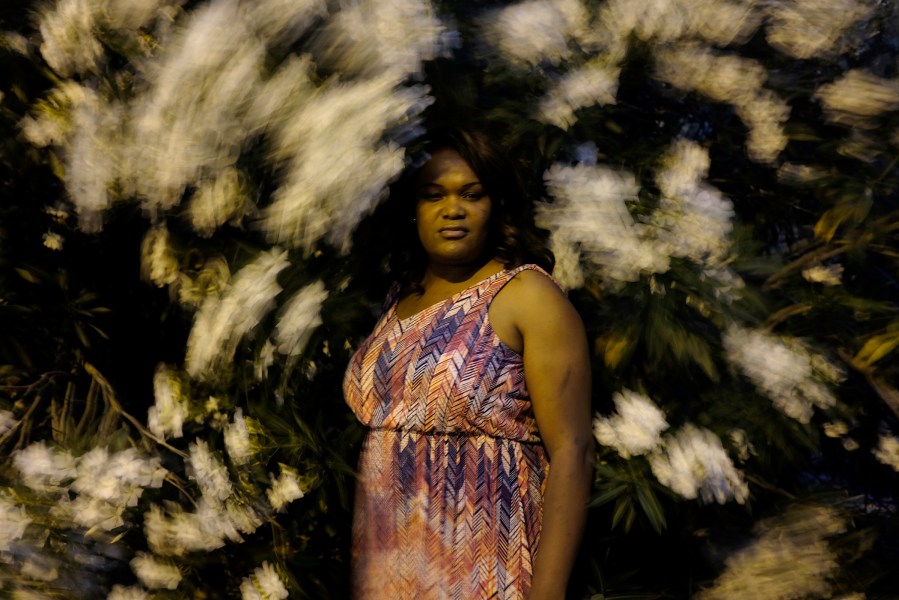
In Cooper’s late teens, she began purchasing hormones on the street to begin transitioning. Though Cooper had the support of her family, she had been bullied by teachers and students throughout her childhood. Suddenly, she was getting a lot of positive attention.
“I was transitioning, and I had my gold hair,” Cooper recalled. “Everybody, they used to always say that I was pretty, and they’d be all over me like, ‘I’ll take care of you.’”
A man she was dating gave her $300. That was how the sex work started, Cooper said.
One night, in 1999, she was stopped by a man who asked how much she wanted. “I gave him a price,” Cooper said. “And when I gave him that price he went into his wallet and he said, ‘You’re under arrest,’ and he charged me with a felony.” Cooper had never been arrested before. She pled guilty, without, she said, being told she would be placed on the sex offender list. Cooper had no idea there were separate and unequal prostitution laws at the time. There was the relatively minor misdemeanor, and there was “unnatural carnal copulation,” a felony that carried mandatory sex offender registration for at least 15 years. It was up to law enforcement to decide how to charge. According to the Center for Constitutional Rights, which litigated the case, 76% of those convicted of Crimes Against Nature were women, and 80% of them were black. Almost 40% of the registered sex offenders in Orleans Parish owed their place on that list to a crimes against nature conviction, which as Women with a Vision pointed out often amounted to a “talking crime” – the verbal promise of oral or anal sex for money, no actual sexual contact or transaction required. “By me being a trans woman, I just feel like he gave me the harshest they had,” Cooper said of her first charge. Two years later, Cooper said, an officer engaged in sexual contact with her before charging her with a second crime against nature. She doesn’t remember if they ever discussed money. That’s when Cooper made a decision. “I was going to be dead, or I was going to be doing life in prison under the habitual offender law,” she said. “So I had to change my life.” Cooper had been spared jail time with a suspended sentence and probation, but the sex offender status haunted her. “It can make a person be suicidal,” she said. “The first thing that comes to someone’s mind is that you must have done something with a child.” She said it cost her at least one job where a new manager was less sympathetic to her plight than an earlier one who had promoted her. It got worse when Louisiana redesigned its driver’s licenses, and her sex offender statuses was emblazoned across hers, stigmatizing Cooper every time she bought cigarettes or was pulled over for a traffic stop. Long after she quit sex work, Cooper said she was targeted by the police. She wasn’t the only one with such allegations. “Community members told us they believe some [New Orleans Police] officers equate being African American and transgendered with being a prostitute,” noted a report issued by the U.S. Department of Justice. In June 2013, after years of complaints from the community, the department issued formal guidelines against discriminatory policing. %22Everybody%2C%20they%20used%20to%20always%20say%20that%20I%20was%20pretty%2C%20and%20they%E2%80%99d%20be%20all%20over%20me%20like%2C%20%E2%80%98I%E2%80%99ll%20take%20care%20of%20you.%E2%80%99%22′ Cooper’s work now with Women with a Vision involves the delicate task of fighting violence in the community while recognizing that many of its members consider the police their biggest problem. “We’re scared to report it,” said Cooper of interpersonal violence among trans women, “because we feel like they’re not for us, they’re against us.” The National Transgender Discrimination Survey, which had a sample of about 6,500 people, found that “almost half of the respondents (46%) reported being uncomfortable seeking police assistance.” One-fifth reported harassment by the police, and the number was even higher among people of color. And in a study by the National Coalition of Anti-Violence Programs, transgender female survivors of partner violence – the very people Women with a Vision is trying to reach — were six times as likely to experience physical violence when interacting with the police compared to other survivors of domestic violence. Twenty-nine percent reported harassment and disrespect by law enforcement. Deon Haywood, Women with a Vision’s executive director, said it’s no wonder trans women, particularly trans women of color, think the police won’t help when they are victimized. “I know for a fact, both when there have been police officers in our trainings or things we’ve heard from women, that things turn up in the police report like, ‘she didn’t look like a victim” and “she seemed angry,’” she said. “The majority of our transgender clients are African American. And how many stereotypes do we have about that?” Cooper, Haywood said, has “made all of us step back and think about what it is to be committed. It takes an amazing amount of strength just being able to sit there and listen to the clients. And some of the stuff we hear every day is heavy.” “It’s a process,” said Cooper. That’s what she tells her clients, too. “I always tell them it’s a process. Things just don’t happen so suddenly.”
Irin Carmon Recommended


