








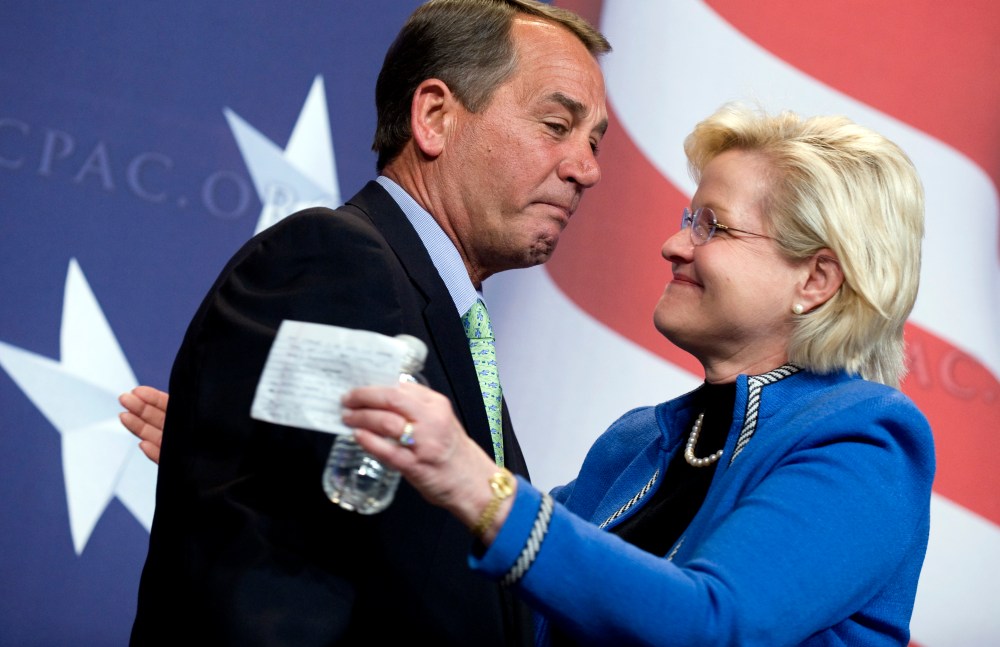
Since news broke nearly two weeks ago that the Internal Revenue Service (IRS) targeted Tea Party groups for special scrutiny, one well-connected Washington insider has led the charge to stoke the story. And she has no intention of letting up.
On Tuesday, Cleta Mitchell, a veteran conservative election lawyer and a partner at the firm of Foley & Lardner, filed a lawsuit against the IRS on behalf of True the Vote, charging that the agency had unfairly delayed the Tea Party-linked group’s application for tax-exempt status, submitted by Mitchell in 2010.
But Mitchell suggested to msnbc that the lawsuit’s ultimate target is Team Obama.
“I’m not saying Obama sat in the Oval Office and directed [the targeting]. But I am absolutely convinced that people in the [Obama] campaign were well aware of all this,” Mitchell said in an interview Wednesday, singling out David Axelrod, Obama’s former top political adviser. “I think there’s a very good chance that it will lead to people who are very highly placed politically.”
No evidence has emerged that the White House or the Obama campaign was aware of the improper targeting, which used keywords like “Tea Party” and “Patriots” to single out for extra scrutiny applications for tax exempt status from conservative groups.
Related: Treasury knew of IRS audit, but likely little more
And True the Vote may not make the best poster child for IRS discrimination. King Street Patriots, the Houston-based Tea Party group out of which True the Vote developed, was last year declared by a Texas judge to have illegally helped the Republican Party through its “poll-watching” arm—exactly the kind of political activity that IRS scrutiny aims to uncover. That poll-watching arm—designed to root out voter fraud, but which many minority voters have described as intimidating—ultimately split off to become True the Vote. (True the Vote isn’t the only conservative group complaining about IRS scrutiny despite close GOP ties.)
But for Mitchell, a former liberal Democratic state lawmaker from Oklahoma, the lawsuit is just the latest step in her effort to push the IRS controversy. Since long before the story broke, Mitchell—who in her role as a board member of the American Conservative Union last year worked to ban a gay Republican group from sponsoring CPAC, the annual conservative convention—has worked tirelessly to move it forward. Washington’s recent feeding frenzy over the issue is in part a testament to her success.
Hours after IRS official Lois Lerner admitted to the targeting at a tax forum earlier this month, Mitchell told Hans Von Spakovsky, who writes a blog for the conservative Heritage Foundation where he’s a senior fellow, that she questions the IRS claim that low-level employees were to blame. (Spakovsky, a prominent advocate of measures to combat voter fraud, is a member of True the Vote’s advisory board—a connection that’s not disclosed in his post.)
A few days later, Mitchell took a similar message to The Washington Post: “For the IRS to say it was some low-level group in Cincinnati is simply false.” In an interview with the right-wing site Newsmax a few days later, Mitchell went further, suggesting that President Obama could be impeached over the issue. She followed that up last Friday with an op-ed in the Post calling for an independent counsel to probe the targeting.
In fact, Mitchell has been on the case for years. Since late 2009, she’s submitted applications for tax-exempt status on behalf of at least four other conservative groups, in addition to True the Vote, according to a memo she prepared this week for reporters and others. (Mitchell declined to identify those groups. “Their applications are still pending and they are afraid of the IRS punishing them,” she said via email.) Those applications were returned by the IRS with long lists of questions she saw as onerous.
“I’ve been doing this twenty years, and all of a sudden I’m getting these very intrusive burdensome letters with these questions. And I’m thinking, this is crazy,” Mitchell said.
So early last year, she began coordinating with other Tea Party groups who had received similar letters, and with other conservative lawyers like Jay Sekulow of the American Center for Law and Justice (ACLJ), to raise a fuss.
“There’s a network of Tea Party groups around the country and conservative organizations,” Mitchell said. “It didn’t take very long for this to spread.”
Related: Some Tea Party groups probed by IRS had close GOP ties A conference call in which Mitchell and Sekulow participated, organized by Toby Marie Walker, an activist with the Waco Tea Party, had 85 or 90 people on it, Mitchell said. “We started talking about how this was not like anything anybody had ever seen before.” Walker told msnbc the group was well aware that this was a potentially explosive story. “We reached out to other people saying, we really want to get this rolling along and try to get this story out.“ Mitchell said she shared with Republican lawmakers the letters sent by the IRS to her clients containing pages of questions. That led Sen. Orrin Hatch and Rep. Dave Camp, who chairs the House Ways and Means Committee, to each write to the IRS demanding answers. Similar letters sent to groups represented by Sekulow’s ACLJ were given to The New York Times. Top agency officials were called in to testify, denying that politically motivated targeting had occurred. It wasn’t long before the inspector general was assigned to conduct an investigation. That effort by Mitchell and her allies generated a few headlines last spring, before petering out amid last year’s election campaign. But it laid the groundwork for the story that landed with such political force earlier this month, when the results of the IG probe became known. Mitchell said she’ll use the lawsuit to uncover just how far up the chain the scandal goes. “We are going to be able to take discovery, we are going to be able to get people under oath,” Mitchell said. “And we are going to be able to find out about their internal communications—something that the inspector general was not able to do in the report we have so far.” She continued: “We have an administration where we know that the Department of Health and Human Services took overt steps to silence opponents and critics of Obamacare back when it was being considered by the Congress. That’s been well documented. So why would we be surprised to learn that this administration and people in the White House were involved in trying to silence potential political critics and grassroots groups around the country?” “It wouldn’t surprise me in the least.”
Zachary Roth Recommended


