








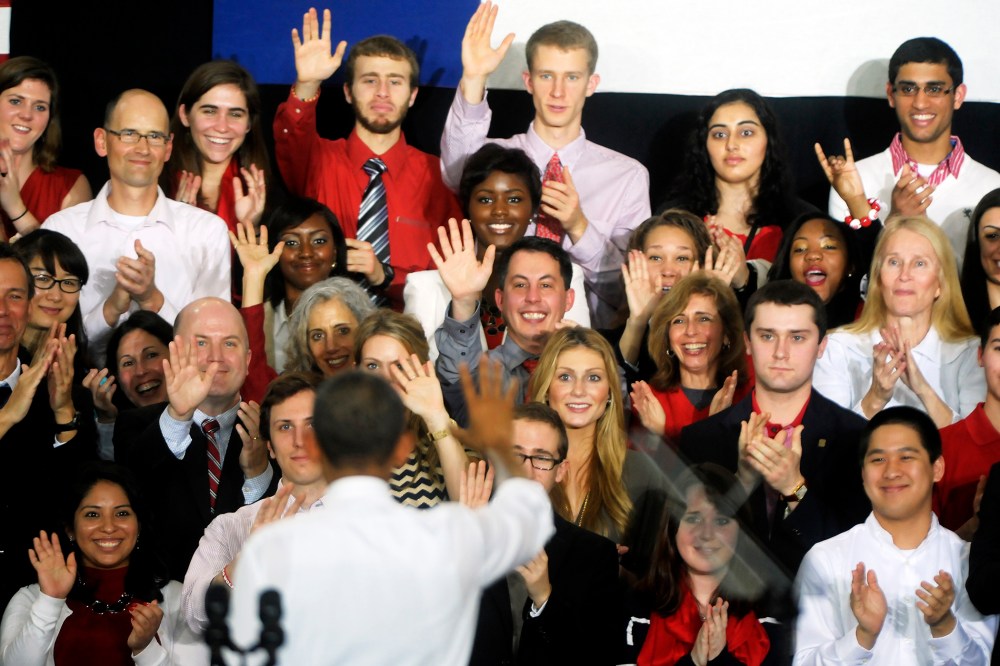
The Obama administration believes that the children are our future. Specifically, the young adults of today — the ubiquitous “millennial” generation — “will shape our economy for decades to come,” according to a White House fact sheet released on Thursday.
The fact sheet included a policy wishlist intended to strengthen the economic fortunes of the millennial generation. Accompanying the release was a new report [PDF] from the White House Council of Economic Advisers (CEA) synthesizing much of the available information about millennials as an economic bloc. Little in the report will come as much of a surprise: It noted that millennials are the most racially diverse cohort in American history, that they’ve invested in higher education more than any prior generation, and that they’ve taken on an unprecedented amount of student debt as a result.
To address student debt and the other economic challenges facing the younger generation — such as persistently elevated unemployment — the White House recommended a slate of proposals including raising the minimum wage, encouraging the creation of more job training apprenticeship programs, and increasing federal financial aid to college students.
“Acting with Congress and on his own where he can, President Obama will continue to invest in our teachers and schools, cut student loan debt, build on our technology boom, expand health coverage and homeownership, and train every hardworking American with the skills they need to find a good job that pays good wages,” according to the White House fact sheet.
The White House’s new appeal to millennials comes less than a month before the Election Day 2014, when Democrats risk losing their delicate foothold in the Senate and sinking further into minority status in the House. When millennials vote they disproportionately vote Democratic, but they might not turn out for the beleaguered party this year: A recent Harvard University poll found that fewer than 25% of young people would “definitely be voting” in the midterms. Conservative millennials were found to be more enthusiastic about the upcoming election than their liberal counterparts.
The youth-friendly spiel that the White House provided on Thursday appears to be a pitch for greater millennial engagement in the looming Election Day. The Democratic National Committee amplified the message in a Thursday blog post saying, “With the president’s important economic agenda and Democrats’ continued record of fighting for their interests, it remains clear why millennials stand with Democrats in election after election.”
“We’re just thrilled to see so much great attention paid to the economic circumstances experienced by our generation,” said Tom Allison, policy and research manager for the millennial advocacy group Young Invincibles. “We’re still five years into the Great Recession, and we’re suffering from it more than any other age group.”
Indeed, a recent Young Invincibles analysis of Labor Department unemployment data found that millennials between the ages of 18 and 34 have an unemployment rate about 45% higher than the population at large — and that the unemployment rate for African Americans of that age is nearly 175% higher. Partially as as a result, according to the CEA report, millennials are less likely to switch careers early in their careers than the prior generation was.
That finding flies in the face of some popular wisdom about “job-hopping” millennials; recent articles in the Chicago Tribune and Forbes, among others, have made the claim that young people are unusually restless when it comes to employment. But Allison pointed out that members of an economically disadvantaged group should be expected to stay put in their current jobs during times of fiscal stress. “Anyone in a recession who is lucky enough to have a job is more likely to remain in that job,” he said. Limited opportunities elsewhere tend to keep young people confined to their current workplaces. The CEA report described that lock of worker mobility as a mixed phenomenon, noting that a longer tenure in one particular job “has important advantages in terms of job security, the benefits of learning on the job, and the additional productivity associated with reduced turnover.” Yet limited ability to switch jobs can also stymie wage growth. Switching jobs is a time-tested way to get a salary bump, and a slack labor market — one which there are for more people looking for a job than there are jobs available — weakens the bargaining power of workers versus their bosses. Similarly, people who lose their jobs in such a market tend to stay unemployed for longer. POTUS joins @medium as we look for new ways to communicate in this hyper-speed chaotic environment http://t.co/oEBtGEC9cY
Ned Resnikoff is an urban policy analyst, researcher, writer, and editor. His byline has appeared in a variety of publications, including the New York Times, San Francisco Chronicle, Dissent, and The Nation. He writes the newsletter Public Comment, which can be found at publiccomment.blog. Recommended


