








This column is part of “The State of America,” an msnbc.com series leading up to President Barack Obama’s 2015 State of the Union Address on Tuesday, Jan. 20. This is the state of the issues you care about, as told by organizations promoting social change and other policy experts.
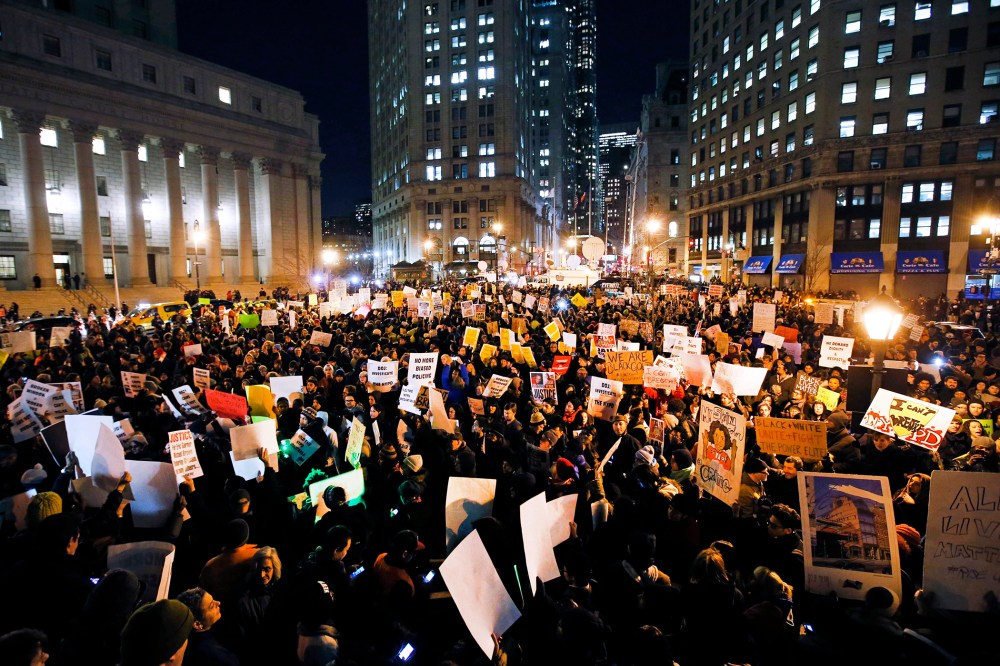
The year 2014 brought us multiple tragic deaths of unarmed black men and a growing leaderless protest movement calling for police reform encapsulated by the hashtag: #BlackLivesMatter.
Just before the holidays, we also witnessed the tragic, merciless, killings of two NYPD officers, resultant police slowdowns, turned backs at funerals, and a #BlueLivesMatter response which highlighted the growing divide between police and the communities they are sworn to protect and serve. On Tuesday, just one day after we commemorate Dr. Martin Luther King, we look to President Obama to set the tone for how our fraught communities can move forward. Even in the face of this alarming reality, the president should state affirmatively that the State of the Union when it comes to race and police reform is actually quite hopeful.
%22Even%20in%20the%20face%20of%20this%20alarming%20reality%2C%20the%20president%20should%20state%20affirmatively%20that%20the%20State%20of%20the%20Union%20when%20it%20comes%20to%20race%20and%20police%20reform%20is%20actually%20quite%20hopeful.%22′
Promoting hope or optimism in the context of race and public policy is tricky business. Decades, if not centuries, of empty political promises and growing disparities have undermined even the best of intentions for most elected officials. And yet, recent innovations in the way we not only understand the experience of race in America but also measure the effects of racial bias and anxiety on how we teach, treat patients and employees, or police our communities, are creating new possibilities for what policy reform can look like where race is concerned.
The greater implicit bias and racial anxiety we hold, the more our performance in any given domain will lead to disparate outcomes. But the more we know about the effects of bias and anxiety in critical work environments and the more data we are able to collect in these domains, the better we can devise interventions that blunt these effects.
Related video: The struggle for meaningful police reform continues
We have reason to be hopeful. There is mounting evidence that successful training and context-specific interventions can mitigate the effects of racial bias. Many are familiar with the so-called “shooter study,” which documented that people in simulations are more likely to mistake a black person for armed and shoot them. However, follow up studies have demonstrated that police officers — who receive a great deal of training on how and when to use their weapons — are less likely than civilians to make the same mistake regardless of the levels of implicit bias they hold.
Training, in other words, works — as does greater awareness about how biases affect our decision-making. In interracial mentorship scenarios, studies show white mentors can be successfully taught how to give feedback in a way that lessens rather than triggers anxieties. Jury instructions can be altered to alert jurors to the presence of bias, leading to fairer outcomes. In education, having middle school students write brief essays about their values, goals, struggles, and fears helps individuate them to their teachers, countering and complicating stereotypes the teacher may hold.
%22The%20more%20we%20know%20about%20the%20effects%20of%20bias%20and%20anxiety%20in%20critical%20work%20environments%20and%20the%20more%20data%20we%20are%20able%20to%20collect%2C%20the%20better%20we%20can%20devise%20interventions%20that%20blunt%20these%20effects.%22′
In the area of police reform, Dr. Phillip Atiba Goff, a social psychologist at the Center for Policing Equity, is bringing cutting edge research into police departments and developing practices that reform and repair interactions between police and communities. By collecting data and identifying trends in racial bias, he has found that biases in police officers correlate with racial disparities in stops, and that racialized masculinity anxieties correlate with greater use of force against blacks and Latinos; but also that interventions that take race into account can dramatically decrease these behaviors.
In other research, Dr. Goff has discovered that police officers often overestimate black youth and see them as more culpable than whites or Latinos in the same age category. These insights are helping us grapple with the realities in which both police officers and citizens of color are living, based on perceptions driven by biases and embedded in our brains. We are learning that bias and racial anxiety are not what make us different from one another — they are actually part of what make us human. Related video: Calls for police reform go beyond Ferguson Moral conviction and the fierce urgency of the present have long been in the toolbox of those fighting for racial justice. Yet on nights like this, when the nation stands as one to debate how to move forward after months of polarization, when emotions run high and deep, we need accountability. As such, it is even more critical that we use the insights of mind science and empiricism to drive our strategy towards racial equity. Measuring bias and racial anxiety can lead us to common ground around why we experience race the way we do. Even more importantly, such data helps us design better interventions to keep us safe and ensure our work is most effective. Rather than debate whose lives matter more, police and communities alike should be rallying around a commitment to understanding this critical research to help us realize the goal of all lives mattering. Alexis McGill Johnson is Executive Director of Perception Institute, a consortium of researchers, educators, and social justice advocates whose work analyzes the role of bias and racial anxiety in our society.
Alexis McGill Johnson Recommended


