








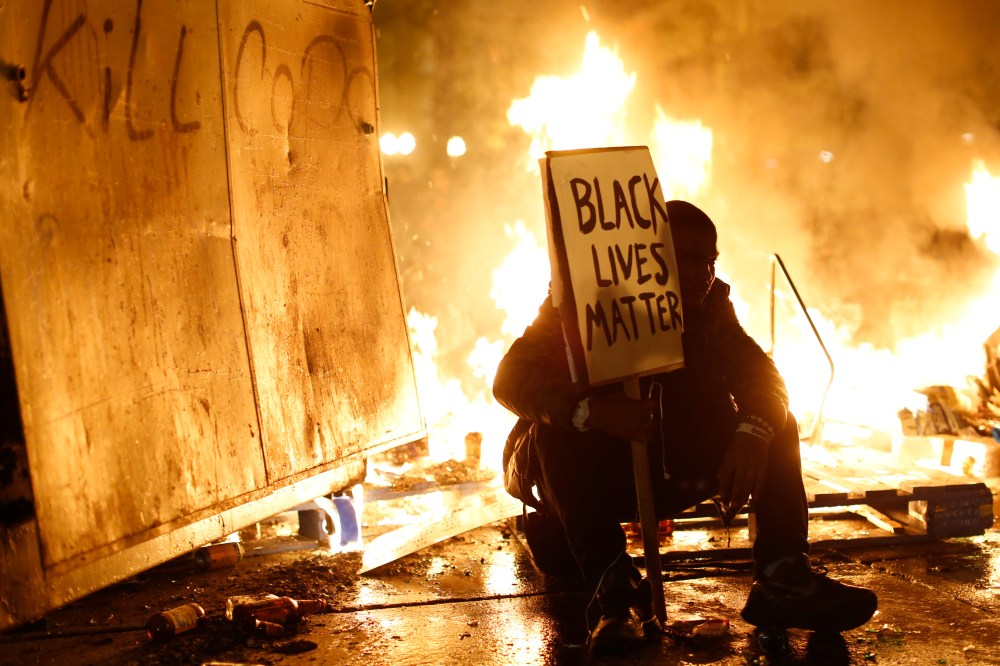
Last year was a year of great tumult in America. Income, education and equality gaps have remained steady. The voting rights of many Americans were eroded or greatly limited. And the killings of unarmed black men by police and later the lack of indictments in those killings sparked massive unrest, illuminating the trust gap between many communities of color and law enforcement.
Even as 2014 marked a year of momentous job growth, many have not seen their job and income prospects buoyed by the upsurge.
“The dark cloud inside this silver lining is that too many people are still being left behind,” Marc Morial, head of the National Urban League, wrote in the organization’s 2015 State of Black America Report, the annual indexing of black and Latino equity in America.
%22America%20today%20is%20a%20tale%20of%20two%20nations.%20It%20is%20a%20tale%20of%20two%20Americas.%22′
“I’d like to be here reporting to each and every one of you that equality is flourishing. I’d like to be here reporting that equal opportunity is abundant and flowing. I’d like to be able to say that racism is dead and gone forever and ever from American life,” Morial said during an event in Washington. “But the reality is that we cannot. And the reality is we have this obligation. This duty, this essential role to report the facts and the truth and how it is today even if those fact and that truth are extremely painful.”
The report, the “State of Black America – Save our Cities: Education, Jobs + Justice” was released on Thursday morning during the event. This year’s report, The National Urban League’s 39th, is available in an all-digital format featuring reports, graphs and articles.
The facts as stated in the report are mostly dismal and stark, particularly in terms of economic parity for blacks and Hispanics and whites. Despite 12 straight months of private sector job gains above 200,000 and a national unemployment rate of just 5.5%, the unemployment rates for blacks and Hispanics in many of the country’s major metropolitan areas is as much as 3-to-1 or 4-to-1.
The numbers are even more disheartening in terms of the wealth gap. The net worth for African-Americans was $6,000, for Hispanics it was $7,000 and for whites it was $110,500.
The disparities weren’t, as some might intuit, limited to the gritty urban cores of the Northeast or impoverished areas of the South. San Francisco, which Morial described as a picturesque, “bastion of progressive politics,” ranked 70th out of 70 major metropolitan areas in medium income equality.
Related: One resident on how Ferguson has changed in 7 months
In that city, the average medium income for black households was just $39,000 compared to $95,000 for whites.
According to the report, which uses a formula of quantifiable factors to produce its equality index, African-Americans in 2014 were just 72% equal to whites with full equality between the two groups being 100%. Hispanics were slightly better at 78%.
The equality index included economics (black 55.8%, Hispanic 61.7%), health (black 79.8%, Hispanic 106.9%0, education (black 76.1%, Hispanic 74.6%), social justice (black 60.6%, Hispanic 72.7%) and civic engagement (black 104%, Hispanic 71%).
“Education is not the automatic great equalizer,” Morial said.
Even college educated African-Americans faced drastically higher unemployment rates compared to their white counterparts with the same level of educational attainment, according to the report.
Yet, even with the deep and lingering disparities 2014 was indeed a banner year in some educational aspects. The high school graduation rates for American students are the highest they’ve been in history, dropout rates are at historic lows and there are more students of color in college than ever before.
But in the aggregate of the broader indexing of education, employment and justice, the outlook for black and brown people remains troubling as ever. “What do we say and how would we frame the state of black America for 2015,” Morial said. “I must use the word crisis.” On the justice front fewer African-Americans were victims of violent crimes. There are more black lawmakers in Congress than ever before, 48. And the Justice Department under Attorney General Eric Holder has confronted misconduct by law enforcement and worked hard to improve police and community relations, Morial said. Yet, 2014 was a watershed moment in the collision of violence and law enforcement. %22There%20are%20Fergusons%20here%20and%20there%20are%20Fergusons%20there%20and%20there%20are%20Fergusons%20everywhere%22′ Perhaps no incident of last year exemplified that crisis – in the confluence of income, housing and social justice concerns— as the killing of Michael Brown Jr. in Ferguson, Missouri and the local and national fallout that followed. Long before Brown’s killing by former Ferguson police officer Darren Wilson last August, the small city in the suburbs of St. Louis was rife with income inequality and deep residential segregation. While blacks made up the majority of the population there, the city’s leadership was majority white including nearly all of the police force, the city council and school board. Brown’s killing sparked protests and riots that spilled nationwide that focused on state sanctioned violence against blacks but also the various inequities in the criminal justice system for African-Americans, in particular young black men. The black community in Ferguson had “no role in their government, with no representation in their police department, so when the incident happened it was as Langston Hughes poems says, it exploded,” Morial said, referencing Hughes’s poem “A Raisin in the Sun.” The Justice Department recently released a scathing report that outlined a broad pattern and practices of abuses and violations of both federal law and the constitutional rights of African-Americans by police. “While America may have seen the reaction, the Justice Department report put a spotlight on a long system of practices in Ferguson, Missouri, there are Fergusons here and there are Fergusons there and there are Fergusons everywhere,” Morial said. “America today is a tale of two nations. It is a tale of two Americas. It is a tale of some who have achieved a great modicum of success, economic success, upward mobility, home ownership, a strong quality of life. “It’s the product of their hard work, it’s a product of opportunity, a product of many factors,” Morial said. “But there is that America that is too black and too brown, not all black and all brown, but too black and too brown, which seems to be stuck on the other side, stuck on the other side of this great American divide.”
Trymaine Lee
Trymaine Lee is an NBC News correspondent. Recommended


