








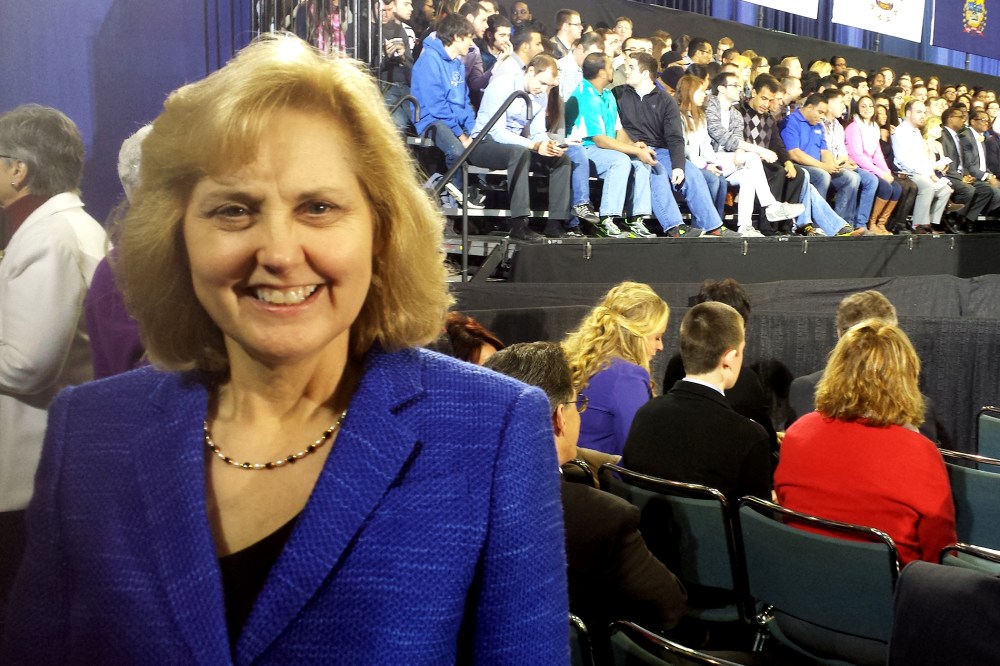
The stakeholders in the Obamacare rollout aren’t just in Washington, D.C. Across the United States, health care providers, small-business owners, patients, and others are all affected by the law. In this expanded interview from the new msnbc series, we speak with a Rhode Island contracter who thought she had adequate health coverage, until a devastating diagnosis.
For days, Susan Groh felt dizzy and weak. She chalked it up to feeling tired from her busy schedule working alongside her husband, Jack, on PR for the NFL Pro Bowl. But when she returned to her family home in Providence, Rhode Island, and the symptoms persisted, she suspected something more serious.
Groh’s doctor ran blood tests and the results were graver than either was prepared for—she had leukemia and would have to be hospitalized immediately.
“At the time we had what we thought was adequate insurance, we had a $100,000 limit,” said Groh, a 53-year-old mother of three whose children quickly made “Team Mom” t-shirts. “I was in the hospital for a month and my bill was $300,000, so I was out of insurance in no time.”
Doctors at The Miriam Hospital in Providence told Groh and her family that with chemotherapy alone she had a 16% chance of survival. A full stem cell transplant, however, where Groh’s immune system would be replaced with donor cells, would give her more of a chance.
The only problem? Without insurance, the family would have to pay $1 million out of pocket.
“It’s tough to know that there is something that could save your life but you can’t afford it,” Groh said. “If we sold our house and dipped into our retirement accounts, it still would not be enough.”
At the time of her diagnosis in February of 2012, the Affordable Care Act marketplaces were not yet open. But a key provision in the law preventing insurance companies from denying patients coverage because of pre-existing conditions had already gone into effect in 2010.
Under protection from that provision, the family obtained a release from their previous health insurance plan so they could pay for a more comprehensive policy with Blue Shield that would include Groh’s stem cell transplant. By May of 2012, Groh was admitted at the Dana Farber Cancer Institute in Boston to begin her treatment.
“I really feel like the Affordable Care Act changed my life,” she said. The family’s current policy is expensive and the Grohs still paid $35,000 in medical bills last year but Groh reasoned that, “it’s a lot cheaper than a hospital stay.”
A naturally private person whose daughter, Sarah, said is always one to pass credit to others, Groh said she felt compelled to share her story to urge people to take a hard look at the ACA and their own health coverage.
“There’s been so much misinformation, people are so wary,” she said. “I wish I could talk to them to tell them, ‘Oh come on, this could save your life.’” Sarah Groh, a 25-year-old Master’s student at Harvard University, said her mother’s fight inspired her and has also made her more sensitive to arguments about the law. “Here’s a story where they did everything they should’ve done,” she said of her parents and their lessons to her and her two younger brothers to live within their means and to put 20% of their earnings into savings. “And they still could’ve fallen through the system—it’s hard to get through the stigma of that.” Nearly two years later, Groh is cancer-free and feeling grateful—for her lifesaving treatment, for the way the soccer club where she volunteered during her children’s little league days sponsored a stem cell drive, for her neighbors who sanitized her house after her hospital stay because her immune system was fragile, and for President Obama and the ACA. “I had written [President Obama] a letter just thanking him for the ACA and how it saved my life,” Groh said. The president apparently got the message. Groh received an invitation to hear the president speak at Central Connecticut University, a two-hour drive from her home, on March 3. In a room just off the stage, she thanked Obama in person. “It was really a thrill to meet him and thank him,” she said. “We didn’t think we were at any risk, we thought we were ok, and then you have something catastrophic come along and you find out.” For more Sakeholders meet: The Florida doctor suing over the employer mandate, The Rhode Island med student, and The Arizona med school dean.
Gabriela Resto-Montero Recommended


