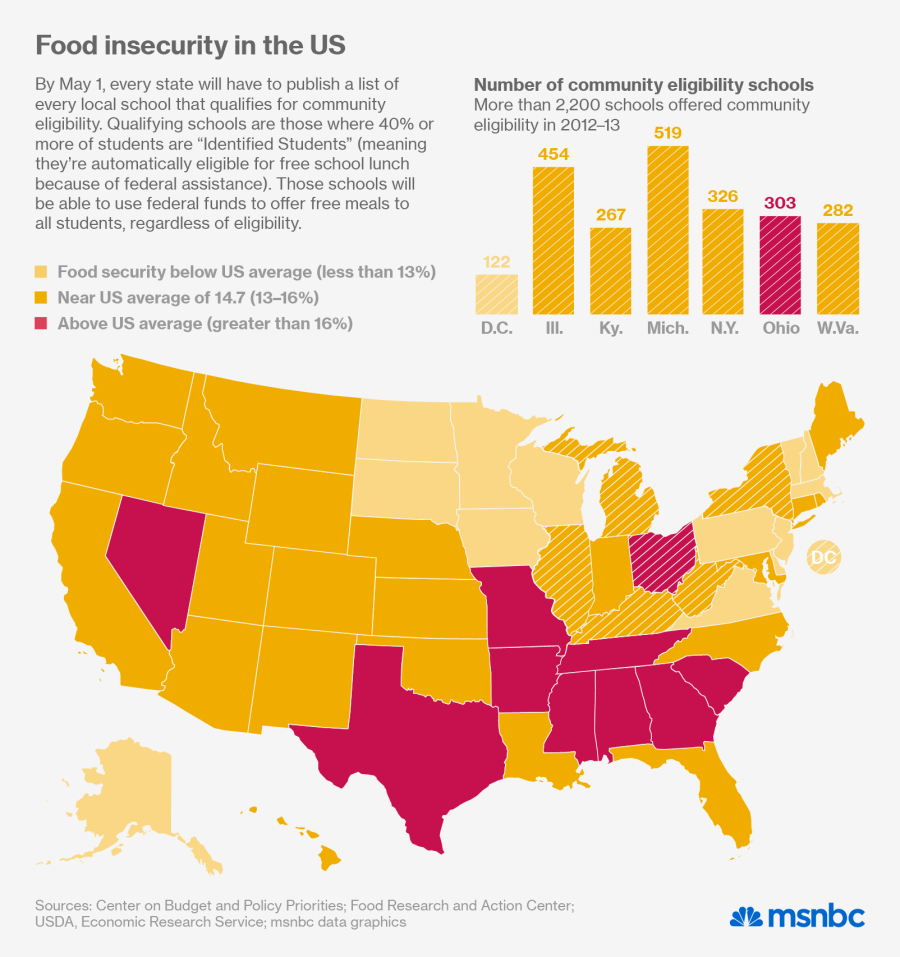
Hunger crises do their greatest damage to those who are already most vulnerable: The poor, the elderly, the disabled, and, of course, children. As a result of America’s present hunger crisis, one-fifth of all households with children are classified as food insecure by the U.S. Department of Agriculture, which which defines food security as “access … to enough food for an active, healthy life.”
In total, 8.3 million children in this country are not getting the food they need. At the same time, food stamp cuts have put extraordinary strain on both public and private anti-hunger programs, to the point where even many food pantries and soup kitchens are unable to meet the basic needs of their clients. The food security safety net is fraying to the breaking point.
But there is one notable exception to the overall trend. Even as Congress signs off on billions of dollars in food stamp cuts, the federal government is dramatically expanding its free school meals program. Thanks to a 2010 law championed by first lady Michelle Obama, a growing number of schools across the country are offering free meals to all of their students, regardless of whether those students’ parents applied for the program.
In the 2012-2013 school year alone, an estimated 2,200 schools fed over one million children by using the new community eligibility option, according to a recent report [PDF] from the Food Research and Action Center and the Center on Budget and Policy Priorities. Those schools were all concentrated in the six states, plus the District of Columbia, where the program was first launched. After May 1, 2014, community eligibility will become open to schools in all fifty states.
FRAC senior policy analyst Madeleine Levin told msnbc that community eligibility had clearly increased the student access to lunch and breakfast in participating schools. The number of children who ate free lunch at those schools rose 13% according to FRAC and CBPP research, while the number of children eating free breakfast increased 25%. The jury is still out on whether those additional free meals will have a measurable effect on food insecurity levels, but Levin said there was reason to hope.
“We do have research that [shows] when kids participate in this school breakfast program in low-income schools, it does improve their family food security,” she said.
Schools qualify for community eligibility when over 40% of their students are “Identified Students,” meaning they automatically qualify for free lunch because they’re homeless, in foster care, enrolled in Head Start, or live in households which receive certain kinds of federal assistance, such as food stamps. If a school meets that threshold, then it can bypass the whole process by which individual parents apply for their children to receive free meals. Instead, the federal government subsidizes free meals for the entire student population. The costs are minimal, Levin said.
“The costs for doing these free meals are not very high because it’s really limited to very high poverty areas where the vast majority of children are eligible for these free meals,” she said. In fact, the school district gets to save on certain administrative costs because they don’t need to process applications for free meals or even hire a cashier.
Boston Public Schools became one of the more recent school districts to adopt community eligibility in September 2013. At the time, Boston Public Schools Food and Nutrition Services director Michael Peck described the move as “truly a win-win for our students and our city” in a statement.
“Every child has a right to healthy, nutritious meals in school, and when we saw a chance to offer these healthy meals at no cost to them, we jumped at the chance,” said Boston Mayor Thomas M. Menino in the same statement. “This takes the burden of proof off our low-income families and allows all children, regardless of income, to know healthy meals are waiting for them at school every day.” Not everything about the law which made this possible is a win-win, however. The 2010 Healthy, Hunger Free Kids Act also raided future food stamp disbursements in order to pay for more nutritious school lunches. Michelle Obama, the law’s champion, personally lobbied reluctant House Democrats until they agreed to swallow the cuts. As a result, food stamp spending sharply declined after November 1, 2013, in a $5 billion across-the-board cut which anti-hunger activists referred to as the hunger cliff. Joy Pullman, a research fellow with the conservative Heartland Institute, has criticized the community eligibility program for contributing to obesity. “So the federal school lunch program, the reason that it exists is actually a collusion between big agribusiness and big government, and what it ends up doing is raising food prices for the poor and middle class, it makes kids more fat, and it also has the effect of making families—depriving them of their ability and the privilege and joy of providing for their own children,” she said during an October 23 appearance on Fox News. Rep. Paul Ryan’s, R-Wis., recent study of federal anti-poverty programs also suggested that free school meals might be adding to childhood obesity, though the report also admitted that results are inconclusive and made no mention of community eligibility.
Ned Resnikoff is an urban policy analyst, researcher, writer, and editor. His byline has appeared in a variety of publications, including the New York Times, San Francisco Chronicle, Dissent, and The Nation. He writes the newsletter Public Comment, which can be found at publiccomment.blog. Recommended