








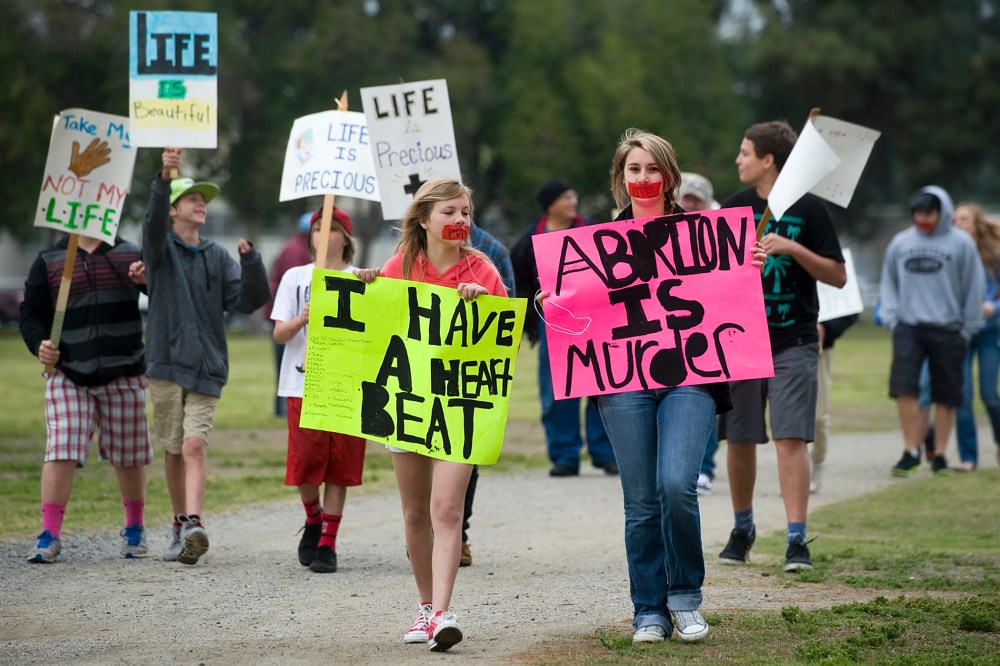
SAN FRANCISCO — Three years ago, Scott Scharpen gave a sermon against abortion at his church in Murrieta, California. It didn’t feel like enough, he says, so drawing on private donations, he purchased a 31-foot RV equipped with an ultrasound machine. As a mobile clinic licensed by the state of California, Go Mobile for Life offers free pregnancy tests, sonograms and urges women considering abortion to give birth instead.
Recently, Scharpen began threatening to shut down his own clinic, one of at least 228 so-called crisis pregnancy centers, or CPCs, in California, and among an estimated 2,500 nationwide. Such centers are the ground troops of the movement opposing abortion rights, familiar from their ambiguous “Pregnant?” billboards and a mainstay campaign stop for GOP presidential candidates like Carly Fiorina and Jeb Bush.
For years, abortion rights advocates have accused crisis pregnancy centers of misleading women, in part by failing to disclose that they don’t provide abortions. Volunteers have gone into centers and documented how they often give out inaccurate medical information about the risks of abortion. One NARAL volunteer in California said that at two centers she visited for the 2015 report, ultrasound technicians inaccurately identified her intrauterine device (a form of birth control) as her “baby.”
“All I can say is that the last thing we want to do is try to lie to women and deceive women,” says Scharpen. “The whole reason for our existence to serve women, to love on them and to help them at a difficult experience in their lives.”
Scharpen’s current dilemma comes in the form of a piece of paper that must hang in his clinic in a prominent place, “at least 8.5 inches by 11 inches and written in no less than 48-point type,” mandated by the state of California. The message is brief: “California has public programs that provide immediate free or low-cost access to comprehensive family planning services (including all FDA-approved methods of contraception,) prenatal care, and abortion for eligible women. To determine whether you qualify, contact the county social services office.” The phone number follows.
The sign is the product of the Reproductive Fact Act, signed into law in October. California legislators, including U.S. Senate candidate and co-sponsor Attorney General Kamala Harris, say it ensures women know all of their options. Scharpen says the sign violates his right to religious freedom and expression.
“What we believe it’s doing is forcing pregnancy centers and licensed pregnancy centers to refer women to get abortions,” says Scharpen. “And I oppose abortion with every fiber of my being.”
His mobile clinic is one of several crisis pregnancy centers that have sued to block the law. With the help of conservative legal nonprofits, they filed in state and federal court. While the litigation is ongoing, the centers have failed to convince any judges to temporarily block the law from going into effect.
Speaking to MSNBC the day before the law was scheduled to go into effect, Scharpen said he planned civil disobedience. “At this point our stance is that we won’t comply,” he said. The first penalty is $500, with each subsequent offense costing $1,000.
In a release on his attorney’s website, Scharpen went even further: “I would rather close the clinic than post that notice.”
To Amy Everitt, state director of NARAL Pro-Choice California, which championed the law, that wouldn’t be such a bad thing. “If that’s what they choose instead of providing fact-based information,” she told MSNBC, “maybe the women in our state are better served.”
When it comes to abortion rights, states are turning ever deeper shades of red and blue.
Set foot in California, the country’s most populous state, which legalized abortion before Roe v. Wade. California wants women to know they can have abortions paid for by the state’s Medicaid program, which the state chose to expand under the Affordable Care Act. California women also have a newly enlarged pool of providers to choose from, thanks to a 2013 law allowing nurse practitioners and physician’s assistants to provide abortions. Many of the secretly recorded videos of Planned Parenthood executives discussing reimbursements for fetal tissue for medical research took place in California, but state officials have declined to investigate the organization. Women in California will soon be able to get birth control pills over the counter.
“We are hoping that we are a beacon and a role model for other states,” Everitt said.
Texas is hoping the same. In the next-biggest state, women can’t use Medicaid to cover their abortions and must submit to an ultrasound viewing and a 24-hour waiting period before undergoing the procedure. The Texas legislature has passed law after law seeking to strip Planned Parenthood of state funds for non-abortion services, including birth control, most recently citing those same secretly recorded videos. With a single 2013 law requiring that abortion providers get additional credentials from hospitals, lawmakers cut the number of abortion clinics in half, and may halve the number of clinics yet again if the full force of the law goes into effect.
In each state, outnumbered groups have asked federal courts to block the laws that seek to shape women’s access to reproductive services — the religious objectors in California, the abortion clinics in Texas. In March, the Supreme Court will hear oral arguments in a challenge to the Texas clinic regulations. What the nine justices decide by July will determine just how much more balkanized the U.S. will become on abortion access, a patchwork of Californias and Texases.
In California, some religious conservatives say they feel like an oppressed minority. Kevin Snider, an attorney at the Pacific Justice Center who is representing other crisis pregnancy clinics challenging the Reproductive Fact Act, said, “We’re finding ourselves gradually coming under the grips of the tyranny of an administrative state. That’s unfortunate. But that’s the world we’re living in.” But, Snider added, “There is a determination out there that I haven’t seen in many years, with people of faith in general, that they are not going to comply with government intrusions into moral issues.” His words evoke an earlier Supreme Court case, Burwell v. Hobby Lobby, another case that pitted women’s access to reproductive healthcare against claims of religious liberty. The court will hear a sequel to that case, Zubik v. Burwell, this term. Previous attempts to regulate crisis pregnancy centers have been undercut by federal courts, which have struck down parts of laws in New York City, Baltimore and San Francisco on First Amendment grounds. Because the clinics offer their services for free, rather than operating as commercial enterprises, they have often successfully argued that they are exercising their freedom of speech and religion, raising the bar for any law regulating them. For example, the Second Circuit Court of Appeals said that New York City could require crisis pregnancies to say whether or not they have a licensed medical provider on staff, but that it went too far to say the health department “encourages women who are or may be pregnant to consult with a licensed provider,” and to require crisis pregnancy centers to say whether they provider or provide referrals for abortion or contraception. Supporters say the California law was written carefully to avoid legal pitfalls. Unlike some of its predecessors, it does not specifically focus on crisis pregnancy centers, although Robert Tyler, co-founder of Advocates for Faith and Freedom and Scharpen’s attorney, disputes that. He argues it implicitly targets them by exempting government-operated clinics and family planning providers. Such singling out could run afoul of the First Amendment. “The only groups that this law really appear to apply to are the pro-life religiously based organizations,” Tyler said. Erwin Chemerinsky, dean of the University of California, Irvine School of Law, disagrees. “I don’t think it’s a close question that this law is constitutional,” he told MSNBC. He compared it to California’s ban on “conversion therapy” for LGBT youth, which federal courts upheld and in which the Supreme Court declined to intervene. With the crisis pregnancy law, Chermerinsky said, “what the legislature found was that these so-called crisis pregnancy centers were giving false information and weren’t providing full information to women. All the legislature required in this law is that they post information about the availability of services. It doesn’t require that they give women advice on abortion.” So far, three federal judges and one state court judge have found it likely enough that the law is constitutional to let it go forward. “The mandated speech provides only factual and incontrovertibly true information about the range of pregnancy-related public health services available,” wrote federal district court Judge Jeffrey S. White in one of the rulings, “especially relevant to patients of clinics that only provide limited options of health care alternatives.” There is a red-state flip side to the crisis pregnancy’s battle against the sign. Ten states require abortion patients to have ultrasounds first; three, including Texas, make the provider show and describe it them. The underlying belief is that women have been misled about their gestating embryo or fetus and that the image will change their mind about terminating the pregnancy. Several states require that abortion providers tell their patients information that belies the scientific consensus and which the doctors fiercely oppose, such as the debunked claim that abortion leads to increased risk of suicide. “I think what’s interesting is that both states have promulgated their respective regulations in the name of promoting health,” said Melissa Murray, a professor of law at the University of California, Berkeley. The irony, she adds, is that each side of the debate is weaponizing information. “The whole question about access to abortion and contraception,” Murray says, “has been a question about access to knowledge.”
Irin Carmon Recommended


