








What if we could slow climate change with a few good inventions? That’s the promise of “geoengineering,” often described as plan B if all the politics and protests fail to spur a response to global warming.
RELATED: SCOTUS rules against pollution regulations
Some experts have suggested we repel the sun with cannon-fired reflective dust or clouds of reflective bubbles. Others have mused about free-floating filters to suck carbon from the air. Still others have never given up the old military dream of controlling the weather.
But besides being dangerous beyond belief — akin to levering the earth without knowing exactly where it will roll — these proposals might also be pointless. We already have the perfect geoengineering technology, as President Obama made clear in a joint press conference Tuesday with the president of Brazil.
They’re called trees.
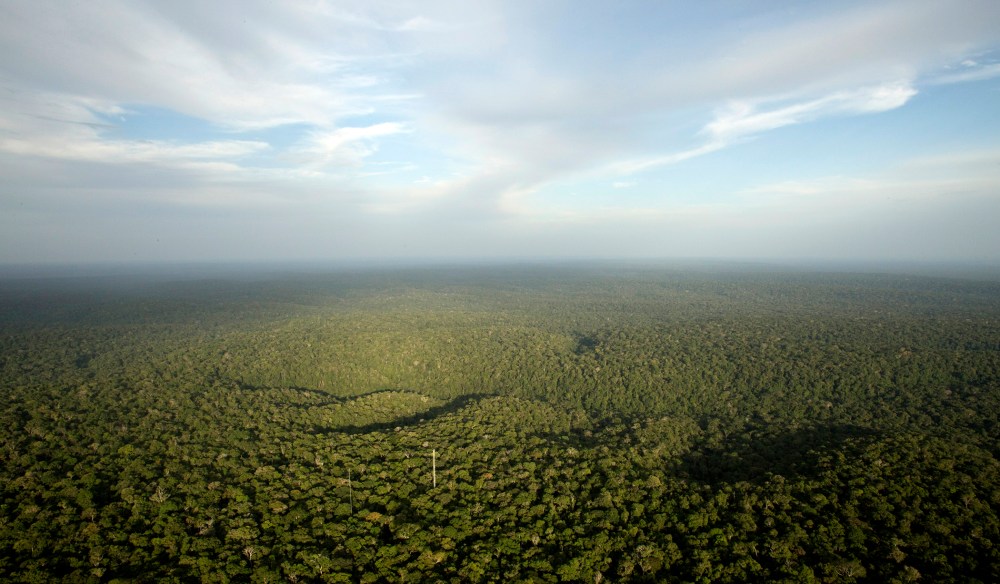
Brazil has done more to slow global warming than any country on earth, primarily by protecting the trees of the rain forest, the White House said in a statement on Tuesday. Those trees were the offstage and understated star of a press conference between Presidents Obama and Dilma Rousseff.
Some environmentalists walked away grumbling, because Brazil didn’t announce a hard cap on greenhouse gases. The bigger news in terms of impact, however, is the country’s new pledge to stop illegal deforestation and regrow a patch of forest the size of Pennsylvania.
You could call it the Lorax-approved solution to global warming.
The Lorax is the Dr. Seuss character who speaks for the trees (because they have no tongues). Brazil already had more trees than most countries. Tuesday’s announcement—to restore 12 million hectares of the Amazon—means millions of additional green, barky things and a huge boost for global efforts to avoid catastrophic climate change.
That’s because trees gobble up carbon, cleansing the sky of the heat-trapping emissions that are blamed for the world’s rising temperatures and increasingly severe weather. If you don’t believe it, just ask a fifth grader: it’s called the earth’s “carbon cycle.”
In the last decade, the Brazilian government has overseen an 80% drop in deforestation, from 28,000 square kilometers a year in 2004 to about 6,000 square kilometers in 2013. It has also boosted agricultural yields, defraying one of the main motivations for further clear-cutting: the need to feed a growing population.
RELATED: Obama administration lays out doomsday climate change scenario The amount of carbon dioxide sucked up by the Amazon may have fallen in recent years, studies show. But it’s still believed to be north of 1 billion tons a year. That’s equivalent to a two week slurp of all the carbon emissions on earth. If the country succeeds in replanting and restoring as much forest as it promised on Tuesday, it could add another 22 million tons of annual absorption capacity. That offsets thousands of cars and trucks. “Brazil has reduced its emissions by around 41% as compared to 2005,” the two presidents said in a joint statement issued by the White House.” By comparison the United States has only cut its emissions by about 10%, which is enough to make us the second most aggressive country. Of course, we can’t entirely plant our way out of danger. That’s why the two countries also agreed to expand the use of renewable energy, promising to generate 20% of electricity from wind, solar and other clean sources by 2030. Brazil also promised to put a limit on emissions ahead of the Paris Climate Change Conference this December. That gathering could be the world’s last chance to avoid deeper changes to the climate, including more punishing droughts, severe storms and longer heat waves. Scientists insist that a cap on carbon emissions is the only long-term solution. Trees can help us along the way, however, buying us time for the slow work of politics and preventing the need for more radical interventions. Plus, more trees would redeem the work of the Lorax, giving him a fan-fiction ending that just happens to be real.
Tony Dokoupil Recommended


