The gun debate in the United States has changed a lot over the last 20 years. Support for gun control has declined sharply as support for gun rights has risen, as we noted earlier this week. Those trends are evident in data from a range of sources including Gallup and the Pew Research Center.
A complicated mix of emotions, attitudes and perceptions go into how people feel about guns, but when you look at the data, two points help explain the drop in support for gun control. Over the same period of time the violent crime rate has also dropped sharply. And the partisan divides that have come to define U.S. politics have pushed into the gun control debate.
RELATED: Ben Carson again directs victims to fight gunmen
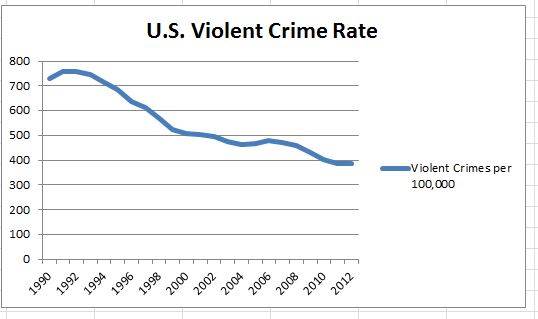
The decline in violent crime over the past 25 years has been remarkable. In 1990, there were 729 violent crimes reported for every 100,000 people in the United States, according to the FBI’s Uniform Crime Statistics. The number got as high as 757 in 1992 — and then it began to fall steadily over the next 20 years.
By 2012, the figure was down to 386 violent crimes per 100,000 people.
(This trend is also true for the U.S. murder rate. In 1990, there were 9.4 murders for every 100,000 people, according to the Uniform Crime Statistics. In 2012, there were only 4.7 for every 100,000.)
These numbers aren’t meant to suggest that people’s attitudes about guns affected the violent crime rate, but it could be the other way around.
Despite the headlines about mass shootings, like last week’s in Oregon, in terms of people’s day-to-day lives and the stories in local media, violent crime is less of an issue today than it was in the United States in 1994. The numbers are still high when compared to other developed countries, but low compared to where the country used to be.
That may have played a role in peoples’ attitudes about gun control. The epidemic of violence that dominated news coverage in the late-1980s and early-1990s gave way to news stories about dropping crime rates and safer cities. That’s become the dominant crime story over the past two decades. It’s one thing see coverage of a senseless horrific shooting somewhere far away from you. It’s another thing to see crime scene tape a few blocks away and personally know victims.
RELATED: Loretta Lynch: ‘Police shootings are not minutiae’
The latest data suggest those declines may be starting to reverse themselves, particularly in big cities and if that rising trend continues, attitudes on gun control may shift.
But there is also a political factor in the gun debate that could be harder to change. As the nation has become more politically polarized and voters have retreated into their red and blue camps, the partisan differences on gun control have become much more pronounced.
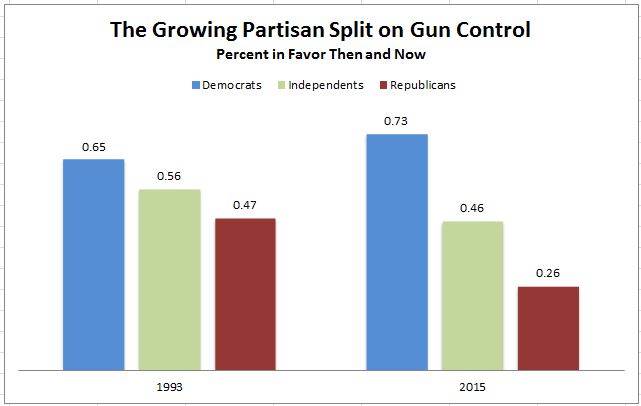
Overall, support for gun control has indeed dropped, but Democrats and Republicans have moved in different directions. In 1993, 47% of Republicans and 65% of Democrats supported gun control, according to Pew Research data. That’s an 18-point gap between members of the two parties, with Republicans sitting near 50%. In 2015, only 26% of Republicans support gun control, in the Pew Research data. But the Democrats have moved in the other direction – 73% now favor gun control. That’s an enormous 47-point gap with the parties at opposite ends of the spectrum on the question. In other words, the gun control issue has become deeply intertwined with political identity and as we see on other issues – from abortion to gay marriage – overcoming factors tied to political identity to find consensus can be extremely difficult. Even if Democratic support for gun control grows and even if independents, who tend to hover around the middle, move back above 50% supporting, it’s unlikely the numbers will show support for it climbing in a significant way. This article first appeared on NBCNews.com.
Dante Chinni Recommended