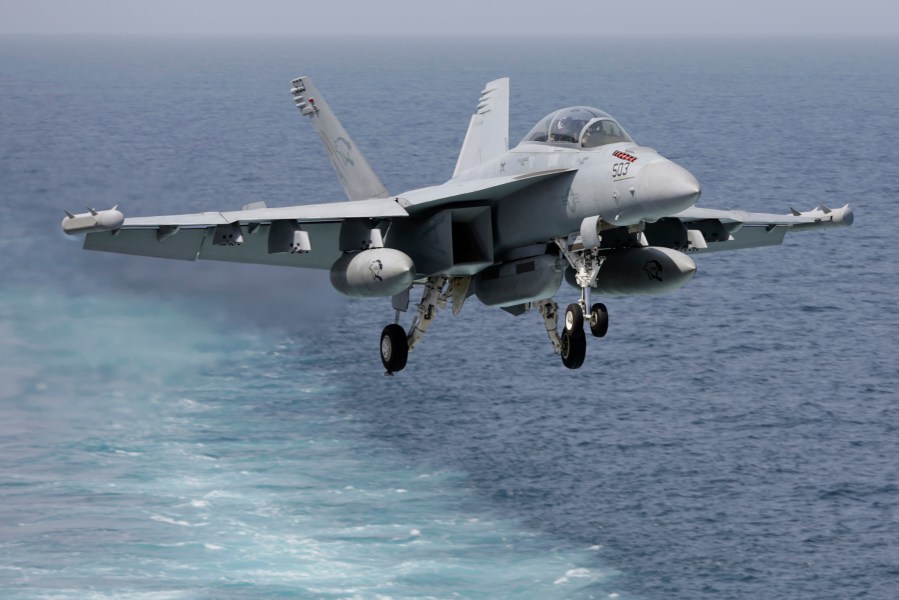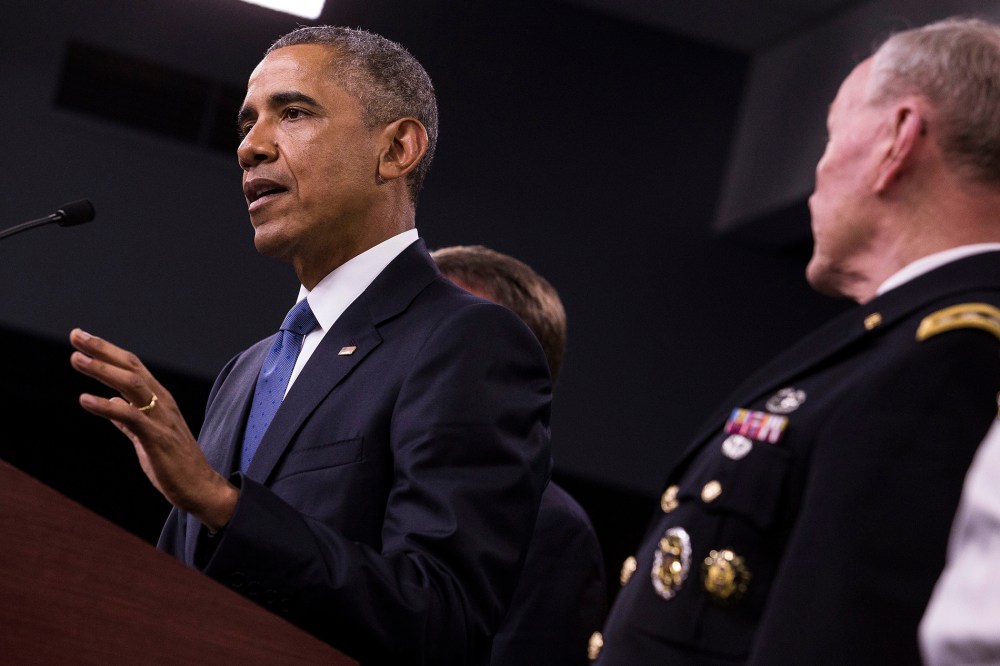
There was a key word missing from President Barack Obama’s speech at the Pentagon on Monday. Despite discussing more than 5,000 airstrikes against the self-described Islamic State and emphasizing the need for partners on the ground to be trained and equipped for combat, the president stopped short of calling the U.S. military campaign “war.”
In fact, the word “war” has been largely absent during the entire year-long conversation about what’s happening in Iraq and Syria. Perhaps this is because, after more than thirteen years of a seemingly endless war on terror, acts of violent extremism are actually on the rise globally and it’s clear that war isn’t working. But turning away from endless war involves changed policies, not changed names. First we need to figure out: what exactly is war?
%22After%20more%20than%20thirteen%20years%20of%20a%20seemingly%20endless%20war%20on%20terror%2C%20acts%20of%20violent%20extremism%20are%20actually%20on%20the%20rise%20globally.%22′
It seems clear that drone strikes are war. The Obama administration has increasingly relied on unmanned aerial vehicles to launch Hellfire missiles into spaces outside of traditional war zones. Instead of armed conflicts between uniformed forces with defined combatants and civilians, drones make it possible for the U.S. to target individuals in their homes or communities for their affiliations or characteristics.
Because these targeted killings are conducted through the Central Intelligence Agency, secret targets are killed for secret reasons under secret legal rationale. The danger here should be obvious – the destructive capabilities of the U.S. military can now be expanded globally without debate, deliberation, clear strategy, oversight, or civilian protections. It’s very difficult to assess anything when we replace traditional land wars with secret drone wars.
RELATED: Obama doubles down on perpetual war
Another clear example is the Obama administration’s vastly expanding security assistance program. By exporting military aid, training and equipping rebel fighters, building partner capacity, and pursuing security cooperation, the U.S. is funding and perpetuating war by yet another name. In the last year alone, Congress authorized three new Defense programs and codified a global train and equip program known as the “1206” program. These new authorities include arming and training Syrian rebels, pouring $1.6 billion into training and equipping the Iraqi military again, and tossing $1.3 billion into the Counter Terrorism Partnerships Fund for global military assistance.
This kind of proxy warfare appears to be quite an important tool in Obama’s counterterrorism toolbox, as he continues to lift up the merits of the “Yemen model,” where the U.S. provides money, weapons and training to foreign military and police forces in an attempt to fight extremist groups while keeping a light American footprint. But ironically, the Yemen model actually demonstrates the madness of such an approach, and is a baffling success story for the administration to raise. Yemen continues to descend into violence and chaos, with the collapse of its central government, the ensuing attacks by Houthi rebels and the air bombardment campaign by Saudi Arabia. If counterterrorism security assistance to Yemen proves anything, it is that regardless of who does the fighting, militarized attempts to diminish violent extremism will not work.
This is why it is important to use the word “war” when we talk about the failures of our counterterrorism policy. It is because of the cognitive dissonance of the Obama administration, which has in one breath claimed to end wars, while in the next proposed and defended policies that are tantamount to war. It matters because these pseudo-war tactics involve the same destruction and death and disappointment as traditional land wars, just without the deep reluctance and careful planning that could and should accompany decisions to go to war. The result is misguided counterterrorism that makes war too easy and makes America less safe. Imagine what would happen if, rather than continuing down the path of endless global war that bears no fruit, the U.S. radically re-thought its foreign policy. Instead of pursuing a futile mission to eliminate all threats from the earth, we started with the understanding that violent extremism grows up in a context of discontent, both political and economic. Instead of pouring resources into the global war machine, we developed the world’s strongest peacebuilding power that addressed weak governance, met basic human needs, rooted out corruption, and undermined the foundations that uphold violent extremism. The results of such a system may finally give us something to truly celebrate, and turn us at last away from perpetual war – no matter what it’s called. Elizabeth R. Beavers is a legislative associate on militarism and civil liberties at the Friends Committee on National Legislation, a Quaker lobbying group. Theo Sitther is the legislative secretary for peacebuilding at the Friends Committee.
Elizabeth R. Beavers
Theo Sitther Recommended