








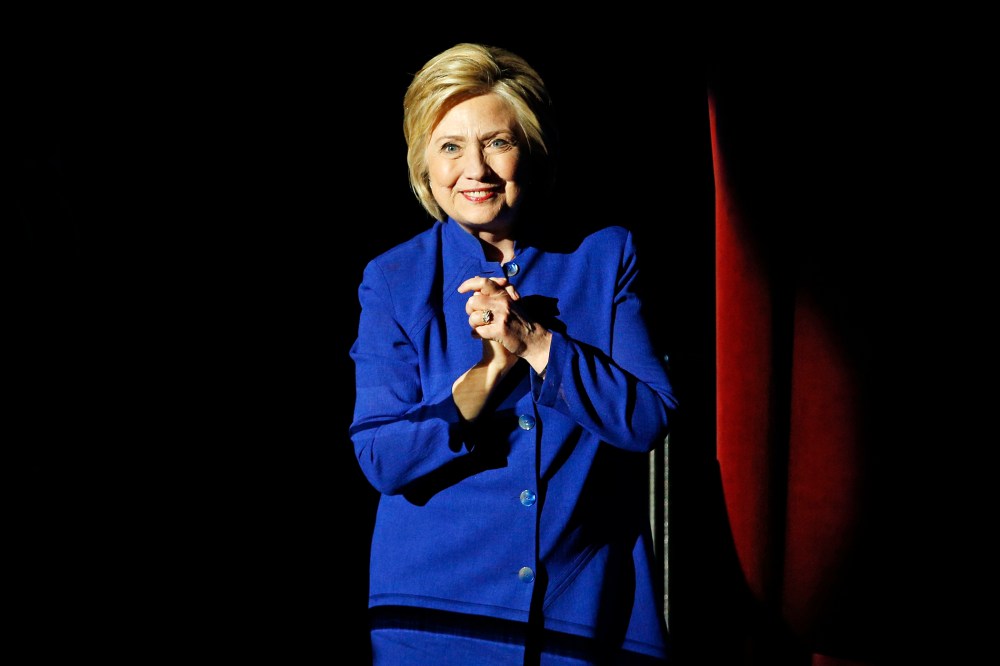
In October, the rapper T.I. noted he could not vote for a woman for president. In explaining his reasoning, the 35-year-old tapped into some very longstanding — ancient, even — stereotypes of why women couldn’t lead.

“Not to be sexist but, I can’t vote for the leader of the free world to be a woman,” he said. “Just because, every other position that exists, I think a woman could do well. But the president? It’s kinda like, I just know that women make rash decisions emotionally – they make very permanent, cemented decisions – and then later, it’s kind of like it didn’t happen, or they didn’t mean for it to happen. And I sure would hate to just set off a nuke.”
It rarely shows up so overtly, but this would have been a familiar trope to Hillary Clinton, whose misty eyes in New Hampshire in 2008 generated a thousand thinkpieces about women, emotion, and fitness for leadership. Syndicated cartoonist Pat Oliphant pictured Bill Clinton narrating before a sobbing Clinton, “This is when PMS goes nuclear.” On “The O’Reilly Factor” in 2008, a guest was asked what the downside was to a woman being president. The response: “You mean besides the PMS and the mood swings, right?” The supposed volatility of women because of their biology was what Donald Trump was tapping into when Megyn Kelly’s debate questions displeased him: “There was blood coming out of her eyes, blood coming out of her wherever.”
There is no readily available biological explanation for Donald Trump’s tempestuous behavior. But the fact that the first woman major-party nominee is running against this most unusual candidate means that one major factor used against women has been taken off the table. In the Democratic primary against Bernie Sanders, it was said often that Clinton had to be exciting. Now, it seems, her campaign will run as if she is the safe and steady one.
RELATED: No one wanted Hillary Clinton to win this way
It’s worth stopping and reflecting on this point: Faced with a man who changes his policies on a dime, who has dispensed with any normal semblance of a campaign, it is the woman — the first woman, possibly —who will be positioned as the reliable one.
This is not subtext. It’s in the text of the speech Clinton gave last week directly taking on Trump’s foreign policy, such as it is. “We cannot let him roll the dice with America,” Clinton said. She added, “Do we want him making those calls – someone thin-skinned and quick to anger, who lashes out at the smallest criticism? Do we want his finger anywhere near the button?” She presented herself as the battle-tested candidate, the deliberative one: “Unlike him, I have some experience with the tough calls and the hard work of statecraft.” So much for the danger of letting a lady have the nuclear codes. Clinton might as well have accused him of going through male menopause. In order for Clinton to seem relatively normal as a woman in office, she has had to become familiar, with years in public life and by running for the nomination a second time after a near-miss. And she has followed in the footsteps of women who never got this far, most of whom were treated as freaks. (Another political cartoonist, Thomas Nast, labeled Victoria Woodhull, the first woman to run for president in 1872, “Mrs. Satan,” and she was referred to as a witch and a harpie.) A hundred years later, Shirley Chisholm became the first black woman to run for the presidency. “I stand before you today, to repudiate the ridiculous notion that the American people will not vote for qualified candidates, simply because he is not white or because she is not a male,” Chisholm said at her campaign launch. “I do not believe that in 1972, the great majority of Americans will continue to harbor such narrow and petty prejudice.” Whether or not she was wrong about the great majority of Americans, Chisholm did not win the nomination. Forty-four years later, Clinton is asking American voters to agree that a woman of her experience and qualifications is the solid and substantial choice. Is America ready? “I think we are always more ready than we may think we are, and I do think we’re ready,” Teresa Younger, president of the Ms. Foundation, told MSNBC. “And if we waited for the country to be quote unquote ready for whatever change needed to happen in our society today, we wouldn’t be where we are today. Because change is hard for people.”
Irin Carmon Recommended


