









When Democrat Lincoln Chafee told a group of mostly young journalists and even younger college students that if elected president he would convert the U.S. to the metric system, the response in the room was laughter.
Virtually every other country in the world uses the metric system. But for this millennial audience, the idea of the U.S. making a switch seemed on par with the moon colonies of Newt Gingrich’s 2012 presidential campaign.
For critics who have followed Chafee’s political career more closely in Rhode Island, it was entirely in character. “He is very consistent in his bizarro world. That was not a bad day. It’ll come up every day,” said Steve Laffey, who challenged Chafee in the 2006 Republican Senate primary. (Chafee was a Republican until 2007.) “He’s a good guy, he’s just odd,” Laffey added.
RELATED: Lincoln Chafee comes out swinging at Hillary Clinton in 2016 speech
Chafee framed his push for a switch to metric as a way for the U.S. to improve its status in a world where every country except Liberia and Myanmar uses the metric system. Despite that goal, it’s hard to find anyone — including metric advocates — taking Chafee’s proposal seriously.
That’s because measurement is woven into to the most fundamental parts of life, from how Americans cook our food (in Fahrenheit), commute to work (in miles), build our homes (in feet), and clothe ourselves (in inches). It would take an enormous psychological change and a huge expenditure of political capital to convert a country of 315 million people to metric.

Few — outside Chafee — seem think it’s worth the cost.
That was, in fact, the argument against converting made in the 1970s by former Rhode Island Sen. John Chafee, Lincoln Chafee’s father, who said the government had far more important issues to tackle than metrication, as the conversion is known.
In addition, even advocates for the metric system concede that American exceptionalism and its cultural identity are bad fits for a francophone international measurement system.
“We have this thing where the metric system is seen as un-American. It’s a really emotional issue for some people,” said Paul Trusten of the U.S. Metric Association, which has been leading the charge for metrication for the past 99 years.
When the Federal Highway Administration announced in 1977 that it was going to start putting kilometers on signs, it was inundated with 6,000 public letters, many from people who saw the system as communist plot. “This change to the Metric System is just part of the Communist Diversionary to keep our country in an uproar,” wrote a man from Kansas City.
Conservatives and even anti-establishment liberals clubbed Jimmy Carter with metric, and when Reagan essentially killed the conversion in 1982, the board responsible for pushing metrication conceded there was “overwhelming” opposition.
RELATED: The six most-Googled questions about Lincoln Chafee
Still, Trusten is glad Chafee is raising the issue. ”It’s been silent for so long, and now people are talking about it,” he said.
For those familiar with the history of the metric system in the U.S., Chafee’s idea is both more and less serious than it might appear.
Technically, but only technically, metric has been the official U.S. measurement standard for more than 100 years. In 1893, after a fire in London damaged the original British Imperial Yard — the physical metal bar that determined for the world how long three feet should be — the U.S. federal agency in charge of measuring stuff started defining U.S. measurements in relation to their metric counterparts.
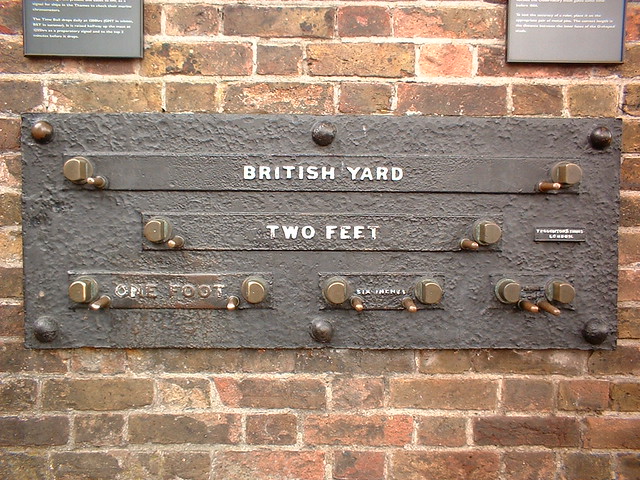
Since then, a foot is officially defined as 0.3048 of a meter. A pound is 453.59237 grams. “We’ve actually been on the metric system since 1893, in a sense,” Trusten said.
For American metric advocates, widespread adoption seemed tantalizingly just over the horizon for decades or more. The closest the U.S. came to conversion was in 1975, as other countries were going metric and trade groups, scientists, engineers and others successfully lobbied Congress to follow suit. Two days before Christmas that year, President Gerald Ford signed a law making metric “the preferred system of weights and measures for United States trade and commerce.”
“To say that this legislation is historic is an understatement,” Ford declared. But there were warning signs, even then. RELATED: Meet the newest Democratic presidential candidate The next four presidents offered lip service instead of real action to move forward with metric. Finally, in the face of political opposition and status quo bias, momentum petered out to almost zero kilogram meters per second (the metric measure for momentum). The U.S. Metric Association maintains a tally every time metrication is mentioned in the press and academic journals. The graph elegantly shows the rise and fall of the metric movement in America. Like a cartoon mountain, discussion of metrication starts near zero around the turn of the 20th century, then peaked in the mid-1970s, before falling back towards zero by the turn of the turn of the next century. The rise and fall of the metric system in the United States. pic.twitter.com/B9NilcGxVn In 1982, Reagan defunded and abolished the U.S. Metric Board, which was supposed to spearhead conversion. That signaled the beginning of the end for metric conversion, even though Reagan six years later signed an omnibus law that, tucked deep inside, contained a measure stipulating the metric system “be used, to the extent economically feasible, in Federal agency’s’ procurements, grants, and other business-related activities.” So some parts of the federal government have adopted metric, others still use the old system. A federal law requires consumer products packages to list both. That helps explain why wine comes in 750-milliliter bottles, while beer comes in 12-ounce cans. Nyquil comes in 8-ounce bottles, but its active ingredients are measured in milligrams. Soda is available in both customary and metric, with 20-ounce and 2-liter bottles. But widespread adoption never regained momentum, even after a conversion error between inches and centimeters was blamed for the crash of NASA’s $125 million Mars Climate Orbiter in 1999. Adam Toobin, who founded Students for Chafee at Brown University in Rhode Island, Chafee’s alma mater and the school where he taught classes between stints as senator and governor, acknowledged metric may not be the most obvious way to fire up young people. “I support it in theory, totally,” he said. “It’s not the perfect issue. The Internet would make a lot of fun with that one.”
Alex Seitz-Wald Recommended


