








President Obama’s re-election means that his most important legislative achievement, the Affordable Care Act (ACA), can’t be repealed for the next four years. But that doesn’t mean Republicans have given up their fight against the law. With repeal no longer on the table, they’re switching to a strategy of trying to chip away at Obamacare, in order to weaken it so badly that it all but ceases to function.
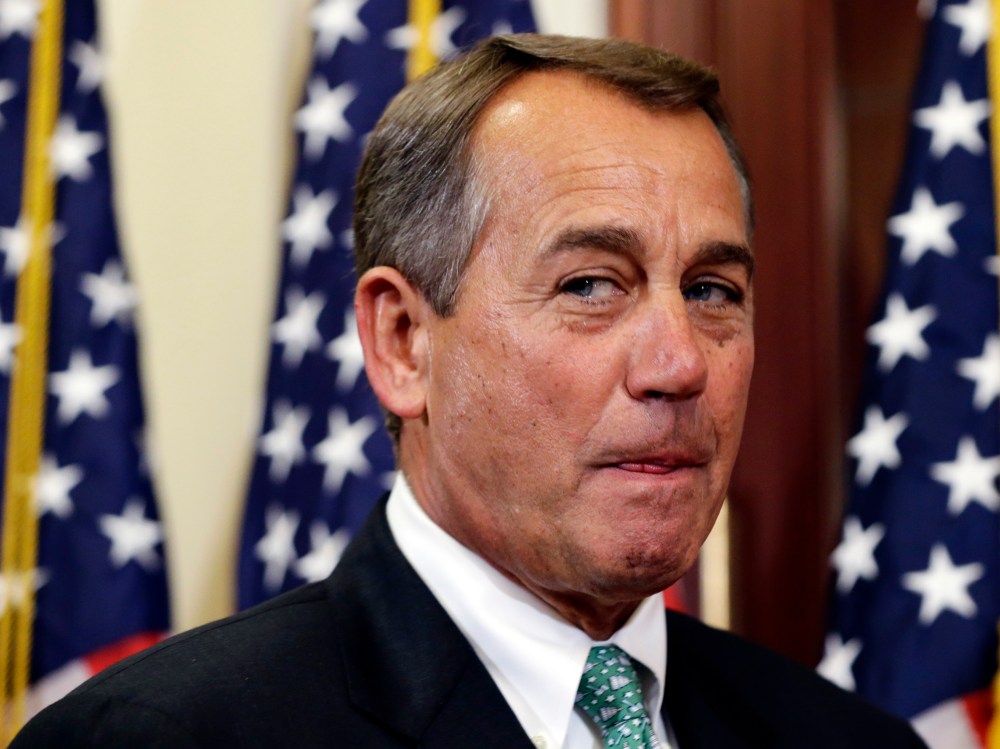
House Speaker John Boehner previewed the plan in an interview Thursday with ABC News. Asked whether the House would continue holding votes to repeal Obamacare, Boehner said GOP lawmakers would instead pivot to attacking individual pieces of it.
“It’s pretty clear that the president was re-elected, Obamacare is the law of the land,” said Boehner. “I think there are parts of the health care law that are going to be very difficult to implement and very expensive and at a time when we’re trying to find a way to create a path toward a balanced budget, everything has to be on the table…There are certainly maybe parts of it that we believe need to be changed.”
For the benefit of his Tea Party lawmakers, Boehner’s office followed up by issuing a statement confirming that he’s still committed to all-out repeal. But it’s clear his comments to ABC reflected the actual path he’ll try to follow. And he even hinted at the two main of ways of going about it: selective repeal of the law’s component pieces, and cutting funding—under the aegis of deficit reduction—for its implementation.
Here’s what health policy experts say that’ll look like:
Republicans’ biggest weapon against the ACA is their power over the federal government’s purse strings. As Boehner and Obama negotiate over a deficit reduction package to avoid the “fiscal cliff,” the GOP is demanding cuts to entitlement programs, including Medicaid. That means they’ll likely target Obamacare’s expansion of Medicaid eligibility—one of the key ways the law extends coverage to the uninsured. (At the state level, Republicans are already trying to weaken the Medicaid expansion, by refusing to participate, after the Supreme Court ruled that states could opt out.)
And the GOP could also go after funding for the law’s other major mechanism for expanding coverage: the subsidies for buying insurance that go to everyone making less than 400% of the poverty level.
Similarly, Republicans could cut funding for operating the state health insurance exchanges that are essential to Obamacare’s implementation. “[Republicans] will try to defund administrative spending, at federal and state grant levels, to implement exchange operations,” predicts Len Nichols, director of the Center for Health Policy Research and Ethics at George Mason University. (Again, Republicans at the state level are also trying to undermine the exchanges, by refusing to set them up.)
Republicans also may go after the Independent Payment Advisory Board (IPAB). That’s the body—demonized by conservatives as “death panels—established by Obamacare to find ways to reduce the growth in the cost of Medicaid. The powerful doctors’ lobby has expressed concerns that the IPAB could infringe upon doctors’ autonomy. The House already passed such a bill in March, and the GOP could now ramp up pressure on Senate Democrats to pass it as well. Experts say such a bill might have a chance of becoming law, unless President Obama pledges to veto it.
The GOP could also target the Centers for Medicare and Medicaid Innovation, which tries to find ways of replacing the current system, in which health care providers make more money for providing more services, with systems that pay for the best treatment—thereby reducing costs and leading to better outcomes, but threatening the interests of powerful health care industry players. “They will probably try to clip the Center for Medicare and Medicaid Innovation’s wings, again through [cuts to] administrative funding of the Centers for Medicare and Medicaid Services and other oversight hurdles and hassles, because this unit is leading transformation of payment in ways that could end fee for service medicine,” says Nichols. “The friends of fee for service–proceduralists, device companies, aggressive underwriting insurers–would all prefer the status quo and they have contributed major money to the Republican backlash against the ACA.” And congressional Republicans have the power of oversight. That could allow them to hold hearings and conduct investigations designed to damage Obamacare in the public mind, in order to be able to run against it again in the future. “If Republicans have thought about their strategy, they’re going to be trying to position themselves for the 2014 races,” notes Kavita Patel, a health policy expert at the Brookings Institution who worked in the Obama White House. “It is probably in their best interest to point a shining spotlight to show how things are not working.” Patel said Rep. Darrell Issa, who has used his post as chair of the House Oversight Committee to aggressively go after the administration, is likely to play a leading role. “Look for Issa to give out letters like crazy,” she said. “He will probably call on administration officials left and right [to testify before Congress.]” Indeed, the effort to chip away at the ACA is already underway. House Republicans are pushing a bill to exempt some of the money insurance companies spend from the ACA’s 80% “medical loss ratio.” In plain English, this is the requirement that health insurers spend at least 80% of the revenue they collect from premiums on actual health care, rather than on overhead. Insurance brokers, who help some individuals select a health insurance plan, get paid a finder’s fee by the insurance companies. With that finder’s fee coming out of the 20% that companies are allowed to spend on administrative costs, brokers worry they will be put out of business. So they have successfully lobbied congressional Republicans to propose a carve-out for them. (The bill would increase the federal budget deficit by roughly $1 billion over the next decade, a CBO report found last week.) In other words, the battle over Obamacare isn’t over. It may have only just begun.
Ben Adler
Ben Adler is a journalist covering climate change, politics, policy and cities. He has written for The New York Times, The Washington Post, Politico, Yahoo News, Grist, and The Nation, among others. Recommended


