








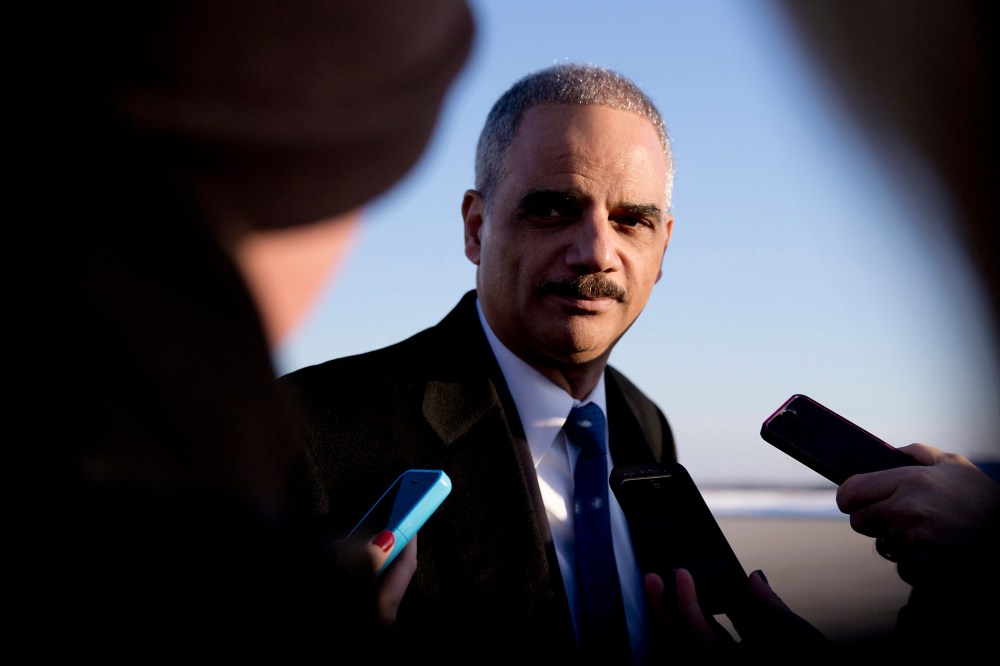
When Attorney General Eric Holder assumed office in 2009 he did so as part of the historic election of President Barack Obama as the nation’s first African-American president. But Holder was also making history in his own right as the first black U.S. attorney general. Holder said that civil rights would be central to his tenure and early in his term called America a “nation of cowards” when it comes to race relations.
He’s been heralded for challenging states that introduced sweeping new voting laws that threatened the voting rights of millions, for instituting new sentencing guidelines for non-violent drug offenders and talking openly and honestly about the plight of young men of color in the criminal justice system. But he’s also been a political lightning rod for right wing and conservative critics who say he and Obama have been racially divisive and for his role in the “Fast and Furious” controversy in which the Bureau of Alcohol, Tobacco, Firearms and Explosives (ATF) allowed thousands of guns to end up in the hands of Mexican drug cartels and at the scenes of Mexican crime scenes.
Related: Holder’s big investigations before departing
Holder announced his resignation last September, and as the protracted Senate fight over the confirmation of Attorney General designate Loretta Lynch comes to an end, Holder gave msnbc an exit interview last month in which he discussed his legacy, race and life after the Obama administration.
Some portions of the Q&A have been trimmed for clarity.
The Eric Holder Exit Interview
Trymaine Lee: What do you look forward to most as you prepare to step away from the Obama administration and into the next chapter of your life?
Eric Holder: What I look forward to is continuing the work. I’m still, in my own mind, a relatively young guy. I’m still sound of mind and ready to continue to do the things that have always interested me during the course of my career. Looking at the whole question of criminal justice reform, finding ways in which we build or rebuild trust between communities of color and people in law enforcement.
Those are the kind of issues that I want to work on and to come up with an entity of some sort, that would be associated with a larger body that would allow me the opportunity to continue this type of work and find allies — people who are in law enforcement, people who are representative of communities of colors, and other communities — so that we start with a dialogue and come in with concrete steps to really rebuild that relationship.
%22We%E2%80%99ve%20made%20mistakes%20as%20a%20nation%2C%20but%20generally%20we%E2%80%99ve%20corrected%20those%20mistakes%22′
TL: That sounds like a heavy lift, to continue the work that you’ve already been doing. But what about your family? What are they hoping for?
EH: I think my wife understands who I am, how I’m wound. She’s not surprised to hear me say this, and she’s supportive. In that way, I hope my kids understand that as well. That’s the way I’ve tried to raise them as well. I think you’re right, it is a heavy lift, but all things that are worth doing are generally heavy lifts. Getting the Voting Rights Act passed in 1965, that was a heavy lift.
We celebrated the 50th anniversary of the march across the Pettus bridge, that was a heavy lift; the ’64 civil rights act, that was a heavy lift. The whole Civil Rights movement, a series of heavy lifts. But, I think what we learned from the moment is that heavy lifts can be accomplished, if people are willing to work together, if people are willing to struggle, if people are willing to accept the fact that there are going to be disappointments along the way. I think some years from now, and it won’t simply be all from my efforts, some years from now, we could be in a much better place when it comes to law enforcement and their interactions with certain communities in this country.
TL: I was in Selma to cover the 50th Anniversary of the Selma to Montgomery march and the Voting Rights Act, and I saw you there with your son. Over the past 50 years, there have been many victories and many losses on the justice and voting rights fronts. Are your children entering a world that is more just than the one that existed 50 years ago?
EH: This is a country that has made great progress, but there is still more to do. The fact that we made progress, it is not in and of itself satisfactory. People have said we’ve made progress. Well that’s great, but we haven’t gotten to the place where we need to be just yet. We’re fundamentally a different country than we were 50 years ago — the fact that you’re speaking to the first African-American attorney general, serving in the administration of the first African-American president of the United States.
I look at my son’s generation, daughter’s generation, and I suspect that 50 years from now, our country will be in a much better place and closer to our founding ideals. I’m pretty optimistic about this and that’s one thing the people tend somehow not to get about me. I’m very optimistic about this country, its capacity for change and where ultimately we end up. This is a country that when it is at its best, questions itself. We’re critical of ourselves when we’re at our best. We’re not comfortable or happy with an unjust status quo. We’ve made mistakes as a nation, but, generally, we’ve corrected those mistakes.
TL: The black community has been tested recently: A number of unarmed young black men have been killed by police. There are deep disparities in access to quality education and jobs, and wealth inequality is steadily growing. During your time as AG, has your optimism been challenged?
EH: I’m not sure if my optimism was dampened, but it certainly made clear the nature of some of the problems that we still have to confront. There are issues in our criminal justice system that have to be confronted. It’s not just my voice, you’re hearing it from other places, maybe unexpected places. These incidents that we are talking about, the events that have occurred during my time as attorney general, have certainty been ones that have been trying, tested my optimism, but that optimism still remains. It was brought, I think, into a sharper focus for the nation as a whole.
The nature of the issues we still confront, the reality we still confront — that’s why I’m really kind of surprised by at least some of the responses of the report that we did about the Ferguson police department. I thought our civil rights division folks did a great job. Fact based, couple of anecdotes, this was a fact-based report. If you didn’t think there weren’t issues that we still had to confront, you just had to look at the report. Look at the way those statistics tell you the nature of the problem, of the extent of the problem that we still have to confront. Those who would criticize or try to make light of it, I think are doing a great disservice to our nation. %22I%E2%80%99ll%20leave%20here%20with%20my%20head%20held%20high%20and%20with%20confidence%20that%20history%20will%20judge%20my%20time%20here%22′ TL: You’ve spoken bluntly about the ongoing struggles that you have just mentioned, but it seems that you’ve also had to weather critics who call you a racist. How have you as a black man, as the first black attorney general, had to manage all that? EH: You have to disassociate yourself from the noise and focus on the work. There are always going to be critics, and they’ll come at you from a variety of perspectives. Some criticism is good — you learn from people who are criticizing you in a constructive way. You change processes, policies, policy, initiatives, and the basis of that is good, valid criticism. A lot of it you simply dismiss as that sort of political posturing, where it might be coming from a more pernicious place. You understand what that’s about. You know I’m 64 years old. I was born in 1951. My father served proudly in World War II and was discriminated against while he wore the uniform of this country. The world I live in is substantially better than the world he lived in. I still have not lost faith in this country, or lost that optimism that I have about where this country ultimately is going to end up. TL: Does any of it sting, particularly the racialized stuff? EH: It doesn’t sting me in that sense. There are times when I’ll get mad. I will be angered about things I’ve heard said. I think of a senator speaking to a right-wing talk show host and questioning my intelligence. I’ve got to tell you: That’s one that I thought, “If I was a different attorney general would that comment have been asked? Would that response been given?” And you have to think, “What is it that you have to do to get beyond even that base level?” I’ve went to some pretty good schools, competitive schools, I’ve accomplished a fair amount in my life. I thought, there’s one that didn’t sting, that pissed me off. Related: Holder on the anniversary of ‘My Brother’s Keeper’ TL: How have you grown, changed, or evolved in those six years? EH: I think it’s been an interesting six years — there’s been good days and bad days. I think there’s been more good than bad. I’m proud of the record that we have established when it comes to civil rights, voting rights, LGBT issues, how we have kept this nation safe, the national security sphere. We’ve done so in a way that’s consistent with our values. This is a job, it’s a tough job. When you’re an attorney general, you’re at the meeting of the policy and the law. If you’re attorney general, you’re subject to criticism for a variety of things. I’ve been in the Justice Department a long time, since 1976, in some form or fashion. I came to this job steeled for what I could expect to deal with, having been deputy attorney general in the Clinton administration. I’ll leave here with my head held high and with confidence that history will judge my time here as attorney general as both consequential and positive for the resolution of a lot of issues that this nation has faced for a number years. TL: Surely there were many high moments, but was your lowest moment? EH: The lowest was the day when I was in Newtown. I went to that school where those young people were killed. I was there with some first responders and crime scene search officers, and there were a lot of tears from hardened 20-year-veteran police officers, men and women. Tears on my part as we tried to wrap … our minds around it. We could see there was still blood on the walls, we could see places in the carpet where the bullets had gone through. That was by far the worst day I had as attorney general.
Trymaine Lee
Trymaine Lee is an NBC News correspondent. Recommended


