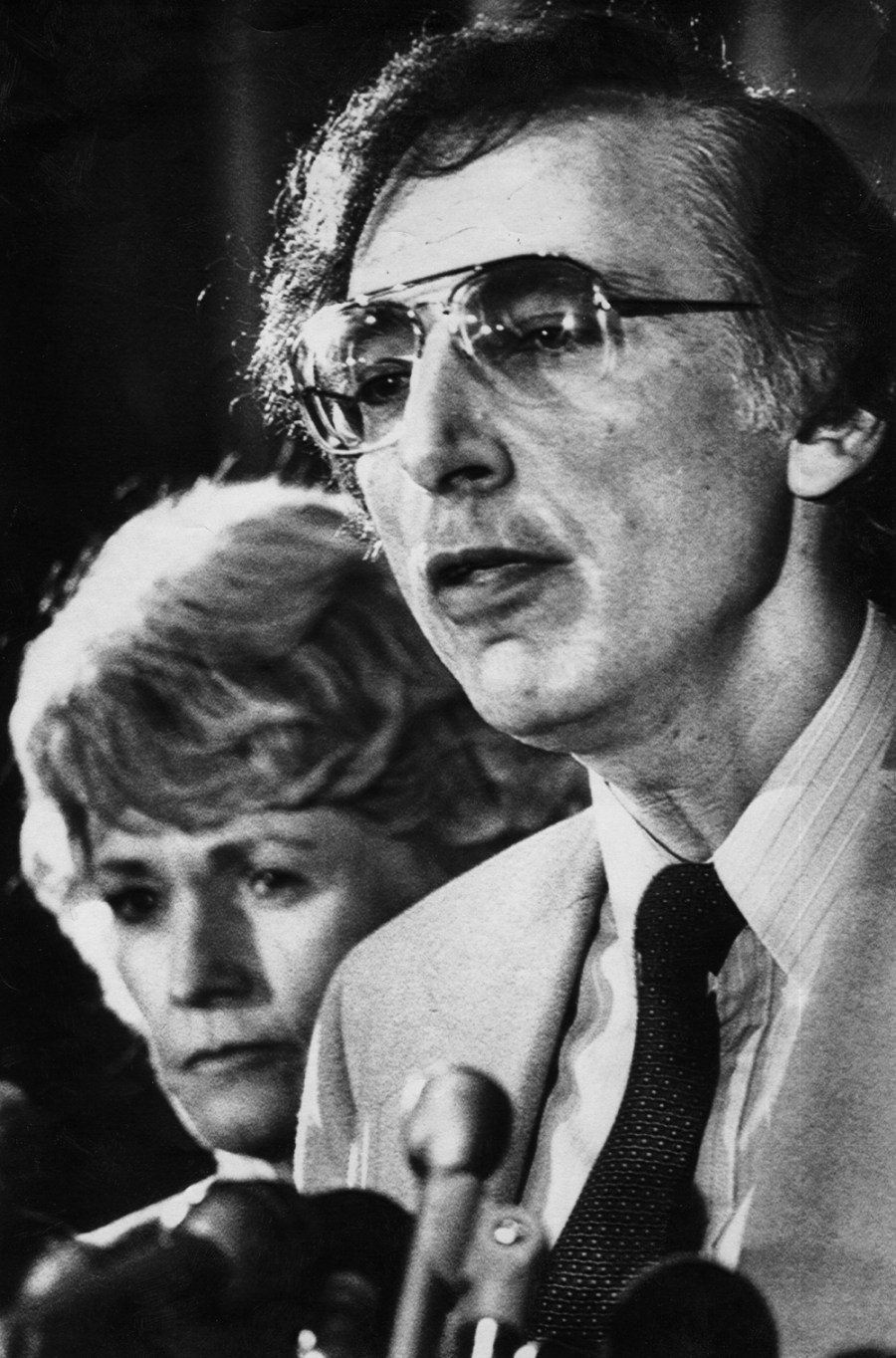
%22First%2C%20the%20probable%20cause%20of%20AIDS%20has%20been%20found%3A%20a%20variant%20of%20a%20known%20human%20cancer%20virus.%20Second%2C%20not%20only%20has%20the%20agent%20been%20identified%2C%20but%20a%20new%20process%20has%20been%20developed%20to%20mass%20produce%20this%20virus.%20Thirdly%2C%20with%20the%20discovery%20of%20both%20the%20virus%20and%20this%20new%20process%2C%20we%20now%20have%20a%20blood%20test%20for%20AIDS.%20With%20a%20blood%20test%2C%20we%20can%20identify%20AIDS%20victims%20with%20essentially%20100%25%20certainty.%22′
That was Margaret Heckler, President Ronald Reagan’s Health and Human Services Secretary, rocking the world 30 years ago this morning. Her hastily arranged press conference was full of blunders—she jumped the gun by several weeks because of a press leak, claimed U.S. credit for what was partly a French discovery, misidentified the newly discovered virus, and predicted that a vaccine would be ready within two years (we still don’t have one). Yet the announcement had epochal impact. It revealed the source of what would soon become one of the worst plagues in human history, and it sparked scientific and social revolutions that are still playing out today.
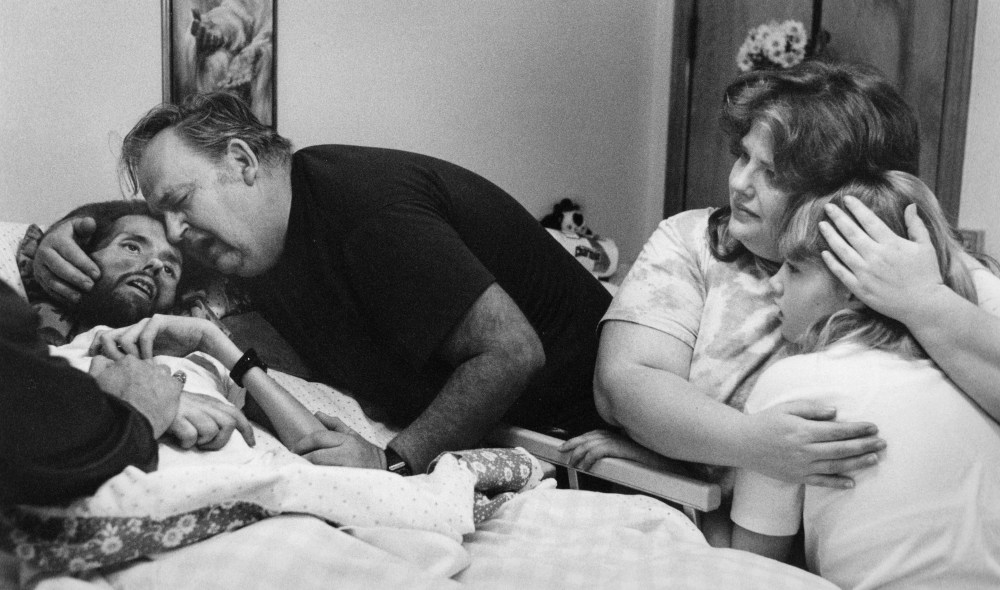
Three years earlier, in the spring of 1981, a ghastly new disease had exploded in the gay communities of New York, Los Angeles and San Francisco. It eviscerated people’s immune systems, allowing normally harmless pathogens to consume them. Though initially dismissed as a “gay plague,” it had begun killing hemophiliacs and injection drug users, as well as their partners and newborns, and it was spreading worldwide.
PHOTO ESSAY: Treating AIDS around the world
The cause was still a mystery, and ignorance was fueling fear and stigma. San Francisco cops had started wearing masks and gloves to shield them from gay men, and right-wing commentators were shaming the afflicted for their wickedness. “The poor homosexuals,” Pat Buchanan wrote in the New York Post in 1983. “They have declared war on nature and now nature is exacting an awful retribution.”
A 1983 New York Times story captured the growing sense of helplessness. “In many parts of the world,” wrote medical correspondent Lawrence Altman, “there is anxiety, bafflement, a sense that something has to be done—although no one knows what—about this fatal disease whose full name is Acquired Immune Deficiency Syndrome and whose cause is still unknown.”

By isolating the culpable virus, and developing a reliable test for it, researchers had suddenly cleared a path from superstition to reason. Almost overnight, the discovery helped scientists explain how AIDS spread and how it did not. It enabled rich countries to secure their blood supplies and reduce hospital infections. And though science has yet to produce an effective vaccine, it has made the infection survivable. The first anti-HIV medication, a failed cancer drug called AZT, reached the market in 1986, and by 1996 a three-drug cocktail had turned a death sentence into a manageable chronic condition.
The science advanced swiftly, as researchers elucidated HIV’s structures and survival strategies, but public attitudes evolved slowly. Fear and ignorance reigned for years (the Ryan White saga is but one memorable example). And as science spawned new tools for prevention and treatment, rich countries kept the benefits largely to themselves. Congress and the NIH spent $10 billion a year on the domestic response during the 1990s, while largely ignoring a burgeoning global crisis. From 1996 to 2000, annual AIDS deaths declined by nearly 60% in the United States (from 38,000 to 16,000). Yet the global toll rose by the same proportion during that period, growing from 1 million to 1.6 million a year.
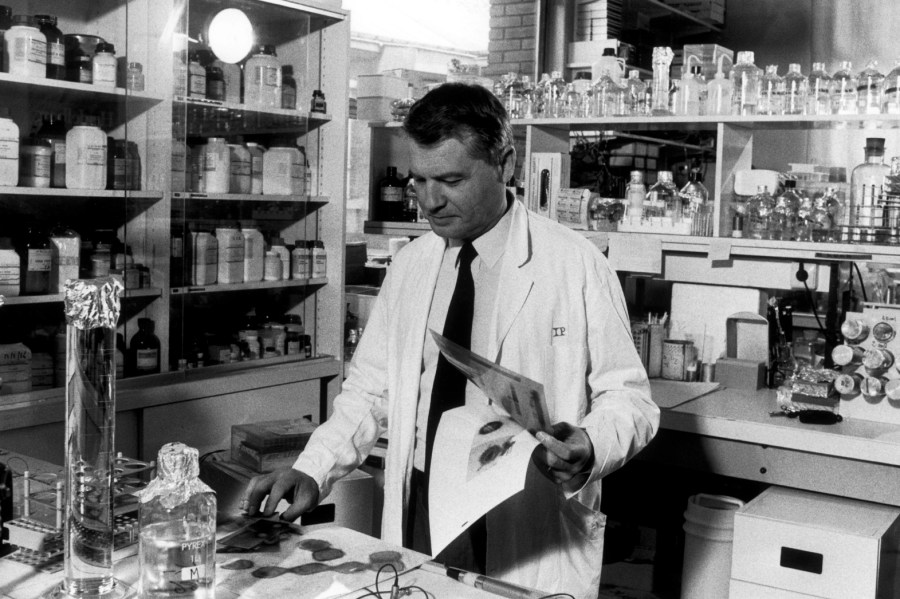
Rich countries had a collective awakening after the millennium, as the burgeoning humanitarian disaster started to ruin economies and destabilize governments. In 2002, donor countries banded together to form the Global Fund to Fight AIDS, Tuberculosis & Malaria, and in 2003 President George W. Bush stunned the world by launching PEPFAR, a five-year, $15 billion effort to expand testing, treatment and prevention in 15 target countries. Thanks mainly to those initiatives, the number of people receiving HIV treatment in low- and middle-income countries grew 40-fold over the next decade, reaching 9.7 million in 2012. The global death toll has fallen steadily since 2004, when it peaked at 2.3 million, and the number of children born with HIV has fallen by half. All of this stems ultimately from the discovery Heckler announced 30 years ago. And for all the folly of the past three decades, we’ve advanced socially as well as technically. President Reagan never publicly uttered the word “AIDS” until 1987, when he threw his support behind a bill to bar people with HIV from entering the country. Sixteen years later, an equally conservative Republican president (George W. Bush) launched what would become the largest single-disease treatment initiative in history. Even Heckler’s ham-fisted triumphalism has lost its sting over time. Robert Gallo, the American researcher she hailed for discovering the AIDS virus, had in fact rediscovered a virus that was isolated in France and shared with his lab. It wasn’t the “known cancer virus” Heckler touted at the press conference but a previously unknown chimpanzee virus that had adapted to humans in West Africa and gone global as cars, trucks and airplanes made people more mobile. After several years of bitter feuding over credit for the breakthrough, Gallo and his French counterpart, Luc Montagnier, agreed to call themselves the co-discoverers of HIV. Montagnier’s team got the credit for isolating the virus, Gallo’s for conclusively linking it to AIDS. The Nobel Committee didn’t sign that treaty. In 2008, it awarded Montagnier and a colleague the Nobel Prize in Physiology or Medicine, snubbing the American team. “I’m a little down about it but not terribly,” the once-fierce Gallo told Science magazine, adding that the prize was well deserved. Montagnier made nice too. “It was important to prove that HIV was the cause of AIDS,” he said, “and Gallo had a very important role in that.”
Geoffrey Cowley Recommended