








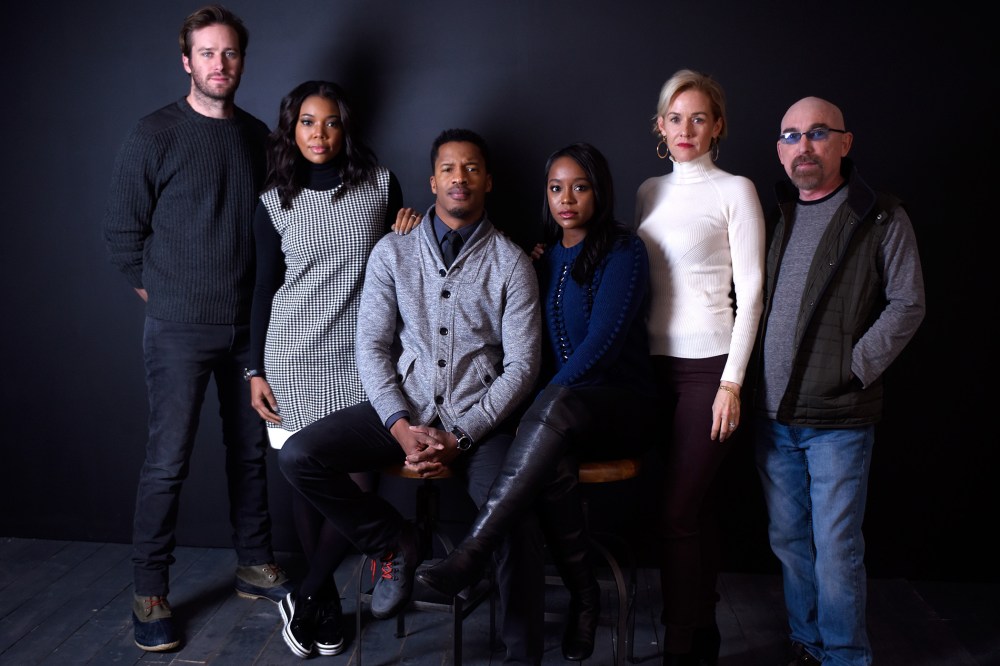
“The Birth of a Nation,” a likely-to-be incendiary new slavery-themed film, has broken the record for a Sundance Film Festival acquisition and been hailed by some critics as a potential “antidote” and “remedy” to #OscarsSoWhite.
Directed, written by and starring up-and-coming black actor Nate Parker, the film recreates the infamous 1831 slave rebellion led by Nat Turner, in reportedly vivid, unsparing detail. The movie, which received standing ovations prior to and after its screening at the Sundance Film Festival, was bought by Fox Searchlight for a record $17.5 million for distribution rights. Boasting strong reviews and already deafening buzz, some are already predicting that the film could be a player in next year’s Oscar races.
Ever since the Academy Awards failed to nominate a single actor of color for the second straight year in a row earlier this month, there has been considerable hand-wringing and finger-pointing within the industry. The perceived snub of black actors has led to calls for a boycott of the awards and the academy enacting significant reform in the make-up of the predominately white and male Oscar voting pool, which is, according to recent statistics, only 2.6% African-American.
RELATED: Chris Rock will have a second chance to take Oscars to task
Parker’s film, which is reportedly a seven-year labor of love, is part of a genre of race-themed films on the subject of slavery that has shown some traction when it comes to the Academy Awards. Steve McQueen’s film “12 Years a Slave,” also based on the true story of Solomon Northup, won best picture in 2014, and Quentin Tarantino’s blockbuster revisionist slavery revenge epic “Django Unchained” scored five nominations the previous year, winning two for best screenplay and best supporting actor.
Still, some, such as Slate writer Aisha Harris, have argued that this preference for films about a narrow, albeit significant, aspect of the black experience shows just how far Hollywood has to go. “Hollywood’s and the academy’s love affair—obsession, even—with celebrating black pain and history (rather than the black present) is well-documented,” she wrote recently, while lamenting the fact that many films on the subject “are about black people in relation to white people, while their nominations hinge on how they make white people feel—guilty, sad, better about their own perceived views on race.”
“The Birth of a Nation” may represent a true break from that trend. The film shares a provocative title with an influential and controversial 1915 D.W. Griffith silent film, which was a innovation in cinematic storytelling but also promoted the Klu Klux Klan as mythic heroes and portrayed African-Americans (played by whites in blackface) in crude, stereotypical fashion in an epic set in the post-Civil War south. This new film, unsurprisingly, presents a very different narrative of the so-called “peculiar institution” of slavery.
“If ’12 Years a Slave’ astutely mapped out both the ruthless economic machinery of American slavery and the complicity of white Christians who used the Bible to cow their slaves into silence, then ‘The Birth of a Nation’ delves even further into this unholy nexus of capitalism and religion, and Parker’s performance becomes a study in escalating outrage,” wrote Variety‘s Justin Chang in a rave review from Sundance.
“It was very difficult, for so many reasons,” Parker reportedly said during a Q&A at the legendary film festival, which has launched previous critical favorites like “Brooklyn” and “Boyhood” to Oscar glory. “I think anytime we’re dealing with our history, specifically with slavery, I find that it has been desperately sanitized. There’s a resistance to dealing with this material.” The 36-year-old Parker, previously best known to audiences for supporting roles in “The Great Debators,” “Arbitrage” and “Beyond the Lights,” allegedly refused several film roles in order to get this film financed and finished. In a sit-down interview with The Hollywood Reporter he said he was inspired by Turner’s story to some degree by the “injustices” he’s seen in his own lifetime. And while some say the film is imperfect, it is being universally hailed for starting a profoundly important conversation about race and American history at a time where the spotlight on the subject, and Hollywood’s handling of it, has arguably never been brighter. “I made this film for one reason: with the hope of creating change agents,” he told the Sundance audience, according to The New York Times. “That people can watch this film and be affected. That you can watch this film and see that there were systems that were in place that were corrupt and corrupted people, and the legacy of that still lives with us.”
Adam Howard Recommended


