








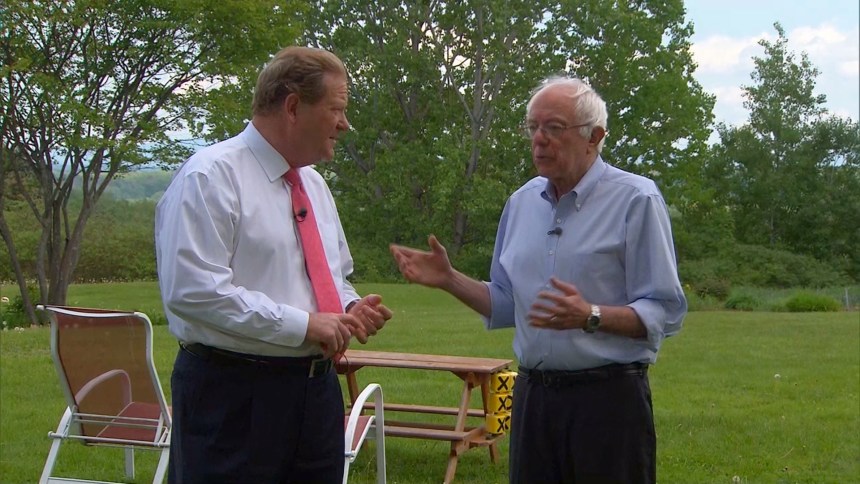
Sen. Bernie Sanders’ political memoir, published by the radical left-wing Verso Books in 1997, has been out of print for several years. It’s shot up in value on used book sites since Sanders announced his presidential campaign, with some sellers asking over $400 for an “extremely rare” paperback copy (it’s available for $65 on Amazon).
Co-written with University of Vermont English professor Huck Gutman, who would later go on to serve as Sanders’ Senate chief of staff, “Outside in the House” is centered around the democratic socialist’s 1996 congressional reelection campaign against Susan Sweetser, a top-tier Republican recruit whose red-baiting TV ads backfired.
The book also recounts, from his own perspective, Sanders’ decade in the political wilderness as a gadfly and perennial third-party candidate in the 1970s, along with his more successful eight years as mayor of Burlington from 1981 to 1989.
RELATED: Can Bernie Sanders take the ‘Burlington Revolution’ national?
In the genre of political memoirs, which tend to be bloodless recitations of carefully crafted rhetoric, Sanders’ is refreshingly candid and revealing. But it is still a political memoir and contains long stretches of the talking points Sanders has been selling his entire career — the same talking points now informing his 2016 presidential bid.
Here’s 25 things we learned from reading his book:
1. Bernie Sanders has been railing against the 1% for a long time. On the very first page of his book, Sanders recounts the speech he gave on election night in 1996 decrying “one percent of the population owning more wealth than the bottom ninety percent.” The Rutland Herald described it the next day as “vintage Sanders.”
He later writes: “Should we ever achieve economic and social justice in this country, I promise I’ll write some new speeches.”
2. He hates the media. Sanders reserves almost as much fury for mainstream media as he does for the 1%. “Big money interests own the media,” which does a “horrendous job” of informing people, he writes. Corporate TV “news” (in scare quotes) “insults the intelligence of American citizens daily, and is even further removed from the reality of everyday life than the average politician.”
In an era before the Internet sparked the proliferation of dozens of new political news outlets, Sanders worried about the consolidation of the press and called on Congress to “pass media antitrust legislation today.” Media conglomerates are “one of the greatest crises in American society” and “clearly a serious danger to our fragile democracy,” he adds.
RELATED: How Bernie Sanders won the talk radio primary
He also states that corporate parent companies of news organizations influence coverage, singling out NBC, which was at the time owned by General Electric. “Is it possible that the enormous financial interests of General Election corporation influence the news and programming of NBC? Frankly, you’d have to be very naive to believe otherwise,” he writes.
3. He once used “60 Minutes” to ambush the Associated Press. Sanders felt the local AP bureau in Vermont was giving him short shrift on coverage, so when a “60 Minutes” crew came to do a story on the socialist politician, he took the camera crew to the wire service’s offices so he could confront them. “It was delicious,” Sanders writes.
Later, when he was in Congress, a Vermont AP reporter went to Washington to do a story on whether Sanders was an effective congressman. The answer, apparently, was “no.” “You never beat the media,” he laments.
4. Bernie Sanders is not a Democrat. He may be running for president as a Democrat, but (at least when he wrote the book) he had no interest in being formally involved with the party. “There wasn’t a helluva big difference between the two major parties,” he writes.
%E2%80%9CThere%20wasn%E2%80%99t%20a%20helluva%20big%20difference%20between%20the%20two%20major%20parties.%E2%80%9D’
When supporters tried to put him on the Democratic ballot in a congressional reelection race, he was adamantly opposed: “If, by chance, I win the Democratic nomination I will respectfully decline. I am an independent and proud of it,” he said he told supporters.
One Democratic congressional opponent passed around an opposition research document detailing “my less than flattering observations on the Democratic Party,” Sanders writes. “I have been extremely critical of the Democratic Party,” he writes at one point.
5. He was the country’s only independent mayor. He was elected “in opposition to the two major political parties” and was also later the first independent elected to Congress in 40 years. But being an independent meant “choosing not to be the spokesperson for the American socialist movement.”
6. He was once slapped by a Democrat. Sanders writes that he “participated in a formal Democratic Party function for the first and last time time in my life” to attend a Jesse Jackson presidential campaign rally in 1984.
When Sanders spoke at the rally, “a number of old-line Democrats staged a silent protest by standing up and turning around as I delivered my speech.” But it got worse: “When I returned to my seat, a woman in the audience slapped me across the face. It was an exciting evening.”
7. Sanders had a complicated relationship with Bill Clinton. “Without enthusiasm, I’ve decided to support Bill Clinton for president. Perhaps ‘support’ is too strong of a word,” he writes of the 1992 presidential campaign.
“Do I have confidence that Clinton will stand up for the working people of this country — for children, for the elderly, for the folks who are hurting? No, I do not,” he writes. But he decided that Clinton was better than the alternative and would give progressives time to “build a movement” — and perhaps one day run a presidential candidate of their own.
RELATED: Why Bernie Sanders is something to look forward to
Once both were in office, Sanders convinced Bill Clinton to meet with the leadership of the “Independent Caucus” in Congress — which consisted of only Sanders – since the president regularly met with the leadership of both parties. He found Clinton to be receptive and intelligent.
8. Sanders ran a proudly amateur political operation. While this has since changed, he took pride in refusing to hire a professional political consultant for many years. Two of his oldest advisers were professors of poetry and religion at the University of Vermont.
%22%E2%80%A6%20I%E2%80%99ve%20decided%20to%20support%20Bill%20Clinton%20for%20president.%20Perhaps%20%E2%80%98support%E2%80%99%20is%20too%20strong%20of%20a%20word.%E2%80%9D’
He did almost everything in-house: His radio ads were written and recorded at his kitchen table with friends; his TV ads (including a famous 5-minute long spot of him speaking with his wife) were made by documentary filmmaker friends; his pollster was another friend with no background in the practice, who used the volunteer phone bank as callers.
Sanders now uses professional consultants, but his presidential campaign’s two top officials are Vermonters who have been with him for a long time.
9. Sanders owes his interest in politics to his brother. Sanders’ older brother, Larry, who is now a left-wing politician in the UK, “introduced me to political ideas.” “You opened my eyes to a world of ideas that I otherwise would never have seen,” Sanders writes in the acknowledgement.
10. His first Senate run was basically a lark. Sanders had been involved in the Civil Rights movement and “radical politics” since college. But not long after moving to Vermont, he dropped by a meeting of the Liberty Union Party on a bit of whim. “An hour later, I had won the nomination as the Liberty Union candidate for the open Senate Seat.” (No one else ran).
Despite a fairly disastrous first radio interview, he found he “enjoyed the experience of running for office very much.” He has barely stopped in the intervening 44 years.
11. But he’s not a big fan of campaigning. “In the middle of a campaign it seems that everything comes to the fore. All your neuroses, all your fears, all your weaknesses,’ he writes candidly about something many politicians probably feel. “It is depressing and debilitating.” 12. He’s got an unusual resume. Sanders was a carpenter before he got into politics, and later wrote, produced, and sold “radical film strips” and other education materials to schools about people like Eugene Debs. Sanders still has a portrait of Debs on the wall of his Senate office, and calls him a “hero of mine.” Debs founded the American Socialist Party and ran for president six times, unsuccessfully. Sanders wrote and produced a documentary about the socialist and fought to get it aired on Vermont’s PBS station. 13. And he holds some head-turning positions. The Vermont senator is “pro-gun, and pro-hunting,” and opposed the Brady Bill to because he thought handgun wait times should be decided by states. The National Rifle Association gave Sanders a major assist in one race went it targeted his opponent. But by 1994, the NRA turned on Sanders, distributing “Bye, Bye Bernie” bumper stickers and running ads against him. As mayor of Burlington, Sanders made opposing property taxes a cornerstone of his campaigns, worked to cut government spending, and earned a critical endorsement from the police officers’ union. 14. Sanders didn’t own a suit when he was elected mayor. He won his first mayoral race in 1981 by just 10 votes, but “an immediate crisis” presented itself — he had nothing to wear. “I didn’t own a suit,” he writes, so he went shopping for clothes more “suitable for a mayor.” 15. He was “flat broke” when he was elected to Congress in 1990. He and his wife, Jane, “borrowed some money from a friend” so they could go on vacation to Mexico for a week after he won his first congressional race. They had no money. When he left City Hall, thanks to self-imposed term limits the year earlier, “I didn’t get any job offers.” (He ended up teaching at Harvard’s Kennedy School). 16. He had a socialism-inspired softball team. Sanders had a softball team called the “People’s Republic of Burlington” and won against “the business community.” 17. He helped make Burlington a progressive utopia. Vermont’s largest city now has arts programs, music festivals, park land development, bike lanes, readings from Noam Chomsky and more. 18. He used to be a “Sandernista.” As mayor, Sanders attracted national attention and controversy for supporting the socialist Sandinista government in Nicaragua, which was fighting a proxy war with the United States under Ronald Reagan. In 1985, he became the highest-ranking American official to visit Nicaragua at the time, and met with President Daniel Ortega. In his book, he called the trip “profoundly emotional” and praised Ortega. Burlington and Managua, Nicaragua’s capital, became sister cities. 19. Sanders honeymooned in the USSR. Sanders married his current wife, Jane, in May of 1988 and the next day left for their “romantic honeymoon” to Yaroslavl, in the then-Soviet Union. The trip was an official delegation from Burlington to cement the two cities’ sister-city relationship. “Trust me. It was a very strange honeymoon,” Sanders writes. %22Trust%20me.%20It%20was%20a%20very%20strange%20honeymoon.%22′ He also visited Cuba with Jane in 1989 and tried to meet with Fidel Castro, but it didn’t work out and he met with the mayor of Havana and other officials instead. Sanders is proud of Burlington’s international diplomacy efforts. “Burlington had a foreign policy because, as progressives, we understood that we all live in one world,” he writes. 20. Richard Nixon and Bernie Sanders have something in common. When Sanders was elected to Congress in 1990, he ended up being assigned to the House office once occupied by former President Richard Nixon when he served in the lower chamber. 21. C-SPAN had to change for Sanders. The cable channel had only ever recorded votes for Democrats and Republicans in the past. Sanders was the first independent elected to Congress in 40 years, so C-SPAN had to add a new column when displaying votes for Independents, even though he was the only one. 22. He admired Newt Gingrich. Newt Gingrich is a brilliant, articulate political strategist,” Sanders wrote. “I disagree with everything that Gingrich stands for, but I was impressed by the scope of his vision. He thinks big.” 23. But not John Boehner. “John Boehner, chairman of the House Republican Conference, threatened to kill himself if the minimum wage increase was passed. He didn’t. Where is Republican honor when you really need it?” 24. He played a tiger’s butt and The New York Times wrote about it. Then-Rep. Sanders participated in a production of Vermont’s Bread and Puppet Theater, the street theater outfit known for its giant puppets at left-wing protests. Sanders performed as “the hind end of a large tiger puppet” — “It’s better than being a horse’s ass,” he notes — and the Gray Lady wrote a story about it. 25. Sanders is a savvier politician than many give him credit for. It’s hard enough to be elected as part of a major party, but let alone as independent democratic-socialist. He essentially created his own political party in Vermont to get allies elected to the Burlington City Council after Democrats on the body refused to work with him. In Congress, he created the Congressional Progressive Caucus to advance his agenda. Today, it’s largest Democratic Party caucus in the House.
Alex Seitz-Wald Recommended


