








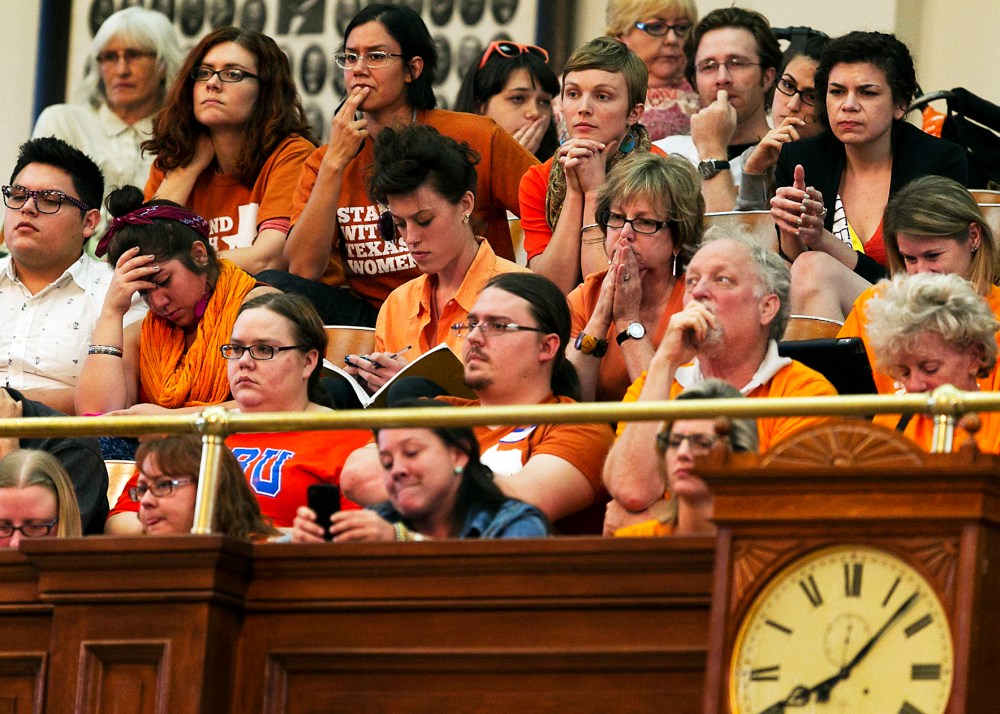
A majority of Justices on the Supreme Court have refused to temporarily halt a provision of a Texas abortion law that is expected to prevent a third of the state’s abortion clinics from providing that service. That means the law will immediately go into effect, pending an appeal expected to take place in January.
The law is part of the omnibus abortion bill that Wendy Davis famously filibustered, but was ultimately unable to block in a second special session. The next stop was a federal district court, which said that the provision requiring abortion providers to have admitting privileges at hospitals within 30 miles was unconstitutional and lacked a rational medical basis. It issued a stay blocking immediate enforcement. But the conservative Fifth Circuit lifted that stay, leaving the clinics and groups like Planned Parenthood, the Center for Reproductive Rights and the ACLU little choice but to appeal to the Supreme Court.
All five of the Justices appointed by Republican presidents, including Justice Anthony Kennedy, joined in the order to let the law go forward; all four of the Justices appointed by Democrats said they would have waited until the court had fully considered its constitutionality.
In a concurrence, Justices Scalia, Clarence Thomas and Samuel Alito stuck to the technical aspects of how and when the highest court can overturn an order from the appeals court. But the dissent, authored by Justice Stephen Breyer, pointed out that there was more at stake than just procedure.
“The balance of harms tilts in favor of applicants,” Justice Breyer wrote, meaning the abortion providers and civil liberties groups. The state waiting a little longer to implement the law if it were found constitutional, he said, paled in comparison to “the potential for serious physical or other harm to many women whose exercise of their constitutional right to obtain an abortion would be unduly burdened by the law. And although the injunction will ultimately be reinstated if the law is indeed invalid, the harms to the individual women whose rights it restricts while it remains in effect will be permanent.”
The ruling disappointed groups representing abortion providers. “We are not giving up on Texas women,” said Louise Melling, deputy legal director of the ACLU. “If the constitutional right to abortion means anything, it must mean that laws like this one that prevent women from obtaining an abortion must be invalidated. This is a very disappointing decision, but we will continue to do everything we can to protect the health and rights of Texas women.” And Nancy Northup, president and CEO of the Center for Reproductive Rights, said, “The promise of our constitution and our judicial system is the equal protection of our rights against attacks like this law singling out women and the doctors they depend on. Today’s decision fundamentally fails to fulfill that promise for Texas women.” Texas Governor Rick Perry celebrated the ruling. “This is good news both for the unborn and for the women of Texas, who are now better protected from shoddy abortion providers operating in dangerous conditions. As always, Texas will continue doing everything we can to protect the culture of life in our state.”
Irin Carmon Recommended


