








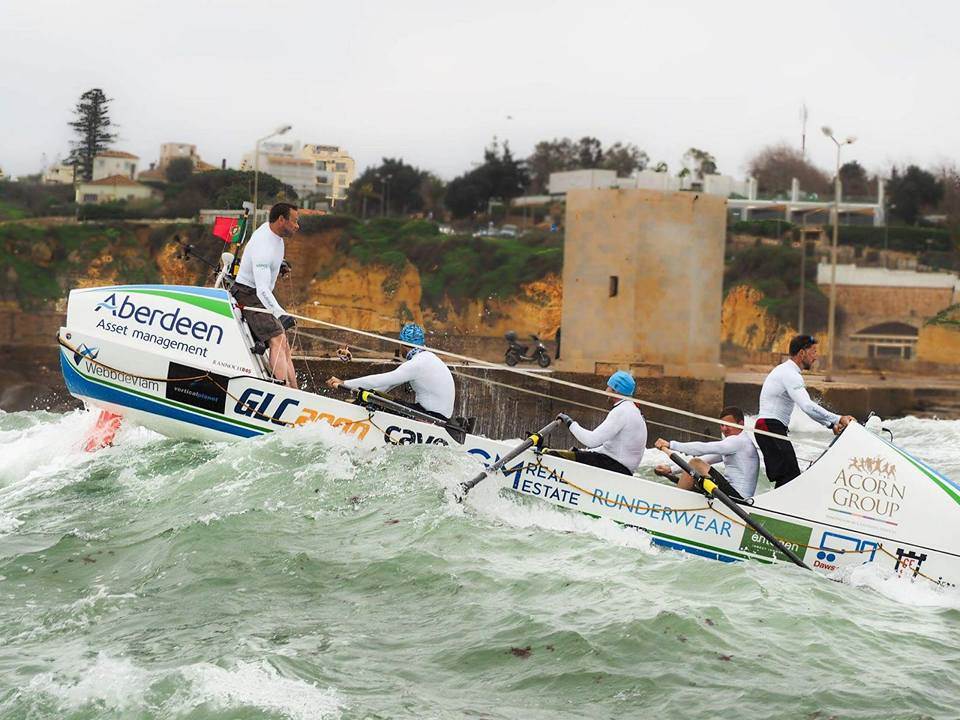
More people have made it to outer space than accomplished this crew’s mission: rowing 3,807 miles, nonstop, across the Atlantic Ocean.
“In fact, more people have actually been to the moon than have rowed from mainland Europe to mainland South America,” expedition captain Mathew Bennett says with a broad smile.
Bennett’s team of five amateurs plans to row 24 hours a day, rotating through two-hour shifts, in what they hope will become a record setting 52-day journey to the shores of Venezuela to raise money for charity.
Their attempt has inspired awe and even encouragement from the International Space Station. As hundreds gathered to watch Bennett and his British crew depart from the coast of Portugal on Sunday, British astronaut Tim Peake delivered a message from the final frontier above.
“Good luck to the boys in the boat below,” he tweeted. “The biggest test of your lives starts today.”
Good luck to the boys in the boat below. Time to grab an oar and be counted, @teamessencerow – the biggest test of your lives starts today.
— Tim Peake (@astro_timpeake) February 7, 2016
The stakes are enormously high. Their tiny carbon fiber rowboat has neither a back-up engine nor life raft. There is no support team trailing behind to rescue them if things go wrong. All they have is each other: five fit forms packing a combined 1,000 pounds of muscle, will and humor to power themselves from one continent to another in the dead of winter.
Bennett and his men will be battling through frigid temperatures in the air and sea, tethered to their deck to face waves up to 40 feet high and winds of up to 40 mph. The prospect of sharks and crossing paths with container ships also pose potential risks for the crew.
“I’d had a very good career and instead of rewarding myself with something material, I wanted to do something different,” Bennett explained. “Cars come and go, houses come and go. You appreciate them for a short while, but then it fades… A memory like this is never going to fade. We’ll take it to our graves.”
His first step post-finance was to establish a network of children’s care homes around the world — and this row is an extension of Bennett’s dedication to helping vulnerable kids.
Who’s involved
Bennett carefully curated his crew, casting characters he felt possessed both the physical and mental fortitude to endure the grueling adventure.
“It’s the right time, the right place and the right bunch of guys,” he said. “We’re all turning 40, and I wanted to do it while we still could.”
Bennett admits it took a “little bit of persuasion and a lot of beer,” but over the course of several years “Team Essence” was formed.
What an amazing send off! @teamessencerow farewell drinks. @Jasonfox1976 @Turbobail @R0SSJ0HNS0N @AldoKane pic.twitter.com/rkarwzE5ks
— Mathew Bennett (@mattbennett79) January 25, 2016
That meant they trained intensively for the journey, humoring themselves with the hashtag #ihaterowing on social media as they prepared for the attempt.
Four of the five men have served in the British military, so the group decided to adopt the Royal Marine Commando ethos for this adventure.
“Courage, determination, unselfishness and cheerfulness under adversity,” says Aldo Kane. “Anyone can be like that on a good day, but it’s on the bad days when it really counts.”
Kane previously served as one of the British military’s youngest snipers and now provides rigging and safety for TV and film in extreme environments.
“We’re actually completely comfortable in the complete uncomfortableness of it all,” he mused.
The strain of the journey
“Uncomfortable” may turn out to be an understatement given the extreme physical demands of their row.
“I expect my body to be completely broken by the end of this,” says team member Ross Johnson. Johnson — who also served as a young sniper in the Royal Marines and now owns a gym — expects to burn off at least 10 to 20 percent of his body weight at sea despite a planned diet of 5,000 calories a day.
The men have packed a total of 1.6 million calories worth of military-style rations, but have accepted that “physical destruction” is an inevitable consequence of the row, regardless of how much they eat.
There’s another dangerous element at play for a journey of this kind.
As Johnson put it, “90 percent of this is a mental battle.” This is our planned route across the #Atlantic going #Mainland2Mainland 52 days of rowing #ihaterowing pic.twitter.com/XJvtTZpzo6 “Part of getting over PTSD is acknowledging that it is actually a good thing, not a bad thing,” he says. Now a motivational speaker, he underscores the value of emotional intelligence and psychological resilience. “A strong person acknowledges their weaknesses,” Fox explains. He hopes his participation in this row with serve as an inspiration to those facing difficulties in their own lives. “Whether it’s someone having a sticky time with his confidence or someone that’s actually suffering from PTSD, if they can see me as someone that’s gone down that same path and came out on the other end then rowed across the Atlantic and is cracking on with life, that’s the target,” Fox adds. Why they’re doing it While Team Essence is keenly aware of the disconnect they’ll face — for most of their journey they’ll be physically closer to Peake and the International Space Station than anyone on the Atlantic shores — Oliver Bailey is looking forward to the solitude. The 39-year-old former philosophy major plans to focus on his “progression as a human” and hopes the row will be a “cathartic” break from his day-to-day pressures of investment banking. Bennett is excited about the lives the row might change: already, they have raised over $175,000 in donations for a U.K.-based charity for vulnerable kids. He hopes to raise double that by the time they reach Venezuela’s shores. There’s also a more immediate and deeply personal motivation that will be pushing Bennett onward. After his father’s diagnosis with terminal emphysema, Bennett wanted to express gratitude to his parents for raising him to believe in life’s endless possibilities. “They taught me to go for these things, that you can do whatever you want to do when you put your mind to it,” Bennett told NBC News. “Ever since I’ve been a child, my dad said the only regret you really have in life, generally, is the things you don’t do. Not things you do do.” After years of buildup and a final push training on the North Sea and off Portugal, he and his rogue crew set out on Sunday, armed with good-luck trinkets and letters from their girlfriends to be read at the halfway point. This is our view right now! Face to the sun @teamessencerow pic.twitter.com/DcELzSgwSM “I am the master of my fate: I am the captain of my soul.” This article originally appeared on NBCNews.com.
Jamieson Lesko Recommended


