








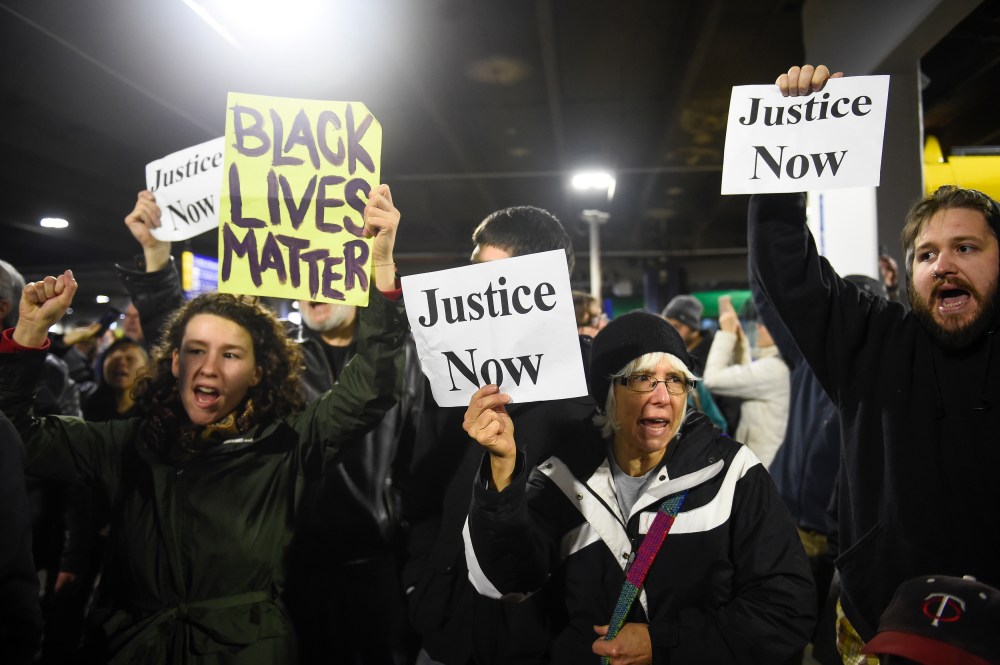
An Ohio grand jury’s decision not to indict the police officer who shot and killed 12-year-old Tamir Rice — and the national outcry surrounding the case — illustrates both the power and the limits of the “Black Lives Matter” movement that has emerged over the last two years.
As in the case of Rice, several of the recent widely covered killings of African-Americans by police did not result in punishments for the officers. The officer accused of choking Eric Garner to death in 2014 in Staten Island was not indicted by a grand jury, nor was the officer who shot Michael Brown in Ferguson, Missouri, a few weeks later.
RELATED: 2015: A year of great reform or great resignation
A grand jury also did not charge Texas officials with wrong-doing in the death of Sandra Bland, the woman who committed suicide in jail earlier this year after being arrested following a traffic stop that civil rights activists say was unnecessary. Earlier this month, a jury could not reach a decision in the trial of the one of the officers who was charged in the death of Freddie Gray in Baltimore, resulting in a mistrial.
While all of these cases had different facts (and some officers involved in similar cases have been charged and convicted over the last year,) the BLM movement has faced a major challenge: Current laws in most states give wide latitude for police conduct, particularly if the officer feels he or she is acting in self-defense.
But even if many officers are not being convicted, the protests, which are happening both online and in communities, are having an obvious impact.
The news coverage and surrounding attention on killings of African-Americans by police has been dramatically increased, with the Rice decision quickly becoming national news. The Washington Post and The Guardian, a newspaper based in London, have started tracking the number of people shot and killed by police officers. The U.S. government currently does not have an official count of police shootings of civilians, but it recently announced plans to compile such data, effectively shamed into doing so by those two news outlets.
Rahm Emanuel, who served in top roles in the Clinton and Obama administrations before becoming mayor of Chicago, is facing calls for his resignation amid protests over how he handled the death of Laquan McDonald, who was shot 16 times by a Chicago officer in 2014. Emanuel fired Chicago’s police chief amid the protests, and Chicago became the latest city under scrutiny by the U.S. Department of Justice for its policing practices.
According to Stateline, a non-partisan news organization that covers policy in states and localities, 26 states adopted new laws around policing in 2015, including provisions that increased crisis management training for officers and mandated more data collection on the use of force by police.
And the language of the BLM movement has strongly influenced American politics, particularly among Democrats. All three Democratic presidential candidates have uttered and defended the use of the phrase “Black Lives Matter,” as has President Barack Obama.
Hillary Clinton has called for a “New Deal” for minority communities, invoking the kind of federal intervention that Franklin Roosevelt used for the whole country during the Great Depression.
But civil rights advocates say the Rice decision illustrates that they have not made enough progress.
“This case is one of the most egregious examples of how the criminal justice system routinely fails in ensuring accountability for the needless killing of unarmed civilians at the hands of police,” said Janai Nelson, a senior official at the NAACP Legal Defense Fund. “Rather than ‘a perfect storm of human error’ as Cuyahoga County Prosecutor Timothy McGinty described this tragedy, Rice’s death and the lack of accountability for it are a result of racial profiling, incompetent 911 services, over-zealous and reckless policing practices, and a systemic bias in favor of police.”
RELATED: Officer who shot Laquan McDonald pleads not guilty to murder charges In a Twitter message, Deray Mckesson, one of the leading BLM organizers, wrote, “Justice is not an abstract concept. Justice is a living #TamirRice. Justice is a smiling #RekiaBoyd. Justice is no more death.” The policing debate, like most issues in American politics, is divided along partisan lines in many ways. Three of the leading GOP presidential candidates, New Jersey Gov. Chris Christie, Texas Sen. Ted Cruz, and Donald Trump, have defended officers and suggested the protesters focus too much on the small number of mistakes by the police instead of their positive actions. Another GOP candidate, neurosurgeon Ben Carson, said recently that Democratic president candidate Bernie Sanders, a U.S. senator from Vermont, was wrong to suggest Bland would be alive today if she were white. “I think we also have a tendency to inject race into everything,” he said. But there are some signs that the two parties could unify on some changes involving policing and criminal justice. Republicans in Congress and President Obama are negotiating a bill that would reduce sentences for some drug crimes. A number of Republican-led states, including South Carolina, have adopted changes such as mandating some police officers wear body cameras. The statement by Ohio Gov. John Kasich in the wake of the Rice ruling illustrated the changing politics around policing. he governor, who is also a GOP presidential candidate, may not have even felt compelled to issue such a statement two years ago, since state leaders often don’t make public proclamations about grand jury decisions. But on Monday, Kasich carefully tried to appeal to both the police and the civil rights community. “Tamir Rice’s death was a heartbreaking tragedy and I understand how this decision will leave many people asking themselves if justice was served. We all lose, however, if we give in to anger and frustration and let it divide us,” he said. “We have made progress to improve the way communities and police work together in our state, and we’re beginning to see a path to positive change so everyone shares in the safety and success they deserve. When we are strong enough together to turn frustration into progress we take another step up the higher path.” This article first appeared on NBCNews.com.
Perry Bacon Recommended


