








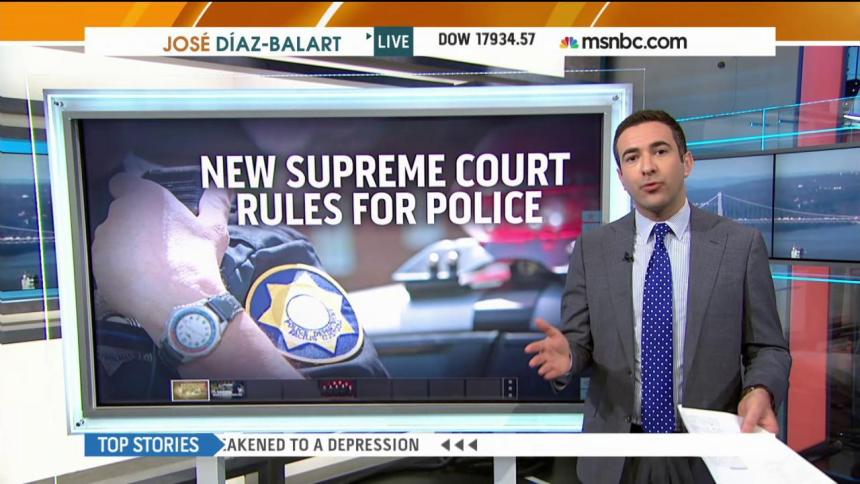
While the public debate over American policing has been roiling for months, a quieter debate has been playing out at the Supreme Court, which is now refining some of the rules that govern police conduct across the country.
During the court’s current term, which concludes at the end of June, the justices have already ruled on three cases regarding controversial police conduct. The court often sides with police, and frequently at the behest of the Obama Justice Department.
One of the recurring criticisms of aggressive or “zero tolerance” policing is that some officers stop people for little to no reason. The court recently weighed in on part of that controversy, taking a case about a traffic stop in North Carolina. An officer said he had a good reason for the stop – a broken brake light – and then he searched the car and found cocaine. But it is perfectly legal to drive with one brake light under state law, so a lower court threw out the cocaine evidence, reasoning it was discovered through an unjustified stop.
The Supreme Court reversed, however, ruling that officers can be mistaken about the law and still perform a valid search. Chief Justice John Roberts held that it was “objectively reasonable” for the officer think the broken brake light was illegal, so that mistaken belief met the legal requirement to justify suspicion for the stop.
While critics say that approach gives police even more power to conduct questionable searches, the decision was not very divisive within the Court.
Most of the justices agreed with Roberts, including Ruth Bader Ginsburg and Antonin Scalia. The only dissent came from Obama appointee Justice Sonia Sotomayor, who questioned at oral argument whether such lax rules invite more racial profiling. At bottom, she stressed in her dissent, the defendant in this case was literally stopped “on suspicion of committing an offense that never actually existed” (emphasis added).
The court reached a similar consensus backing San Francisco police in the shooting of a mentally ill woman inside a group home. Six justices, including Sotomayor and Ginsburg, ruled that the officers had qualified immunity for any injuries they inflicted on the woman, who had brandished a knife and threatened her social worker.
While the court is often sympathetic to the judgment calls that police make in the field, it did also rule against police this term, tightening limits on certain traffic stops.
RELATED: Mom of California man beaten by police: My son needed help
A Nebraska officer pulled over a driver for veering onto the shoulder of a highway, issued a ticket, and then asked for permission to search the car with a police dog. When the driver exercised his right to refuse, the officer did the search anyway, unearthing 50 grams of methamphetamine.
While the DOJ backed the police, proposing that routine traffic stops can be extended to include a dog search, six justices rejected that approach. In an opinion by Justice Ginsburg, the court essentially dialed back pre-textual searches, ruling officers can only detain citizens in a traffic stop for as long as it takes to check their information and issue a ticket – not to extend the stop into a wider search.
Ginsburg singled out and rejected the DOJ argument that an officer who performs a quick stop “can earn bonus time” to conduct extra searches that would otherwise be illegal. Just like the court’s other decisions siding with police, the opinion was a lopsided six to three. Taken together, these cases suggest some of the gaps between the political disputes over policing and efforts at national legal reform. Even in an administration critical of excessively harsh policing, the traditional presumption in favor of law enforcement has led the Justice Department to argue in favor of police in nearly every Supreme Court appeal. Neal Katyal, who led the Obama administration’s Supreme Court arguments, has said that given the Justice Department’s oversight of the FBI, Drug Enforcement Administration and federal agents, its “instinctive reaction” is to “support law enforcement interests.” He spoke to The New York Times for a report on the administration’s support for use of force before the court. Even apart from who leads the Justice Department, these cases also show that the court itself is less divided than the public. The court’s police decisions have not been closely split, unlike the five-to-four decisions on politically charged issues such as gun rights and Obamacare, and today’s more liberal appointees do not seem automatically skeptical of the police practices before the court. That’s a contrast to the 1960s, when Chief Justice Earl Warren led a more liberal bloc of judges to expand protections in criminal procedure. Today, many of those precedents seem almost sacrosanct, from the basic right to a lawyer in a criminal trial (1963) or interrogation (1964), which most Americans take for granted, to Miranda rights during an arrest (1966) or the right to privacy on a phone used outside the home (1967). By the 1970s, however, crime, unrest and “law and order” politics shifted the public mood and, ultimately, the composition of the federal judiciary. Today’s debates over Ferguson and Baltimore may be nudging the pendulum back a bit, with leaders in both parties calling for at least some reform. But every police department is governed at the local level, making the Supreme Court the only institution that can swiftly change the national boundaries for police, and it doesn’t look like it will be doing that anytime soon.
Ari Melber
Ari Melber, an Emmy Award-winning journalist, writer and attorney, is the host of “The Beat with Ari Melber” airing nightly at 6 p.m. ET on MSNBC. He also serves as MSNBC’s chief legal correspondent and an NBC News legal analyst. Before joining MSNBC, Melber practiced First Amendment law and served as a legislative aide in the U.S. Senate. He received a J.D. from Cornell Law School and is a member of the New York Bar. Recommended


