








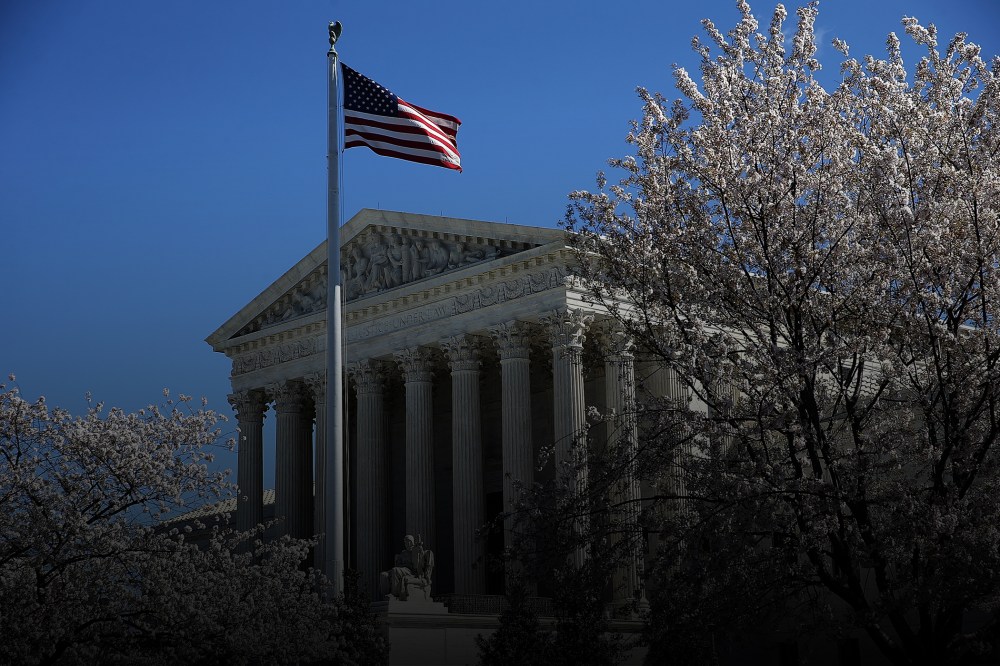
The U.S. Supreme Court heads into the final month of its term with decisions yet to come on such divisive issues as immigration, abortion, and affirmative action.
Those cases could produce major rulings affecting millions of people. But with just eight justices now on the bench, some could end in a modest decision or fizzle out in a four-four tie.
A tie vote would change nothing. It would leave lower court rulings in place, and it would not set any precedent. As a legal matter, it would be as though the Supreme Court never took the case.
Ties would also suggest that the court is hopelessly split between four conservatives and four liberals — an impression the justices have tried hard to avoid.
“The court has been grappling with how to function smoothly and collaboratively, and so far it has succeeded,” says Tom Goldstein, the publisher of the SCOTUSBlog website and a lawyer who argues before the court.
“There are blockbuster cases, but we may not get divisive blockbuster rulings.”
Immigration
The most closely watched is a challenge to President Obama’s proposed change in immigration rules, announced in late 2014, that would shield more than four million people from deportation.
Adults in the U.S. illegally could remain if they meet certain residency requirements and have children who are U.S. citizens or lawful permanent residents. It would also expand another program that allows young people to stay in the country if they were brought here under age 16.
But the changes have not gone into effect. Lower courts blocked the plan after Texas and 25 other states sued, claiming the president had no power to act on his own.
RELATED: Ruth Bader Ginsburg: Eight is not enough
A tie vote would leave that legal hold in place, and President Obama would be unable to put his policy into effect during the remainder of his time in the White House.
The Obama administration urged the court to rule that the states had no legal standing to sue in the first place, because immigration is strictly the province of the federal government. If the court agreed, that would toss out the lawsuit and allow the president to begin enforcing his plan.
Abortion
What could be the most important abortion case in 25 years is a challenge to one of the nation’s toughest restrictions on abortion.
Passed in 2013, a Texas law requires clinics providing abortion services to meet the same building standards as walk-in surgical centers. And doctors performing abortions must have admitting privileges at nearby hospitals.
Since the law was passed, the number of clinics providing abortion services in Texas dropped to 19 from 42, and could fall to ten if the state wins.
RELATED: Supreme Court Declines to Block Texas Voter ID Law
A federal appeals court upheld the law, and a Supreme Court tie would leave that ruling in place, allowing the state to enforce the restrictions.
The justices could also send the case back to the lower courts to get a clearer picture of how the law is affecting clinic operations.
Affirmative action Opponents of affirmative action in college admissions are hoping the Supreme Court will use a case from Texas to end the practice once and for all. Their target is the program at the University of Texas at Austin. A state law guarantees admission to the university for students in roughly the top 10 percent of the graduating class of any Texas high school. To fill the remaining slots — about one fourth of each entering class — the school considers several other factors, including an applicant’s race. That last step is the program now under court challenge. A sweeping ruling on affirmative action nationwide seems unlikely. A tie vote would be a victory for UT Austin, since it won in the appeals court. RELATED: Who are Trump’s potential Supreme Court picks? And even a vote on the merits of the case — either upholding the UT program or striking it down — could have a minor impact on affirmative action elsewhere if it’s tied to the specifics of the Texas system. “The court has found all kinds of creative ways of compromising and avoiding divisive and bitter fights,” Goldstein says. “Neither side seems interested in picking a public fight right now.” While a tie vote or even a modest ruling leaves the big legal issues unresolved, Chief Justice John Roberts said at a recent legal conference that he tries to achieve as much consensus as he can. “I think we should be restrained when we decide the issues when it’s necessary to do so,” Roberts said. The past few terms have ended with major decisions on gay marriage, Obamacare, and voting rights. This may end as the term of restraint. This story first appeared on NBCNews.com.
Pete Williams Recommended


