








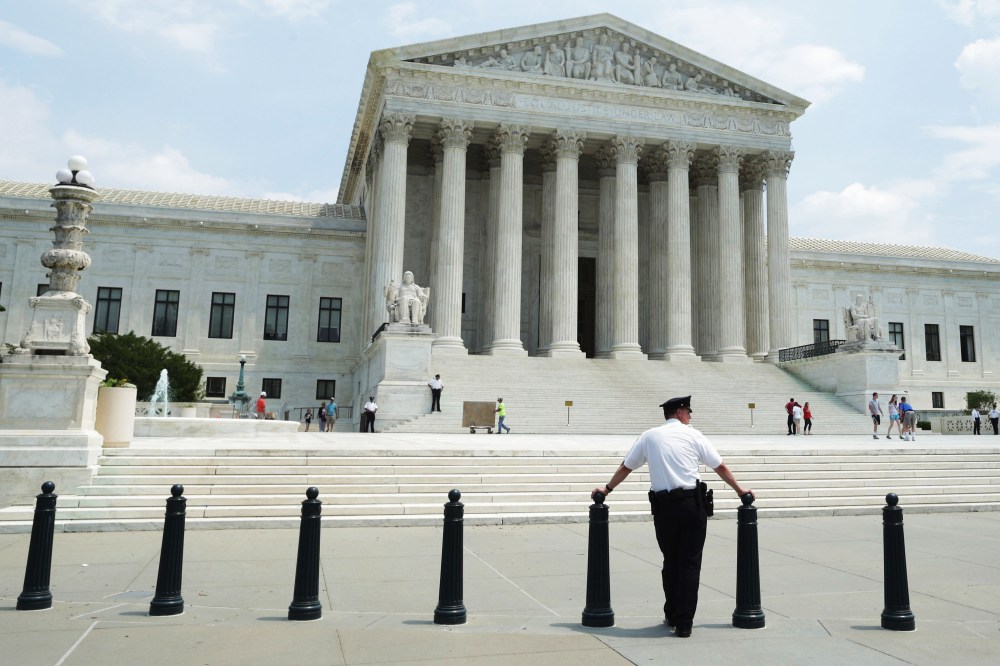
The future of public sector unions is in the hands of the Supreme Court, which is expected to rule Monday on a key case that could send shockwaves throughout organized labor.
The labor movement has lost plenty of battles over the past decade, but it is now facing a potentially devastating possibility: A nation in which state, local and federal government employees all labor under a national right-to-work system.
Right-to-work laws, which are now on the books in 24 states, make it illegal for unions to automatically deduct collective bargaining fees from the paychecks of the workers they represent.
The Supreme Court has the power to make that happen. Depending how the nine justices rule in the Harris v. Quinn case, it is possible that automatic fee deduction could become a thing of the past for public sector unions.
The head plaintiff in the case is Pam Harris, an Illinois-based home care worker who says automatic fee deduction violates her First Amendment rights.
For the purposes of collective bargaining, Harris — whose job consists of caring for her son in her own home — is an employee of the state. The union, SEIU (Service Employees International Union), that represents publicly employed home care workers in Illinois automatically deducts Harris’ contributions paychecks.
“I object to my home being a union workplace,” Harris told NPR in January, around the time the Supreme Court heard oral arguments in the case.
Yet labor advocates such as attorney Sheila Bapat, the author of a recent book on domestic worker labor rights, argue that it is well within the rights of public sector unions to deduct membership dues for the purpose of collective bargaining. In Bapat’s view, a ruling in favor of Harris would be potentially disastrous for other unionized home care workers.
“My overarching concern is over what this does to workers, and I think this case is wielding the First Amendment in a really damaging way against a program that has helped workers raise their wages,” Bapat told msnbc.
But Bapat argues that that judicial precedent favors SEIU and Illinois Gov. Pat Quinn in the case currently before the Supreme Court.
In the 1977 case Abood v. Detroit Board of Education, the Supreme Court ruled that the automatic deduction was OK if the money went toward servicing the union’s collective bargaining functions, but that union members had the right to object if their dues money was being used for other, explicitly political causes.
“If a union wants to spend 10% of its money on politics, for example, in a jurisdiction which is not a right-to-work jurisdiction, someone who objected to a portion of their dues being paid to politics would have a right to object,” said University of Toledo law professor Joseph Slater. In other words, unionized public employees can “opt out” of those expenditures, but not out of the basic costs of maintaining an organized bargaining unit in their workplace.
With that in mind, Slater said the Supreme Court is likely to rule in one of three ways. It could institute a de facto right-to-work system across the entire public sector; it could leave the law unchanged; or it could require that public employees explicitly “opt in” to political expenditures, rather than allowing unions to assume their consent until they opt out.
Of all those options, Slater called the first choice – national, public sector right-to-work – “the most potentially radical change.”
“If I was a betting man I would guess that they would not go that far,” said Slater. “The more likely thing they would do is go this ‘opt in’ route, where instead of affirmatively having to object to your being money being spent on politics, every individual member of the union would have to individually opt in.”
But the National Right to Work Legal Defense Foundation, which brought the case before the court, isn’t just arguing for an “opt in” system.
“The ideal outcome would be for union membership and dues payment to be completely voluntary and the choice of each individual,” said the group’s vice president for public information, Patrick Semmens, over email. He added that the Legal Defense Foundation has “similar cases in other states, although the outcome in this case may make the result of those cases largely a formality.” Home care workers are unionized in only a handful of states, but there is some evidence that collective bargaining improves their living standards and quality of life. A 2004 study by economist Candace Howes found that home care workers in California began to have a 57% lower year-to-year turnover rate after they unionized. That result, Howes argued, had much to do with “the nearly doubling of wages and the addition of healthcare benefits” that came about as a result of collective bargaining. “They gave us a voice, and we could negotiate our salaries and our benefits,” said Flora Johnson, a home care worker in Illinois. “Our benefits and our wages kept rising.” Johnson, 80, cares full-time for her 47-year-old son, who suffers from cerebral palsy. An employee of the state, she earned $5.40 per hour prior to joining SEIU in 2000; now she makes $11.85 per hour, and will soon get that bumped up to $13. “If we didn’t have a union we wouldn’t be getting the health care we have, we wouldn’t be getting any of that,” said Johnson. “So how can they say that it’s violating our rights? This is helping us.” A favorable outcome for the National Right to Work Legal Defense Foundation would send shockwaves through the entire labor movement, not just the public sector wing. Only 6.6% of the private sector is unionized, versus more than one-third of all government employees, making the public sector into one of the last fortresses of a declining labor movement. If that fortress were seriously breached, it could be a crippling blow to the labor movement at large. Yet Johnson, the 80-year-old Illinois health care worker, says she would still persevere. “We’re still going to fight and we’re still going to give quality care,” she said. “The decision, whichever way it goes, is not going to stop home care workers from organizing and sticking together. And there’s power in numbers.” UPDATE: Pam Harris is not an SEIU member, and collective bargaining fees paid by non-members are not referred to as dues. The article has been changed to reflect that.
Ned Resnikoff is an urban policy analyst, researcher, writer, and editor. His byline has appeared in a variety of publications, including the New York Times, San Francisco Chronicle, Dissent, and The Nation. He writes the newsletter Public Comment, which can be found at publiccomment.blog. Recommended


