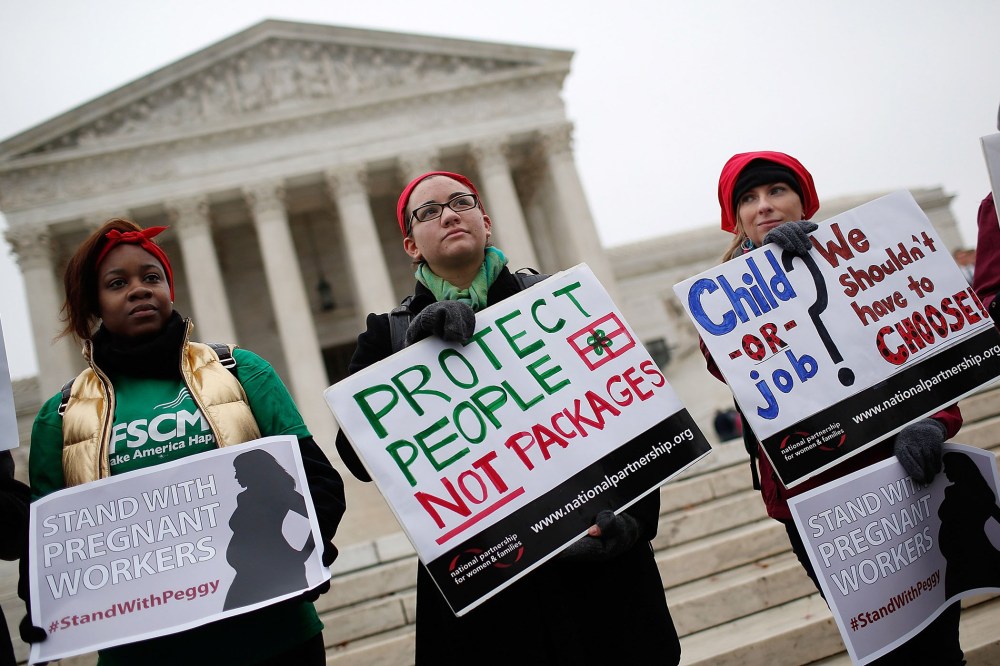
WASHINGTON, D.C. — Supreme Court justices hearing a case of alleged pregnancy discrimination today struggled over a key question: What does it mean to discriminate against a pregnant worker? Does it mean being “pregnancy blind” — treating them like anyone else, but drawing the line at any physical accommodation they might need — or does it mean treating them like other workers who have restrictions, like injured ones?
%22…%20what%20you%20are%20saying%20is%20that%20there%27s%20a%20policy%20that%20accommodates%20some%20workers%2C%20but%20puts%20all%20pregnant%20women%20on%20one%20side%20of%20the%20line.%22′
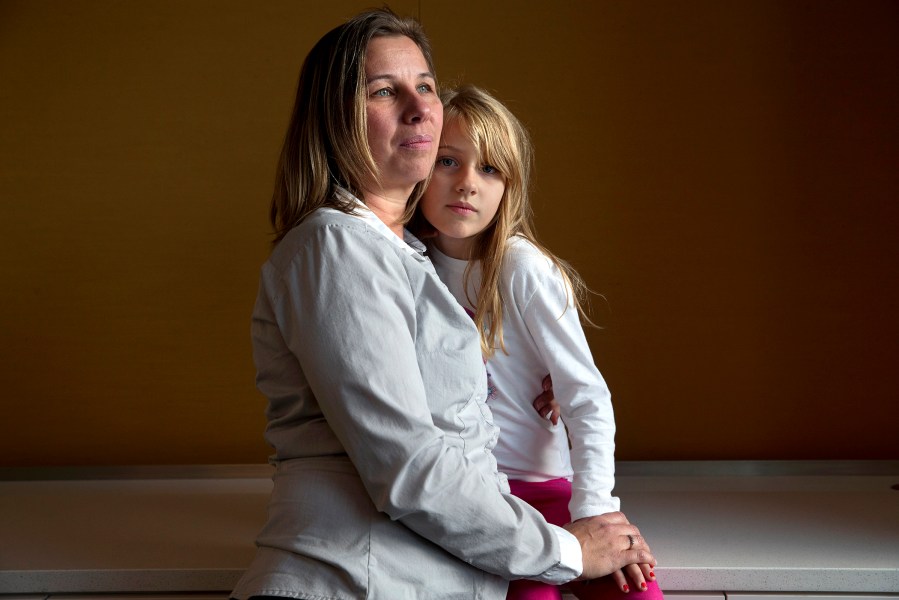
The justices seemed torn Wednesday on the case of Peggy Young, a former UPS driver who was put on unpaid leave when the company said it couldn’t accommodate her restrictions to not lift heavy packages. In oral argument, they focused on the meaning of a phrase in the 1978 law banning pregnancy discrimination, which says pregnant workers have to be treated the same as non-pregnant people who are “similar in their ability or inability to work.”
Young has argued that UPS violated that law by offering accommodations to people who were similar in their inability to work, like disabled or injured ones, but not offering such conditions to pregnant workers. UPS says all the law says is that you can’t specifically discriminate against pregnant workers, not that they have to do anything to help them stay on the job.
Justice Elena Kagan seemed troubled by the UPS position, argued Wednesday by Caitlin Halligan. In what turned into a two-person show between Kagan and Halligan, Kagan suggested that UPS was ignoring a huge chunk of the Pregnancy Discrimination Act.
Over a dozen states, including Young’s home state of Maryland, have passed laws specifically requiring employers to make reasonable accommodations, and federal legislation has been introduced to do the same. Halligan said that’s what’s required if pregnant workers want accommodations, not a Supreme Court reading of existing law.
“This is an area where the democratic process is working as it should,” Halligan said.
“Well, Ms. Halligan, for the democratic process to work as it should, the PDA has to be given a fair reading,” Justice Kagan retorted, referring to the Pregnancy Discrimination Act. “And what we know about the PDA is that it was supposed to be about removing stereotypes of pregnant women as marginal workers. It was supposed to be about ensuring that they wouldn’t be unfairly excluded from the workplace. And what you are saying is that there’s a policy that accommodates some workers, but puts all pregnant women on one side of the line.”
Kagan wondered whether there was a middle ground where an employer could come back and claim a legitimate purpose for not offering the accommodation, but a court would have to evaluate whether that was legitimate, similar to straightforward sex discrimination cases.
Several justices, notably Justice Stephen Breyer, pressed Young’s attorney Samuel Bagenstos to say where such an accommodation requirement would end. Was it enough to show that one other person got some sort of workaround?
If you have your senior employees driven to work when they are unable to drive themselves, you have to do the same for pregnant women,” said Justice Antonin Scalia. “Would you say that’s the case?” Bagenstos said that employers would still be allowed to differentiate among workers based on seniority, but they couldn’t discriminate on the basis of what caused a disability.
“The most important aspect of this case is that UPS provided accommodated work to basically anyone who has a lifting restriction of 20 pounds or more,” Bagenstos, a law professor at the University of Michigan, told msnbc before the hearing, “except when it results from pregnancy.”
%22…%20UPS%20provided%20accommodated%20work%20to%20basically%20anyone%20who%20has%20a%20lifting%20restriction%20of%2020%20pounds%20or%20more%20–%20except%20when%20it%20results%20from%20pregnancy.%22′
At oral argument, UPS disputed that, saying some workers were not accommodated. But Justice Ruth Bader Ginsburg pressed Halligan to be more specific. “Mr. Bagenstos has told us that there is not in this record a single instance of anyone who needed a lifting dispensation who didn’t get it except for pregnant people,” Ginsburg said. “And if that’s the case in fact, then you lose, don’t you?”
Halligan said the burden was on Young’s attorney to have asked for such an example. The case did not go to trial, with UPS having succeeded in getting the case dismissed on summary judgment.
“So why shouldn’t there be a trial on that or further proceedings?” said Breyer. “If it turns out that they’re right that there were four people who weren’t pregnant, and that’s all, who didn’t get the benefits, that’s pretty strong evidence that the employer is discriminating. If there were 400,000 people who got the thing off the job and there were only, like, 19 people on the job who got the benefit, well, then you have a better case.”
Solicitor general Donald Verrilli also argued that the court should take Young’s side, though the justices took note of the fact that the government had shifted its position from an earlier case in which it said such accommodations were not required.
UPS has since changed its policies to accommodate workers like Young, but it argued in its brief that the law does not “mandate accommodations or other special treatment for pregnant employees.”
Young’s side has drawn support from an unusual coalition of advocates for reproductive rights, who are used to advocating for the choices of pregnant women, and opponents of abortion, who justifiably worry women would be more likely to have abortions if their pregnancy cost them a job.
“Economic pressure is a significant factor in many women’s decision to choose abortion over childbirth. Protecting the ability to work can increase true freedom for women, promote the common good, and protect the most vulnerable among us,” wrote a coalition of anti-abortion groups, including Americans United for Life. And several reproductive justice groups that advocate for women of color submitted a brief pointing out that “black women disproportionately hold jobs that require physical exertion that may be unsafe while pregnant … Black women thus are disproportionately put to a Hobson’s choice between the economic security that their current jobs provide and the health of themselves and their children.” While this Supreme Court hasn’t exactly been friendly to workers’ rights, it’s an encouraging sign that the court took Young’s appeal. If the more conservative justices can overcome their distaste for regulating businesses, they have an opportunity to dispel the notion that they have a “blind spot” on women’s rights, as Justice Ruth Bader Ginsburg put it earlier this year. Some aren’t waiting for the court. In January, New Jersey Gov. Chris Christie signed a pregnancy accommodation bill into law, joining states like Connecticut, Hawaii, and California and cities like New York City and Philadelphia. There is also a federal bill, the Pregnant Workers Fairness Act, to guarantee such accommodations, though in the current Congress it faces an uphill battle. The bill is modeled on the Americans with Disabilities Act, which passed with bipartisan support and was signed by Republican President George H. W. Bush in 1990. But times have changed: The bill’s champion, Democratic Sen. Bob Casey of Pennsylvania, told msnbc in an interview there are no Republican senators supporting the Pregnant Workers Fairness Act and only “very limited” Republican support in the House. “You have some politicians in Washington saying they’re pro-family,” said Casey. “I don’t know how they square that.” Casey offered one theory: “They often reflexively oppose any kind of new regulations that relate to a workplace, what employers can’t and can do,” he said of his GOP colleagues. “That argument would be a lot more credible if you didn’t have the ADA for almost a quarter century now.” Bagenstos, Young’s attorney, wants the Court to declare that existing law already provides for such on-the-job accommodations. And he says it doesn’t just violate the Pregnancy Discrimination Act — it’s also sex discrimination. “The idea that pregnancy is the time when women leave the workforce is what Congress was trying to combat,” he said. “This is a holdover of the same kinds of attitudes that have been calcified in policy.” Indeed, an anti-abortion group that joined UPS’s side with an amicus brief pretty much spelled that out. The Eagle Forum, founded by Phyllis Schlafly, wrote in its brief that in banning discrimination against pregnant women, Congress didn’t mean “to eliminate stereotypes of husband-breadwinner, wife-homemaker families or “have pregnant women work as package-delivering truck drivers … [or] to privilege the status of female truck drivers over either male truck drivers or the women married to male truck drivers. While the eradication of typical – or even stereotypical – families was the goal of the feminist movement, Congress generally has taken the more moderate path advocated by UPS here.”
Irin Carmon Recommended