








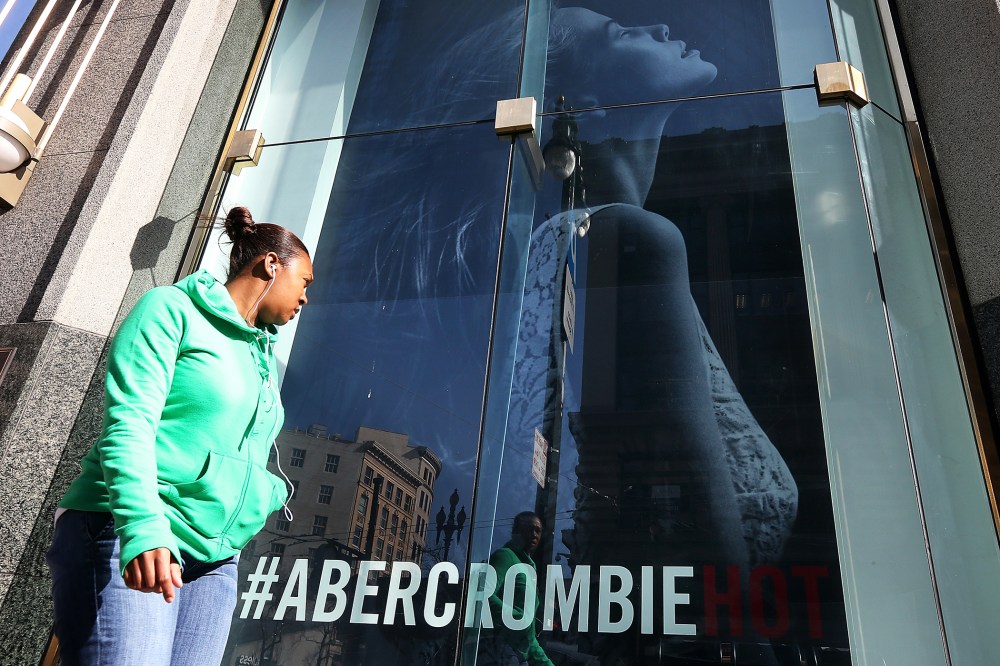
The Supreme Court said on Thursday it would hear the case of Samantha Elauf, a Muslim teenager in Oklahoma who was rejected from a job she applied for at an Abercrombie and Fitch store because her hijab didn’t meet their “Look Policy” for floor staff.
Abercrombie refers to its sales floor employees as “models,” who are supposed to conform with that “Look Policy,” which includes bans on “caps” and black clothing. Applicants are graded on a three-point scale of “appearance & sense of style.” Elauf, then seventeen years old, originally scored a two, but when a district manager learned she wore a black hijab, he had her score changed to a one, bringing her overall score low enough to disqualify her entirely.
Elauf, represented by the federal Equal Employment Opportunity Commission (EEOC), sued under Title VII of the Civil Rights Act, which prohibits employment discrimination on the basis of “race, color, religion, sex or national origin.”
Though Abercrombie lost at the district court, Tenth Circuit Court of Appeals ruled Elauf couldn’t claim religious discrimination because she hadn’t explicitly told her prospective employers she wore a hijab for religious reasons. That puts an impossible burden on employees, argued the EEOC: “Job applicants cannot be expected to request an accommodation when they are unaware that a conflict exists,” they said in their petition. Elauf was never formally told she wasn’t hired because of her hijab, even as Abercrombie employees assumed she wore one for religious reasons.
Violating the Look Policy with a hijab, said Abercrombie, “inaccurately represents the brand, causes consumer confusion, fails to perform an essential function of the position and ultimately damages the brand.”
In court, Abercrombie questioned whether Elauf even had a sincere religious belief because some Muslim women choose not to wear a headscarf and others wear one for cultural rather than exclusively religious reasons.
In 2013, Abercrombie settled two other cases of young Muslim women who were fired or not hired because they wore hijabs, and promised it would improve its religious accommodation policies. Mike Jeffries, still the CEO, recently became notorious again for 2006 comments about Abercrombie’s intended market: “We go after the attractive all-American kid with a great attitude and a lot of friends. A lot of people don’t belong [in our clothes], and they can’t belong. Are we exclusionary? Absolutely. Those companies that are in trouble are trying to target everybody: young, old, fat, skinny.” (These days, Abercrombie’s own business is itself “in trouble.”)
The Roberts court has not been particularly enthusiastic about Title VII, the most famous case being its rejection of Lilly Ledbetter’s pay discrimination case against Goodyear Tire because she hadn’t sued early enough, even though she hadn’t known she was being discriminated against. (That prompted Congress to act, in the first law signed by President Barack Obama.) In 2011, the court looked at 1.5 million female Wal-Mart employees who said they had been discriminated against as a class and shrugged. That opinion was written by Justice Antonin Scalia. Its end result was to make it that much harder for class action discrimination suits. In two cases in the term ending in June 2013, the Supreme Court made it significantly more difficult for employees to sue under it, with decisions written by Justice Samuel Alito and by Justice Anthony Kennedy. Each split procedural hairs on discrimination lawsuits, narrowing who counted as a supervisor and what counted as retaliation, respectively. (The latter case, University of Texas Southwestern Medical Ctr. v. Nassar, involved a religious and ethnic discrimination claim from a Muslim doctor.)
When it comes to religious accommodation cases, the record is mixed. In the last term, the court ruled 5-4 that a Christian prayer at a town hall meeting didn’t violate the First Amendment rights of non-Christians. And of course, in Hobby Lobby it also allowed Christian for-profit corporations to opt out of contraceptive coverage under the Affordable Care Act. The Tenth Circuit happens to be the Court that, in an en banc ruling coming from the entire circuit, handed a broad victory to Hobby Lobby,. That was technically a different kind of religious liberty claim — a corporation claiming an exemption from a federal law under the Religious Freedom Restoration Act, not an individual saying a corporation had discriminated against her in violation of the Civil Rights Act. But the fact remains that the appeals court warmly received one religious claim from a corporation owned by a Christian evangelical billionaire in Oklahoma, but was highly skeptical of a Muslim teenage girl in the same state. Hobby Lobby, the court said, was burdened by having to cover contraception on its insurance plan; young Samantha Elauf, on the other hand, should have done more to not be discriminated against. There are other ways to read the comparison. In a 2013 blog post on a similar case against Abercrombie brought by a Muslim teenager in California, Mark Rienzi, senior counsel at the Becket Fund for Religious Liberty, which represented Hobby Lobby, claimed it was the Obama administration being inconsistent, because in arguing that religious exemptions to laws didn’t apply to corporations, “the federal government has lately been arguing that religious freedom is incompatible with making money, at least in the HHS Mandate context….That is why it is such a pleasant surprise to see the Obama Administration’s EEOC fighting for the right to religious accommodations.” Of course, Abercrombie isn’t saying it has religious reasons to deny Elauf employment, it’s saying it has business reasons. The religious liberty in question belongs to Elauf and her right to get a job free from discrimination. That was underlined in an amicus brief filed in the Abercrombie case by an interfaith coalition of religious groups, including the Christian Legal Society, which cites the reason why Title VII exists in addition to First Amendment religious protections: “After all, many of the faithful will never feel the weight of the government impacting their religious lives, but nearly everyone needs a job.”
Irin Carmon Recommended


