








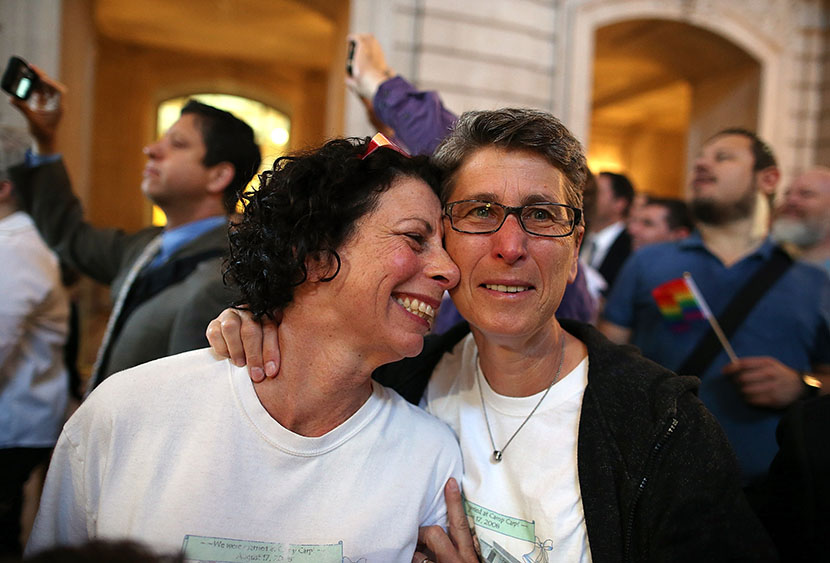
In a win for gay rights, the Supreme Court declined Wednesday morning to overturn a lower court ruling that struck down California’s same-sex marriage ban. But, as expected, the justices did not assert a sweeping right to gay marriage, limiting the ruling’s impact to the Golden State.
The ruling was released minutes after a separate Supreme Court opinion striking down the federal Defense of Marriage Act. Together, the twin rulings represented a major victory for same-sex marriage advocates.
By a 5-4 margin, the court ruled that Proposition 8’s defenders, private citizens, did not have legal standing to defend the ban in court, because the state’s leadership had declined to do so. That means a federal court’s 2010 judgment against Prop 8 stands, allowing gay marriage in California.
“Today is a great day,” said Paul Katami, one of the plaintiffs in the Prop 8 case, at a press conference outside the court, as he embraced his partner, Jeff Zarrillo. “It’s the day that I finally get to look at the man that I love and say, ‘Will you marry me?’”
The ruling, written by Chief Justice John Roberts, leaves open the same-sex marriage issue in the rest of the country. Some gay marriage advocates hoped the justices would assert a universal right to gay marriage in the Constitution, though that had appeared unlikely since oral arguments in March.
However, some observers were suggesting Wednesday that the court’s ruling in the DOMA case may be interpreted to find such a right, leaving the question uncertain for now. Katami said gay marriage advocates would keep fighting until same-sex nuptials are legal across the country.
The Prop 8 case split the court along unfamiliar lines. Roberts was joined by Justices Scalia, Breyer, Kagan, and Ginsburg. Justices Thomas, Alito, Sotomayor, and Kennedy dissented.
Still, the ruling ends a long and convoluted journey for gay marriage in the nation’s most populous state. In 2000, Golden State voters banned the practice for the first time. Four years later, San Francisco mayor Gavin Newsom, arguing that the ban was unconstitutional, directed clerks to allow gay couples to marry. The state’s Supreme Court stopped the weddings, though it didn’t rule on the constitutionality of marriage. In 2008, the same court struck down the 2000 ban, prompting gay couples to head to the altar that summer. But that stopped in November of the same year, when voters passed Proposition 8 by a 52-48 margin, reinstating the ban. In 2010, a federal judge found Prop 8 to be unconstitutional. That ruling was affirmed by an appeals court last year. The Supreme Court ruling Wednesday represented a third finding against the ban. Public opinion among Californians appears to have shifted since the initiative passed: 58% of respondents to a Los Angeles Times poll this month said they back same-sex nuptials. Nine states— Connecticut, Iowa, Maine, Maryland, New Hampshire, New York, Massachusetts, Vermont and Washington—and Washington D.C. allow same-sex marriages. Three more – Minnesota, Rhode Island, and Delaware—have approved gay marriage but their laws have not yet gone into effect.
Zachary Roth Recommended


