








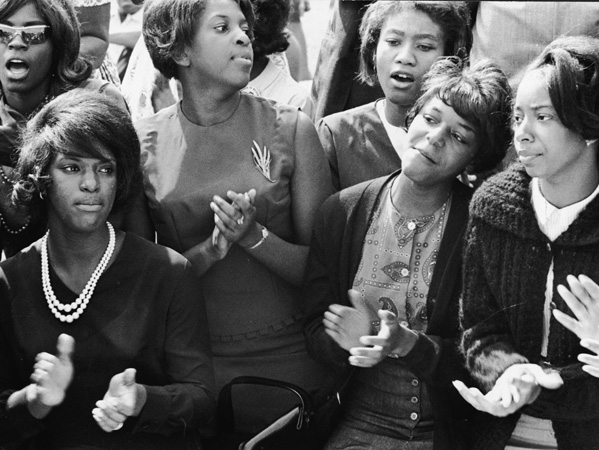
Horace Burton closed down his gas main jobsite on M Street in Washington, D.C., to attend the March on Washington almost 50 years ago on Aug. 28, 1963.
“I knew this was going to be a historical thing,” Burton, who was in his 30s during the original march and is now 85, told MSNBC. “It was a message of hope for me.”
Lionel Hollis also attended the first march. He couldn’t see Rev. Martin Luther King Jr. deliver his “I Have a Dream” speech at the Lincoln Memorial, but he listened from a few blocks away.
Hollis, now 81, told MSNBC he often plays the civil rights leader’s words “over and over.”
“It was beautiful,” said Hollis, a member of Labors International Union of North America who was in Washington, D.C., to celebrate the 50th anniversary of King’s speech.
More than 200,000 marchers assembled on the Washington Mall in 1963 to hear King speak from the steps of the Lincoln Memorial. Thousands of people this weekend will honor the 50th anniversary with a week’s worth of events, which begin Saturday. Throughout the day MSNBC’s Rev. Al Sharpton will lead the “50th Anniversary March on Washington National Action to Realize the Dream” with civil rights groups. Leaders including Democratic Rep. John Lewis—who was the youngest speaker on the dais in 1963—will speak before commemorations end with a march from the Lincoln Memorial to the Martin Luther King Jr. Memorial.
President Obama will deliver and address Wednesday from the steps of the Lincoln Memorial. Bells will ring at three p.m. to mark the time King finished speaking in 1963. Former Presidents Bill Clinton and Jimmy Carter, as well as King’s eldest son, Martin Luther King, III, and second daughter, Bernice King, will also address the crowd.
Speakers will most likely declare that the struggle for racial equality is not over. “The Unfinished March” report recently found that segregation continues in some American communities, decades after it ceased to be official policy. For example, African-Americans are still more likely to be unemployed as white people, and many of the country’s schools and neighborhoods continue to be de facto segregated, according to the study.
Related: 50 years later, what happened to the dream? Fewer than one in five African-Americans believe that King’s speech—in which he declared his desire for a colorblind country—has been realized, according to an NBC/Wall Street Journal poll from July. Fifty-four percent of those polled agreed that America is a country where people are not judged by the color of their skin but by the content of their character, whereas 45% disagreed. In addition, the percentage of Americans who said they think race relations are “very good” or “fairly good”—52%—has declined since Obama, the nation’s first black president, took office in 2009. That same year, 79% of people believed race relations were “good.” King’s dream hasn’t been achieved because there is “too much politics,” said Burton, who added he hopes people can remember the leader’s speech and advice for the country to move forward. “I don’t think he’d be that happy,” Hollis said about Americans failing to fulfill King’s dream. “I think there’s still a lot of room for improvement.”
Michele Richinick Recommended


