








There are now 24 states — meaning nearly half of the country — suing President Obama over his executive actions on immigration. And even as more and more states continue to sign onto efforts to dismantle the president’s measures, the Republican leaders hoping to bring them down just got another wind at their back.
The federal judge assigned to hear the states’ challenge has been critical of the Obama administration’s immigration policies to the point of even accusing the Department of Homeland Security last year of engaging in a criminal conspiracy for returning young immigrants caught at the border to their families living in the United States. U.S. District Judge Andrew Hanen, who was appointed to the South Texas court in 2002 by President George W. Bush, just might be exactly what Republicans need to steamroll the most far-reaching executive actions on immigration seen yet.
RELATED: Undercurrent of fear in executive actions on immigration
In a blistering court order last year, Hanen called the agency’s actions “both dangerous and unconscionable” after officials caught a woman trying to smuggle an undocumented immigrant child across the border, and then later reunited the young girl to her mother, who lived in Virginia. The mother had paid the smuggler $6,000 to bring the young undocumented immigrant from El Salvador to the U.S.
“The DHS, instead of enforcing our border security laws, actually assisted the criminal conspiracy in achieving its illegal goals,” Hanen wrote. “In summary, instead of enforcing the laws of the United States, the government took direct steps to help the individuals who violated it.”
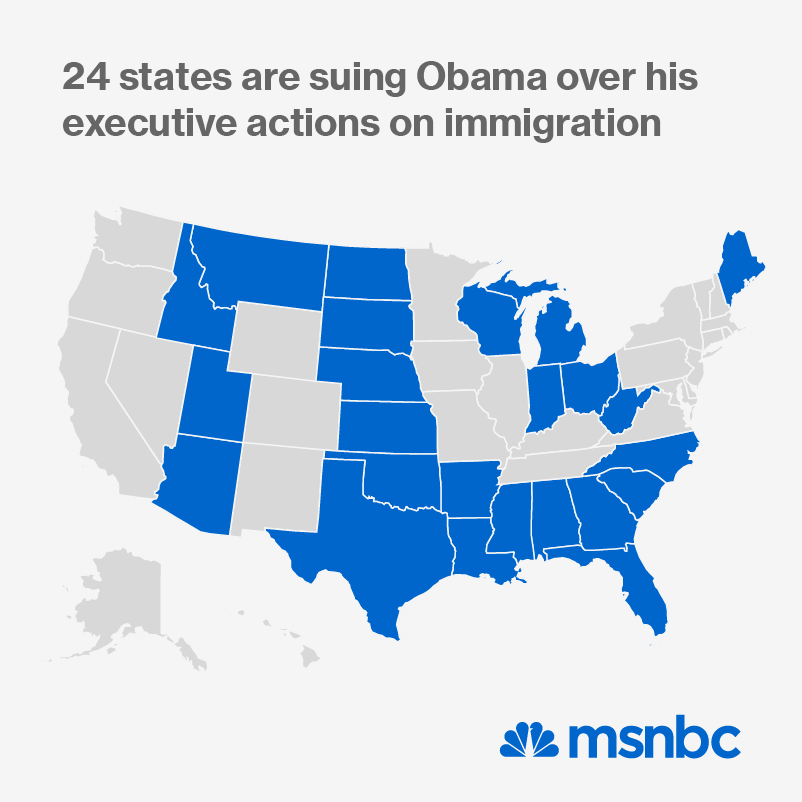
Now a year later, Hanen is assigned to a suit against the Obama administration, filed by a coalition of 24 states: Alabama, Arizona, Arkansas, Florida, Georgia, Idaho, Indiana, Kansas, Louisiana, Maine, Michigan, Mississippi, Montana, Nebraska, North Carolina, South Carolina, North Dakota, Ohio, Oklahoma, South Dakota, Texas, Utah, West Virginia and Wisconsin.
Texas, home to one of the largest undocumented immigrant populations in the country and at the center of political firestorms over issues along the southwestern border, is the lead plaintiff. In a press conference to unveil the preliminary motions last week, Attorney General Greg Abbott said Texas was “uniquely qualified” to challenge the president’s executive action. He said he chose to file the suit in South Texas specifically because it was “the epicenter of where border security is of concern for Texas and the entire nation.”
RELATED: Mayors to make Obama immigration order a reality
But it’s not likely by chance that Abbott chose to file the initial motion with the Brownsville division of the Southern District of Texas. There, Hanen is one of two federal judges who could be assigned to preside over the suit. And with a sympathetic GOP judge on the bench who is already critical of how the Obama administration carries out existing immigration laws, the first challenge to President Obama’s measures providing deportation relief to as many as five million undocumented immigrants could move into some uncharted waters.
The White House insists that the president is acting well within his authority to determine which undocumented immigrants should be priorities facing deportation, and which shouldn’t. Because the federal government does not have the resources to go after the estimated 11 million undocumented immigrants who currently live in the U.S., President Obama said his administration is going to do what it can to allow non-criminals to remain in the U.S. with their families. “I asked the Office Legal Counsel to give me their best ruling on how much legal authority I had,” President Obama told MSNBC’s Jose Diaz-Balart this week. “And we stretched as far as we could.”
The lawsuit alleges that a similar executive action in 2012 — known as Deferred Action for Childhood Arrivals — led directly to a “flood of immigration” and a “humanitarian crisis” in Texas that would only be exacerbated if expanded as intended. The Obama administration’s directives will “substantially increase the number of undocumented immigrants,” the suit continues, putting the burden on the states involved. The president does not have the authority to rewrite laws “under the guise of executive ‘discretion,’” the lawsuit alleges.
This isn’t Abbott’s first rodeo. The attorney general, now governor-elect poised to take over the Lone Star state after Rick Perry’s 12-year-reign, has already filed dozens of lawsuits against the Obama administration. This latest lawsuit tips him over at 31. RELATED: Bill Clinton: Obama immigration order on ‘firm legal ground’ “Abbott has made a routine habit of suing the president. If there were a punch card for such a thing, he’d have filled it up,” said Brandon Rottinghaus, associate professor of political science at the University of Houston. Whether Hanen will decide the coalition of states have legal standing to argue they will suffer from specific harm as a result of the president’s initiative remains unclear, Rottinghaus said. There is established precedence that President Obama is able to take this type of administrative action, he added, but any challenge to the president’s executive actions could potentially jeopardize an issue that Obama has staked the last half of his presidency on. The suit could be the start of a long drawn out legal process hanging on whether the states can prove the harm has been met. “The arguments could have been made stronger,” Rottinghaus said. “The approach has been more political and less legal and the difficulty for the complaint is that it doesn’t reach a strong enough case that this does legal harm and that this is not a political battle.”
Amanda Sakuma Recommended


