








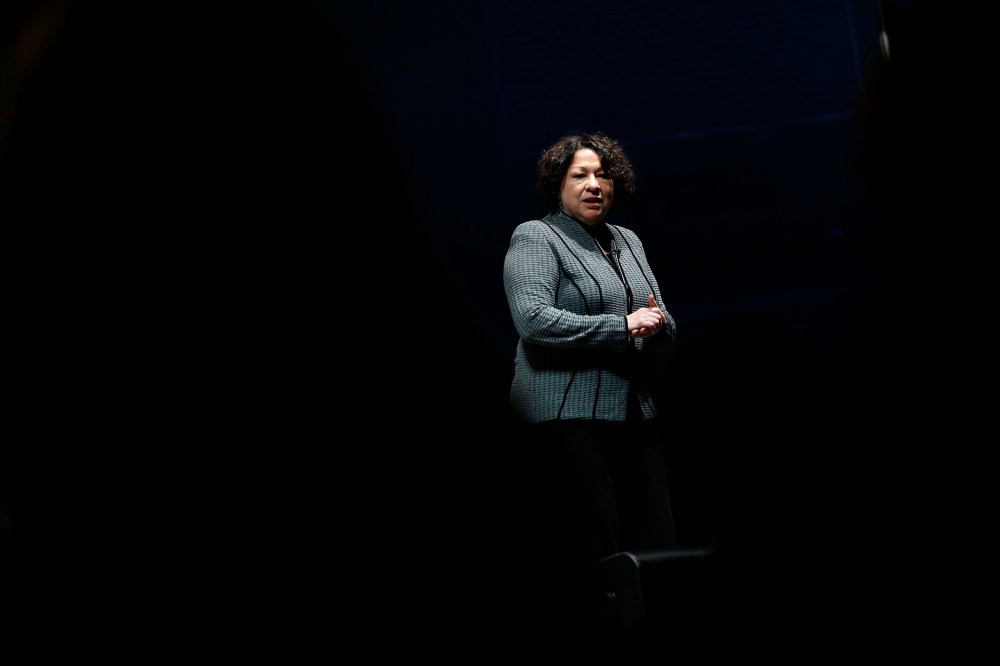
Simmering tensions over the high court’s approach to race burst into the open Tuesday morning when Justice Sonia Sotomayor, reading from her dissent in an affirmative action case, mounted a full-scale assault on the right wing of the court, calling her conservative colleagues “out of touch with reality.”
“The way to stop discrimination on the basis of race is to speak openly and candidly on the subject of race, and to apply the Constitution with eyes open to the unfortunate effects of centuries of racial discrimination,” Sotomayor wrote. “[W]e ought not sit back and wish away, rather than confront, the racial inequality that exists in our society. It is this view that works harm, by perpetuating the facile notion that what makes race matter is acknowledging the simple truth that race does matter.”
Sotomayor’s dissent was the most direct attack on a doctrine of “colorblindness” that has guided the conservative wing of the court’s attack on civil rights era laws designed to remedy the effects of racial discrimination. In a 2007 decision striking down a school desegregation program, Chief Justice John Roberts penned the battle cry of the movement when he wrote, “The way to stop discrimination on the basis of race is to stop discriminating on the basis of race.”
For Roberts and his conservative colleagues, government intervention to remedy the effects of centuries of racism are morally tantamount to racism.
“The right side of the court all seems to believe that race consciousness is the problem, and that focusing on race exacerbates racism,” said Guy Uriel-Charles, a professor at the Duke University School of Law. “The core of Sotomayor’s opinion is that you can’t simply say that racism is a product of race-consciousness, racism is a product of racial history that is persistent with us today. You can’t get beyond racism by not paying attention to race.”

Sotomayor’s formulation turns Roberts’s dicta on itself, and attacks the the conservative justices’ adherence to a doctrine of “colorblindness” on historical terms.
Although other Justices have penned eloquent criticisms of their conservative colleagues’ approach to racism, the left wing of the court has not had a Justice who could speak with the authority that comes with direct, personal experience with discrimination since Thurgood Marshall died in 1993. Since then, the only person of color on the high court, Justice Clarence Thomas, has lent the authority of his personal experience growing up in the segregated South to the conservative movement’s effort to gut or strike down landmark civil rights laws. Sotomayor, who was raised by a single mom in a housing project in the Bronx and became the first Latina Justice, has forcefully defended government efforts to fight discrimination.
Though the outcome of this battle hinges more on which party gets the opportunity to fill vacancies on the high court than the eloquence of the individual justices, Sotomayor’s dissent was nonetheless notable.
“It’s a really strong dissent, it probably is the most significant opinion Justice Sotomayor has written since she’s been on the court,” said Samuel Bagenstos, a professor at Michigan Law and former official in the civil rights division of the Justice Department. “I thought it was a very powerful response, it was important to have someone who clearly is coming from the perspective of having experienced discrimination on the basis of race talk about the reality of the situation.”
Sotomayor engaged the conservative wing of the court despite Justice Anthony Kennedy’s insistence that the case itself was not about race. In 2006, the state of Michigan voted to amend its state constitution to ban affirmative action in college admissions. The court ruled 6-2, with Justice Elena Kagan abstaining and Clinton appointee Stephen Breyer siding in part with the majority, that it was constitutional for Michigan to do so.
Sotomayor argued that by amending the state constitution just to bar race-conscious admissions would allow “a white graduate of a public Michigan university who wishes to pass his historical privilege on to his children” to “freely lobby the board of that university in favor of an expanded legacy admissions policy,” while preventing “a black Michigander who was denied the opportunity to attend that very university from being able to “lobby the board in favor of a policy that might give his children a chance that he never had and that they might never have.” In doing so, Sotomayor wrote, the state had unconstitutionally barred racial minorities from fully participating in the political process.
Roberts’s “colorblindness” bears only a superficial resemblance to the concept as understood by past champions of equal rights, since as applied by the conservative majority on the court the approach has had dire consequences for racial minorities.
Since Roberts became chief justice, the high court has struck down school desegregation plans, narrowed affirmative action, crippled the Voting Rights Act, limited the circumstances under which Americans can sue for racial discrimination, and enabled the denial of health insurance to millions of financially struggling people of color. Though the opportunity has not yet presented itself, the conservative movement from which Roberts sprung would see the Civil Rights Act of 1964 and the Fair Housing Act of 1968 destroyed as well. “In my colleagues’ view, examining the racial impact of legislation only perpetuates racial discrimination,” Sotomayor wrote. “This refusal to accept the stark reality that race matters is regrettable.” Sotomayor attacked that “colorblind” approach as one that chooses to see no evil. The dissent runs through a litany of historical examples of practices that are superficially “colorblind,” but were intended or had the effect of harming minorities, such as “literacy tests, good character requirements, poll taxes and gerrymandering,” methods used in the Jim Crow South to circumvent the Constitution by not explicitly mentioning race. “My colleagues are of the view that we should leave race out of the picture entirely and let the voters sort it out,” Sotomayor wrote. “It is a sentiment out of touch with reality, one not required by our Constitution, and one that has properly been rejected as “not sufficient” to resolve cases of this nature.” In one notable passage, Sotomayor writes: “Race matters to a young man’s view of society when he spends his teenage years watching others tense up as he passes, no matter the neighborhood where he grew up. Race matters to a young woman’s sense of self when she states her hometown, and then is pressed, “No, where are you really from?”, regardless of how many generations her family has been in the country. Race matters to a young person addressed by a stranger in a foreign language, which he does not understand because only English was spoken at home. Race matters because of the slights, the snickers, the silent judgments that reinforce that most crippling of thoughts: “I do not belong here.” It was to this passage that Roberts felt compelled to respond. In a short concurrence, Roberts ignores Sotomayor’s larger argument to defend himself personally and argue that affirmative action, not racism, is the reason minorities would feel excluded from society. “It is not “out of touch with reality” to conclude that racial preferences may themselves have the debilitating effect of reinforcing precisely that doubt, and—if so—that the preferences do more harm than good,” Roberts wrote in response. “People can disagree in good faith on this issue, but it similarly does more harm than good to question the openness and candor of those on either side of the debate.” Roberts’s argument that affirmative action, rather than racism, reinforces those “crippling thoughts” is all the more remarkable given that Sotomayor sits on the court with a fellow Justice who once belonged to a group that would have barred her from attending Princeton. Sotomayor wasn’t questioning Roberts’s candor or openness as much as judgement. The results, from the Voting Rights Act to the Medicaid expansion, speak for themselves, at least for those who choose to listen.
Adam Serwer Recommended


