








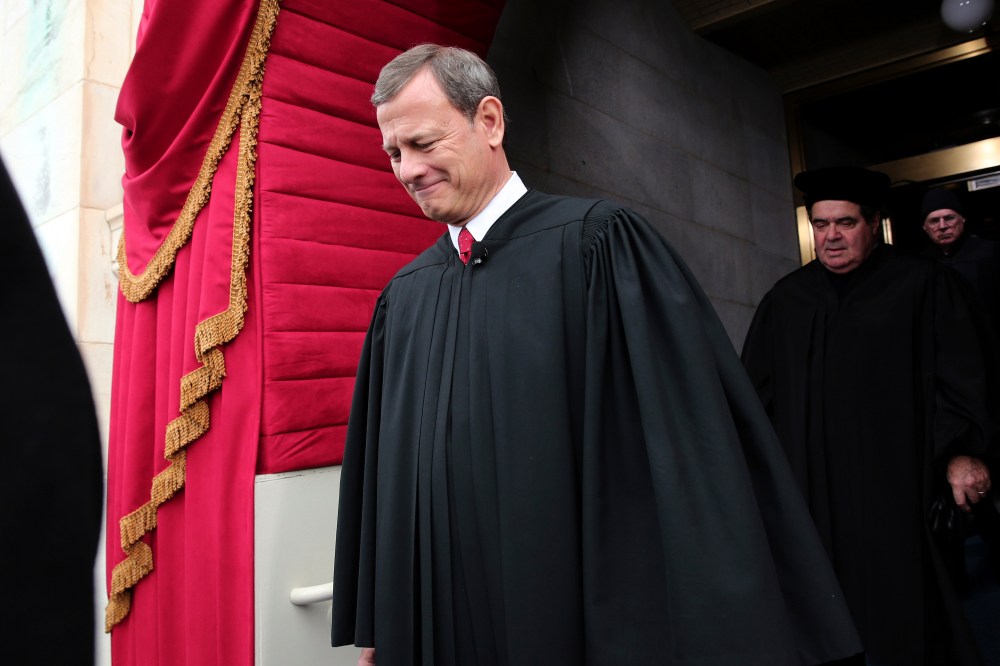
Chief Justice John Roberts figured out how to solve a problem like Antonin Scalia.
In February, when the high court heard Shelby County, Alabama’s challenge to a core section of the Voting Rights Act, Justice Scalia blurted out that the 1965 landmark civil rights law, which ensured that Americans would be able to vote regardless of race, was the “perpetuation of a racial entitlement.” The gasps in the courtroom sounded like a busted airlock.
Roberts, for decades a critic of the Voting Rights Act and a skeptic of government efforts to resolve the lingering effect of racism in American life, had to find a way to neutralize a key part of the law without provoking that sort of reaction. Ever mindful of the legacy of the high court, the chief justice could not allow a decision on the Voting Rights Act to seem rooted in the sort of racial resentment so nakedly expressed by Scalia. On the contrary, Roberts’ opinion repeatedly praises the Voting Rights Act as “immensely successful” before burying it.
Instead of striking down Section 5, the part of the law that mandates that certain parts of the country with histories of discrimination in voting “preclear” their election law changes with the Justice Department, the high court struck Section 4, which determines which parts of the country are covered by Section 5. Instead of proclaiming racism is over, Roberts simply argues that the “formula” for determining which parts of the country should be monitored by the Justice Department is outdated.
“[V]oting discrimination still exists; no one doubts that,” Roberts wrote. “The question is whether the Act’s extraordinary measures, including its disparate treatment of the States, continue to satisfy constitutional requirements.”
Instead of invalidating Section 5 in its entirety, Roberts tells Congress to go back to the drawing board and update its supposedly outdated formula, one he sees as “punishing” the South for sins long past. “While any racial discrimination in voting is too much,” Roberts wrote, “Congress must ensure that the legislation it passes to remedy that problem speaks to current conditions.” This is not Scalia’s cries of “racial entitlement” or Justice Clarence Thomas’ equating of supporters of affirmative action with supporters of Jim Crow, it is an opinion designed to persuade rather than provoke.
Roberts’ contention relies on the notion that the criteria for determining which states are covered by Section 5 is outdated because it supposedly hasn’t been changed since the 1960s. As Justice Ruth Bader Ginsburg points out however, it’s less that the formula hasn’t changed than that the covered states still find creative, even superficially race-neutral ways to disenfranchise voters based on race. Ginsburg points out that a key study considered by Congress when they were reauthorizing the Voting Rights Act in 2006 showed that since 1982, successful voting rights lawsuits were far more likely in the states covered by Section 5.
“Throwing out preclearance when it has worked and is continuing to work to stop discriminatory changes,” Ginsburg writes, “is like throwing away your umbrella in a rainstorm because you are not getting wet.” Roberts writes that “history did not end in 1965. By the time the Act was reauthorized in 2006, there had been 40 more years of it.” But it’s Roberts, not Congress, and not supporters of the Voting Rights Act, who fails to appreciate everything that’s happened since. Jurisdictions can “bail out” of Section 5 by avoiding attempts to disenfranchise minorities, but for the conservative majority, that is apparently too high a bar to clear. For places like Shelby County with recent violations of the Voting Rights Act, it’s recent history that’s the problem. With Section 4 invalidated, Section 5 is inoperable rather than dead. By kicking the decision of whether Section 5 the Voting Rights Act lives or dies to Congress, Roberts avoids the blame for its demise. Congress overwhelmingly reauthorized the Voting Rights Act in 2006, but Roberts knows that today’s Republican Party is far more hostile to any cooperation with Democrats, and that a legislative fix for Section 4 is unlikely. Rather than killing a landmark civil rights law by borrowing the racial resentment of Scalia or the historical inversions of Thomas, Roberts chooses a route that appears more narrow but may be no less final, one that better insulates the high court from criticism. Roberts didn’t kill Section 5, he simply anesthetized a terminally ill patient and left her in the operating room, waiting for a surgeon who will never arrive.
Adam Serwer Recommended


