








The ongoing rift between New York police officers and Mayor Bill de Blasio continues to roil the nation’s largest city. And nearly 1,000 miles away, last week saw more angry clashes between protesters and St. Louis police.
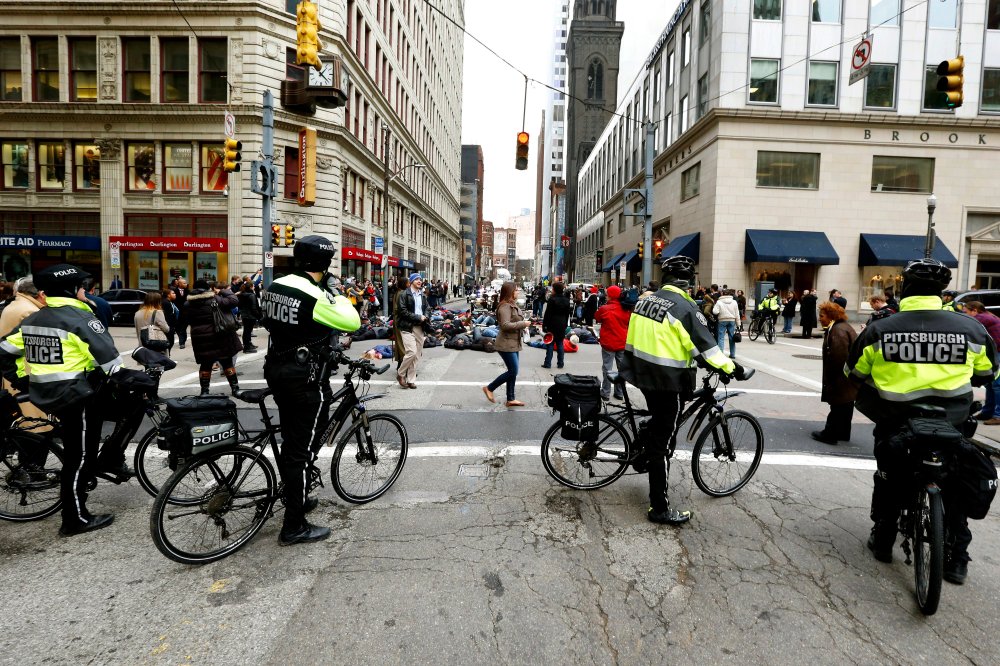
But away from the major hot-spots of tension, some police departments and law enforcement officials have more quietly taken a different approach. In Nashville, police have served protesters hot chocolate instead of arresting them. Pittsburgh’s police commissioner called for a dialogue on poverty and racial injustice. And in Richmond, California, the police chief even joined protesters on the barricades.
RELATED: Why NYPD officers’ silent demonstration spoke volumes
These bright spots, coming amid a stepped-up effort by the Obama administration to help ease police-community tensions, could point a path out from the atmosphere of antagonism and distrust that has characterized police-community relations at least since the spate of police shootings of unarmed blacks this past summer and fall.
In New York, that looks a long way off. New numbers released Monday showed that for the second straight week, police made far fewer arrests and issued far fewer summonses than the previous year—suggesting that at least some cops are conducting a deliberate work slowdown to demonstrate their anger at the mayor. On Sunday, disobeying a request from NYPD Commissioner Bill Bratton, many turned their backs on the mayor as he spoke at the funeral of Officer Wenjian Liu, just as they had a week earlier at the funeral of Liu’s partner, Rafael Ramos.
Some police have accused de Blasio of siding with protesters over law enforcement. A press conference held Monday by de Blasio and Bratton to tout a drop in crime last year appeared unlikely to ease the tension.
And in St. Louis last week—an epicenter of protests since the summer when Michael Brown was killed by police in a nearby suburb—police used pepper spray and made several arrests after protesters briefly occupied the police department building. Some officers drew tasers, and one protester said he was dragged out of the building by his feet.
Things have been much calmer in Nashville, a city with a rich history of civil disobedience that in recent months has seen vigorous protests over police tactics. In November, police shut down city streets and a major interstate so protesters could march unimpeded, then offered the crowd coffee, hot chocolate, and hand shakes when they arrived at police headquarters.
RELATED: The NYPD versus Mayor Bill de Blasio
“In Nashville, if you want to come to a public forum and express your thoughts, even if they’re against the government, you’re going to get your First Amendment protection and you’re going to be treated fairly by the police officers involved,” Police Chief Steve Anderson explained.
After some conservatives complained about that approach, Anderson posted a long and thoughtful holiday message on his department’s website that politely but firmly rejected the criticism. “The police are merely a representative of a government formed by the people for the people—for all people,” Anderson wrote.
Pittsburgh Police Chief Cameron McLay appears to share that philosophy. On New Year’s Eve, McLay was photographed holding a sign created by activists that read: “I resolve to challenge racism at work. #endwhitesilence.” That prompted an attack by the city’s Fraternal Order of Police, whose president accuse McLay of “insinuating that we are now racist.”
In response, McLay sent a department-wide email noting that “race impacts how we view one another, and urging officers to join in a dialogue about “issues of racial injustice, poverty, etc.” McLay continued: “The reality of U.S. policing is that our enforcement efforts have a disparate impact on communities of color. This is a statistical fact. You know, as well as I, the social factors driving this reality. The gross disparity in wealth and opportunity is evident in our city. Frustration and disorder are certain to follow. The predominant patterns of our city’s increased violence involves black victims as well as actors. If we are to address this violence, we must work together with our communities of color.” RELATED: Tensions high between NYC officials, police Neither Anderson nor McLay has gone as far as Chris Magnus, the police chief in Richmond, California, near Oakland. Last month, he stood with protesters while holding a “Black Lives Matter” sign and wearing his uniform. After the inevitable backlash, Magnus told the press, “When did it become a political act to acknowledge that ‘black lives matter’ and show respect for the very real concerns of our minority communities? This should not be about ‘us versus them.’ It should be about finding ways to build bridges and address the schism that exists between many of our residents and police.” Magnus doesn’t just talk the talk. After he took over the department in 2006, he instituted reforms to reduce the use of lethal force. No one in this city of 106,000, historically one of the most violent in the Bay Area, has been killed by a cop since 2007. There is reason to think that the recent activism over police violence could spark a broader interest in reforms like these. The Obama administration has already announced increased funding for a Justice Department program that works with local police departments to ease tensions with the community. And the president has appointed a high-level task force, chaired by Philadelphia Police Chief Charles Ramsey, to offer recommendations on the issue. That panel may want to sit down with Anderson, the Nashville chief. “We have to safeguard life,” Anderson said after the protests in November. “So even if people put themselves in some peril it’s our obligation to make sure that they’re safe.”
Zachary Roth Recommended


