








For MSNBC’s audience of political junkies, election season is akin to the the NFL playoffs and an election day itself, the Super Bowl. With that in mind, MSNBC makes a priority of building exciting, interactive digital campaigns to inform, engage, and empower MSNBC’s loyal community of passionate progressives.
During the 2014 midterm elections and leading up to the 2016 election, we utilized our digital and social media platforms and proprietary MSNBC.com community tools to offer our community resources to inform, to speak out and share their opinions, and to have our audiences voices heard both online and on air.
Here are the highlights of MSNBC’s recent digital election coverage through social media.
DIGITAL DECISION 2014
Interactive Election Night Live-Stream
In November 2014, MSNBC hosted the network’s first-ever live-streaming Election Night web show from 10 pm – 2 am covering the election results as they came in, hosted by MSNBC’s Krystal Ball, Ari Melber, and Richard Wolffe, as well as many special guests.
One key objective of the show beyond just covering the election results, was to bring the audience watching at home into the conversation and let them participate through social media:
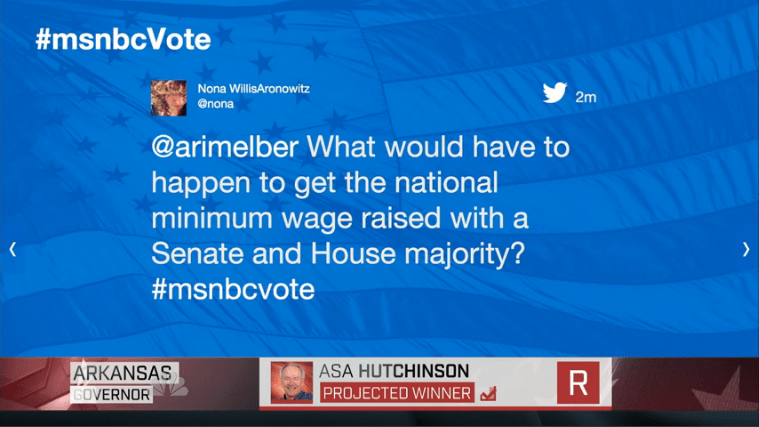
1) Audience members were invited to get involved by tweeting their questions about the election results with #MSNBCvote, and the hosts answered several audience questions during the show. Watch a clip here.
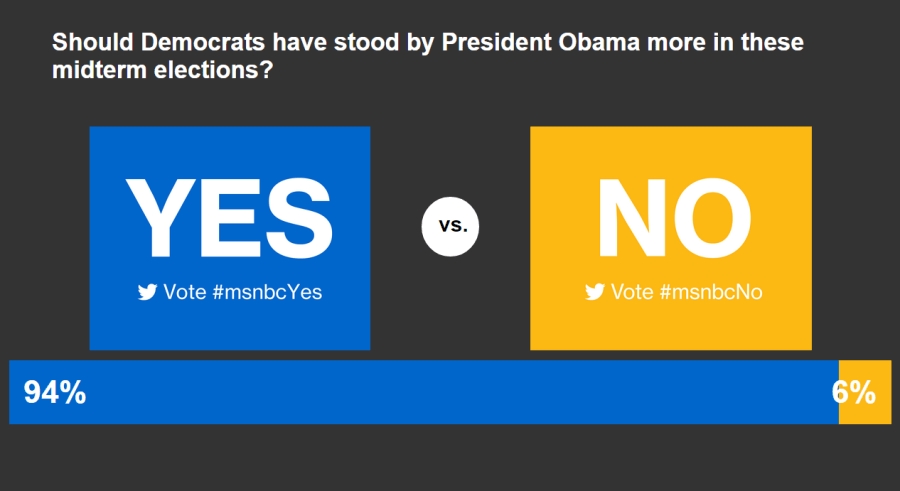
2) The show also featured an interactive “hashtag battle,” where users could vote on whether they thought Democrats should have stood by President Obama by tweeting with the hashtag #MSNBCyes or #MSNBCno. The results updated in real time and were shown on air in the show several times throughout the night. MSNBC’s online audience includes many political junkies and progressives, so we felt this was a great question for them to answer and a great opportunity for those watching at home to feel involved in the show.
#MSNBCvote
On social media platforms, MSNBC used the hashtag #MSNBCvote to drive conversations and get our community excited about the elections. We kicked off the #MSNBCvote effort with an on-air spot featuring MSNBC hosts and staff encouraging people to get out and vote on election day. Then, the audience was asked to tweet why they’re voting and why voting is important to them using the hashtag #MSNBCvote. Their responses were collected and curated on a special page on MSNBC.com here.
I voted today bc I refuse to sit on the sidelines and let policy be made w/o me. Have you? #msnbcvote
— Michael Cormack, Jr. (@mikeinthedelta) November 4, 2014Election Twitter Chat Series
MSNBC’s audience loves our on-air personalities and their expertise on their favorite issues, so we wanted to offer our community a way to directly engage with their favorite hosts. Beginning a week and a half prior to Election Day, MSNBC held a series of election-themed Twitter chats with MSNBC talent, including:
- Chris Matthews
- Jose Diaz-Balart, on the topic of Latinos and the midterms
- Alex Wagner
- Krystal Ball on women and the midterms
- Melissa Harris-Perry
- Lawrence O’Donnell
- Mika Brzezinski and Joe Scarborough
- Chris Hayes on Election Day
The chats were a unique way for MSNBC’s passionate audience to talk to their favorite MSNBC talent, ask their burning election questions, and get answers.
Election Twitter Data
In partnership with Twitter, we produced a set of pieces looking at Twitter conversation data around major marquee Senate races: in Iowa, Colorado, Georgia, North Carolina, and Kentucky. Each of these pieces featured widgets which pulled in Twitter API data displaying the volume of conversations around the race, the most talked-about issues by voters in that state, and the amount of buzz around each candidate. View the original pages here (note data is now outdated):
Community Engagement on MSNBC.com
A set of informational cards for the 14 states where voters faced new hurdles for the first time in a major election this year. This collaboration with the Brennan Center for Justice was a well-designed, useful resource for voters looking to cut through the confusion and find out exactly what they needed to vote.
Voter stories: A 93-year old woman among those facing voting hurdles in 2014
Since voting laws can be inherently confusing and overly technical, we tried to take simpler approaches to informing our audience about voting rights issues. One approach was the voter info cards, and a second was to tell the stories of average voters who were having a tough time voting this year because of new laws. Personal stories are often much more compelling and relatable than the back and forth legal battles that tend to take over voting rights news. We saw incredible traffic on our community voter stories, boosted when shared by such organizations as the ACLU. The stories got over 200 comments.
Quizzes
QUIZ: How much do you know about voting restrictions?
A seven-question quiz testing our readers’ knowledge of new voting laws. The quiz has over 20,000 responses.
QUIZ SERIES: Hot midterm races
Five-question quizzes about four of the hottest midterm races in the country. These short quizzes were an opportunity to test users’ knowledge of the big races and also inform users about some candidates’ surprising stances on the issues. In total, the quizzes have over 22,000 responses.
- Alison Lundergan Grimes vs. Mitch McConnell
- Close race in corn country (Joni Ernst vs. Bruce Braley)
- Can North Carolina hold on to its last bit of blue? (Thom Tillis vs. Kay Hagan)
- Heat is on in the Sunshine State (Rick Scott vs. Charlie Crist)
Community Polls
Take our poll before you go to the polls
In another effort to listen to our audience, we published a poll a few days before Election Day to get a sense of what issues matter most to MSNBC.com users and whether or not our audience was planning to vote.
From these polls, we found:
- 59% of MSNBC.com users say “Jobs and the economy” is the most important issue
- 98% of MSNBC.com users say they are registered to vote
- 96% of MSNBC.com users said they would vote on Nov. 4
- 97% of MSNBC.com users said they knew when and where to vote
- 89% of MSNBC.com users said they knew what kind of identification they needed to vote
You decide: Who will win on Nov. 4?
This was another set of polls we published was an effort to see if MSNBC.com users could predict the midterms. Unsurprisingly, the only races our audience called correctly were:
- 81% of MSNBC.com users said New Hampshire would re-elect Sen. Jeanne Shaheen83% of MSNBC.com users said New Mexico would re-elect Sen. Tom Udall
- 52% of MSNBC.com users said Greg Abbott would be elected Governor of Texas
In total, community polls received nearly 43,000 votes.
DIGITAL DECISION 2016
While still in the 2015 calendar year, the 2016 election cycle has already begun. MSNBC has continued to prioritize compelling social media content through all phases of the 2016 presidential election, beginning as early as the primary debate cycle.
#ShiftTheDebate Engagement
MSNBC hosted the network’s first-ever live-streaming Debate Night web show August 6, 2015 from 9 pm – 11 pm covering the first Republican presidential primary debates. Hosted by MSNBC’s Seema Iyer, Dorian Warren, and Richard Wolffe, the program welcomed many other special guests. Even as this first debate was hosted on a competitor network, MSNBC facilitated an opportunity for the community to continue the dialogue within MSNBC owned platforms.
MSNBC used the hashtag #ShiftTheDebate to encourage the audience to engage. The hosts responded to user questions in real-time over the course of the debate night during live program.
How does Trump compare to Buchanan in 1992?#ShiftTheDebate
— Joe Lowndes (@JoeLowndes) August 6, 2015
Quizzes and Polls
MSNBC again utilized quizzes ahead of the event to drive interest and provide an alternative educational tool, beyond traditional articles and videos, for the audience to prepare.
QUIZ: 2016 Republican candidates: Who said it?
Polls were published to stimulate dialogue after the debate’s conclusion.
Sample questions:
Who won the first Republican debate?
Did Donald Trump’s “blood” comments about Fox News debate moderator Megyn Kelly cross the line? These polls received nearly 30,000 votes. The Twitter Conversation An integral part of coverage was showcasing live social media data over the course of the evening, and keeping viewers updated on its nationwide impact. This data was referenced in live programming, and made easily accessible for users to view from their home devices. B-I-N-G-O Anticipating the hot topics of the evening, and commentary expected from the participating candidates, MSNBC created a gamified experience for its viewing audience. Through custom BINGO game cards viewers and hosts simultaneously competed through the evening providing a compelling reason to pay attention to the moment-to-moment details of the debate. Lucky 7 Democratic Debate Challenge The social team kicked off the first Democratic debate if the 2016 cycle with a new interactive game called the Lucky 7 Debate Challenge. When key moments happened during the debate, the audience shared their reaction to those moments on Twitter, and also gave their take on the buzzwords or moments. LOCAL ENGAGEMENT THROUGH INNOVATIVE MEANS First in the South Democratic Candidates Forum Snapchat Challenge On November 6th, 2015, MSNBC’s Rachel Maddow moderated the “First in the South Democratic Candidates Forum,” live from Winthrop University in Rock Hill, South Carolina. When the event was announced, tickets sold out almost immediately, leaving many students without an opportunity to attend the event in person. If you're near South Carolina, here's your chance to see the next potential president! https://t.co/AbB0NmQfil pic.twitter.com/Zrd3IJgPul MSNBC turned this moment into an opportunity to engage the local youth community through a live action Snapchat scavenger hunt to win tickets to attend the forum. MSNBC coordinated with Winthrop University to design a journey through the campus, asking students to respond to trivia related to the 2016 race, general politics, and the history of Winthrop University.Students who correctly completed the challenge in full were directed to showcase their answers at a surprise final location on campus. The first 5 contestants to arrive with correct answers in hand received a pair of tickets to the forum. The activation had students running around the university and dashing to the finish line on November 6. The success of the campaign was it’s merging of education, innovation, and fun. While only those in the local area were able to win the ticket prizes, Snapchat followers watching from afar were given a behind the scenes look at the forum later that day to incorporate them into the happenings on the ground. More: https://www.ms.now/msnbc/chance-win-tickets-see-hillary-clinton-and-bernie-sanders-msnbc-snap-challenge Press Coverage: http://www.heraldonline.com/news/local/article42959409.html MSNBC Snap Challenge winners are headed to the Democratic Candidates Forum from MSNBC Originals on Vimeo. Momentum Is Just Beginning The lead up to 2016 has begun, and in the new year MSNBC will continue driving election coverage cross platform, designing innovative and engaging solutions to reach voters of all ages and demographics on the platforms they use most.
The place for in-depth analysis, commentary and informed perspectives. Recommended


