








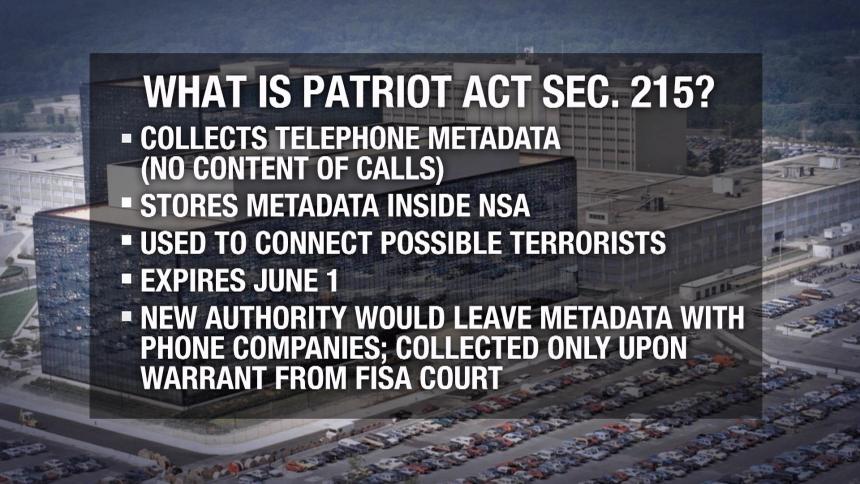
The National Security Agency’s authority to collect troves of bulk telephone metadata under the post-Sept. 11 USA Patriot Act expired at midnight Monday after Republican senators were unable to make a deal.
Sen @RandPaul: Some in DC "want there to be an attack on the (US) so they can blame it on me." http://t.co/RGwTZtsIgW
— Frank Thorp V (@frankthorpNBC) June 1, 2015Senate Majority Leader Mitch McConnell sought a two-week extension Sunday of two less controversial provisions of the Patriot Act, but that effort was blocked by Sen. Rand Paul, his fellow Kentucky Republican who is running for president partly on his strong objections to the surveillance programs.
“Tonight we stopped the illegal NSA bulk data collection,” Rand said in a statement. “This is a victory no matter how you look at it. It might be short lived, but I hope that it provides a road for a robust debate, which will strengthen our intelligence community, while also respecting our Constitution.”
The provisions of the Patriot Act that expired are:
- Section 215, which authorized the NSA’s bulk collection of telephone metadata. Metadata record who called whom when, but not what was said.
- A “lone wolf” provision that gave intelligence agencies powers to follow terrorists who may not be affiliated with a terrorist group.
- Roving wiretaps, which gave intelligence agencies the ability to monitor someone who may use a number of different telephone lines to evade detection.
Fellow Republicans, particularly Sen. John McCain of Arizona, denounced Paul, accusing him of playing politics with the nation’s safety. McCain said Paul was placing “a higher priority on his fundraising and his ambitions than on the security of the nation.”
RELATED: Republicans pile on Rand Paul over Patriot Act threat
McConnell said: “We shouldn’t be disarming unilaterally as our enemies grow more sophisticated and aggressive, and we certainly should not be doing so based on a campaign of demagoguery and disinformation launched in the wake of the unlawful actions of Edward Snowden.”
Paul refused to give ground.
“People here in town think I am making a huge mistake,” he said on the Senate floor. They “want there to be a great attack so they can blame me.”
Paul told NBC News that he wasn’t campaigning from the Senate floor.
“I don’t think many people question my sincerity on this issue,” Paul said. “I’ve been fighting this battle since I came here. I forced the issue in 2011. There’s always going to be cynics.”
In a bid to salvage some of the program, senators Sunday moved on to considering the USA Freedom Act, a compromise bill passed by the House and supported by President Barack Obama. McConnell said amendments to that measure were likely, and no final votes are now expected until at least Tuesday. “We call on the Senate to ensure this irresponsible lapse in authorities is as short-lived as possible,” the White House said late Sunday. “On a matter as critical as our national security, individual Senators must put aside their partisan motivations and act swiftly. The American people deserve nothing less.” Paul has issues with the House bill, as well. While he didn’t reject it outright, he didn’t give it a glowing endorsement. “I have several amendments I am interested in if we could amend this bill,” he said. Some lawmakers said that once the bulk collection program was allowed to “sunset,” it could mark the end of the program entirely, as a vote to restart it has become increasingly tough from a political standpoint. Under the law, any investigations that began or any offenses that took place before the provisions expired will be allowed to continue. But new investigations can’t be started. Frank Thorp V and William J. Gorta of NBC News contributed to this report
M. Johnson Recommended


