








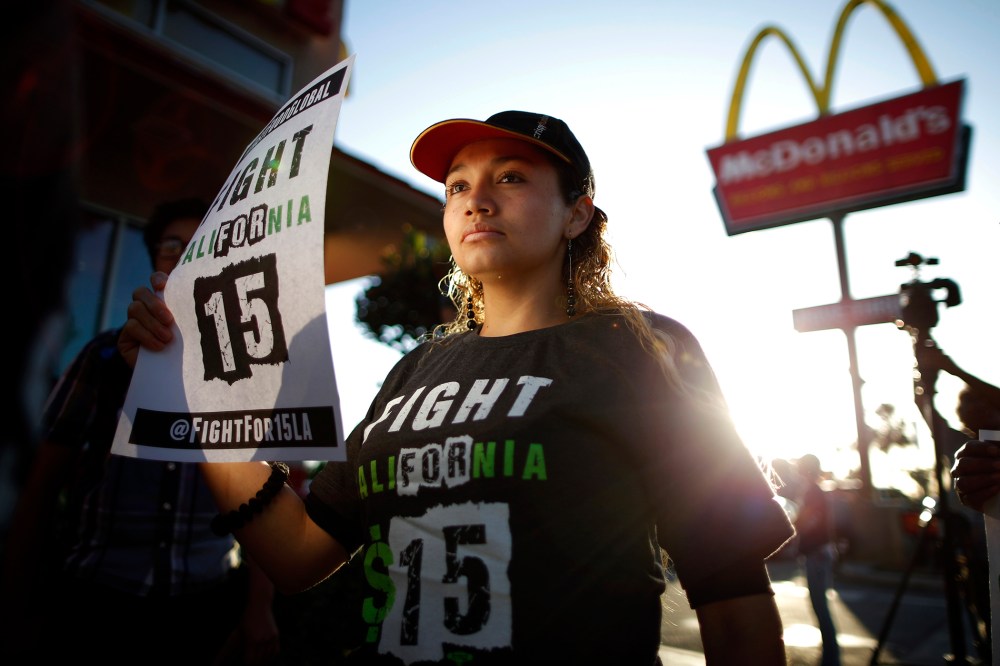
VILLA PARK, Illinois — Thousands of low-wage workers from around the United States convened Friday in a Chicago suburb and kicked off the first-ever national fast food strikers’ convention. They were greeted by the president of one of America’s largest unions, who brought a message of unity to the burgeoning fast food workers’ movement.
“Tonight, I want you to know that 2 million SEIU workers have your back and are standing with you,” said Service Employees International Union president Mary Kay Henry. Her union, which claims to represent about 2.1 million workers, has long been a backer of the fast food strikes.
The convention’s itinerary for Friday night, including Henry’s speech, represented something of a victory lap for striking fast food workers. Since November 2012, the movement has ballooned from about 200 workers in one American city to thousands of workers across the country.
The most recent strike in mid-May affected fast food restaurants in 150 cities across the U.S. and was accompanied by solidarity rallies in 33 other countries. Friday was an opportunity for thousands of fast food workers from around the nation to meet one another and celebrate their successes thus far.
Henry’s speech fit very much into that theme; near the end, she even encouraged the audience to stand up and give themselves a bow.
“Because of your courage, this movement is getting stronger every day,” she told the audience. “It’s getting larger.”
The fast food movement has two key demands: An industry-wide minimum wage of $15 per hour, and the right to form a union. Discussing the first of those two demands, Henry argued that striking fast food workers have already had some success in raising the wage floor for the economy as a whole. By her estimate, 6.7 million workers have already had their wages go up as a direct consequence of fast food worker agitation. That includes low-wage workers in Seattle, where local officials recently struck a deal to raise the minimum wage to $15 per hour.
“One-hundred thousand workers sent me here to thank you,” said Henry, referring to the $15 deal.
A spokesperson for Berlin Rosen, the public relations firm that often works with organizations in the fast food workers movement, told msnbc over email that the 6.7 million figure was based on Bureau of Labor Statistics (BLS) estimates of how many people are affected by recent minimum wage increases. Seattle is just one of several states and municipalities that have recently hiked the minimum wage. Chicago and San Francisco are both contemplating their own increases to $15 per hour. Henry’s speech framed the assembled workers as the front line of a much larger movement, which encompasses home health care workers, port truckers, adjunct professors, Walmart employees, and workers in various other industries which have seen recent labor unrest. If the fast food movement is indeed bolstering wages across the country and giving juice to other attempts at worker organizing, it helps explain why SEIU has pumped millions of dollars into supporting workers who aren’t likely to be paying union dues any time soon. Over the past few years, large unions like SEIU have made significant investments in so-called “alt-labor” groups of non-union workers, although it has not always been clear whether such an investment would return dividends. But minimum wage hikes tend to be unqualified coups for the labor movement, since they raise the median wage for union and non-union workers alike. Similarly, radicalized non-union workers can help provide mass and mobilization on behalf of other causes unions support. That leaves open the question of what could happen if the fast food workers’ interests diverged from SEIU’s. At least for now, both the union and the non-union workers seem to be reaping benefits from the alliance. As Henry herself put it near the end of her speech, “We will win together.”
Ned Resnikoff is an urban policy analyst, researcher, writer, and editor. His byline has appeared in a variety of publications, including the New York Times, San Francisco Chronicle, Dissent, and The Nation. He writes the newsletter Public Comment, which can be found at publiccomment.blog. Recommended


