








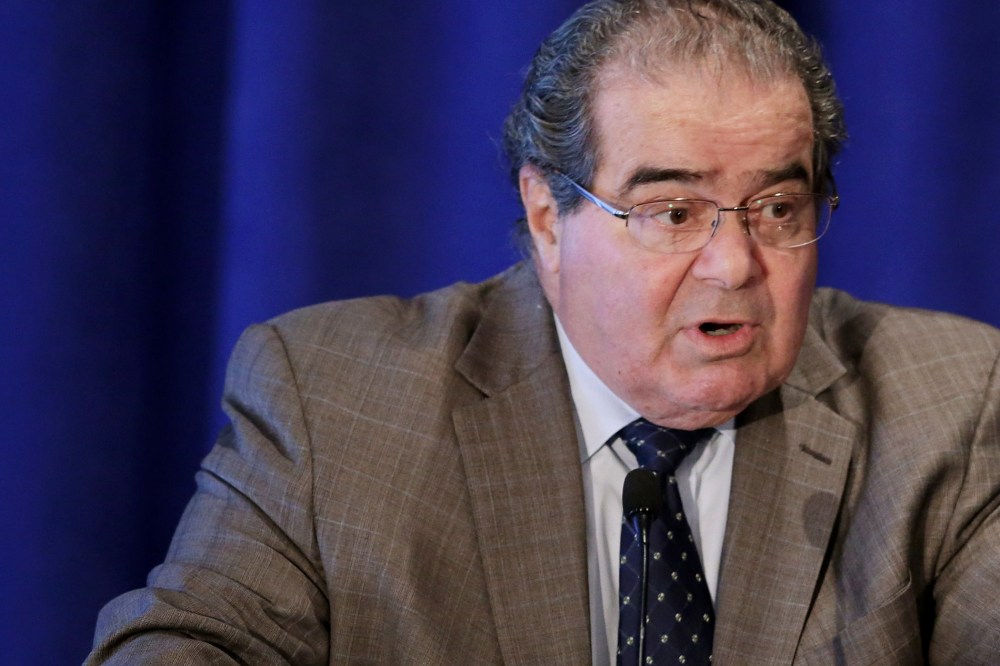
WASHINGTON — Could Justice Antonin Scalia — the arch conservative who famously called the Voting Rights Act a “racial entitlement” — now ride to the rescue of a different landmark civil rights law?
At a Supreme Court hearing Wednesday, Scalia joined all four liberal justices in sounding deeply skeptical of a bid by the state of Texas to dramatically narrow the scope of the 1968 Fair Housing Act (FHA), which prohibits racial and other forms of discrimination in housing.

At issue in the case is whether the FHA bars acts that have a discriminatory effect — what’s known as “disparate impact” — or only acts that are intentionally discriminatory. For four decades, courts have interpreted the FHA to cover disparate impact. But Texas argues that’s not what Congress intended.
From the start, Scalia seemed unconvinced by Texas’ claim. He noted that, in 1988, Congress amended the law to narrow the range of disparate impact claims it covers, something it would hardly have done if it didn’t intend for disparate impact to be covered under the law at all.
The 1988 amendments “make no sense unless there is such a thing as disparate impact,” Scalia told Scott Keller, a lawyer for Texas. “If there is no such thing, they’re prohibiting something that doesn’t exist.”
RELATED: The state of affordable housing in America
“Why doesn’t that kill your case?” Scalia asked Keller, referring to the 1988 amendments.
The justice returned to the point again and again, later saying the wording of the amendments “seems to be an acknowledgement that there is such a thing as disparate impact.”
Sherrilyn Ifill, the president of the NAACP Legal Defense and Educational Fund, said afterwards that Scalia’s questioning was “encouraging.”
“We were happy to hear Justice Scalia very clearly articulate, using the text of the 1968 statute and the 1988 amendments, an understanding of how, together, they make clear Congress’s understanding that disparate impact is an available standard under the act,” Ifill told msnbc.
Justices Sonia Sotomayor and Elena Kagan also peppered Keller with skeptical questions on whether Congress intended to cover effects.
At one point, Keller appeared close to conceding the point about Congress’ intentions, retreating to a different, less far-reaching argument: That the law wasn’t intended to cover disparate impact to the degree that it’s being used in this case.
%22%5BThe%201988%20amendments%5D%20make%20no%20sense%20unless%20there%20is%20such%20a%20thing%20as%20disparate%20impact.%22′
“Well, but now you’re talking about application,” Sotomayor jumped in.
Justice Stephen Breyer said that even if it’s ambiguous as to whether Congress meant to include effects, there was little reason for the justices to overturn the way it’s been interpreted for four decades, with few problems.
“A disaster has not occurred,” said Breyer. “Why should the court come in and change it?” The case arose when a Texas non-profit, the Inclusive Communities Project, claimed the state was approving tax credits for low-income housing only in heavily African-American neighborhoods of Dallas, and denying tax credits in white neighborhoods. That approach, they say, has prolonged the city’s racial segregation, making it harder for poor blacks to have a shot at upward mobility. Civil rights advocates say narrowing the FHA to exclude disparate impact would make it far less effective as a tool for fighting modern-day discrimination, which is rarely explicit enough to be proved intentional. Instead, it often takes the form of policies that don’t explicitly touch on race, but have the effect of perpetuating or worsening the impact of past discrimination. “I have not yet found a bank that has an email that I can discover that says, ‘how can we make fewer loans in this African-American neighborhood?’” said Shanna Smith, a lawyer with the National Housing Alliance who has been bringing housing discrimination cases since the 1970s. “You can’t show intent like they did when I started this work.” But, Smith said, banks will often develop allegedly neutral policies that nonetheless have the effect of harming the victims of past discrimination, and thereby prolonging that discrimination. RELATED: Buying a home: The American dream that won’t die Civil rights advocates had come into Wednesday’s hearing sounding far less optimistic about the prospects for the law, which was passed in the wake of Martin Luther King Jr.’s death, and remains a key part of the panoply of civil rights legislation that transformed the country in the 1960s. For several reasons, most observers had expected that the court will rule to narrow the FHA, as Texas wants. For one thing, almost every lower court to address the issue has said disparate impact is covered, so the fact that the Supreme Court took the case at all suggests they may want to overturn precedent. And Chief Justice John Roberts has made little secret of his long-held desire to push back against anti-discrimination and other civil-rights laws that he thinks go too far in taking race into account. That philosophy was evident in Roberts’ questioning. He repeatedly asked Solicitor General Donald Verrilli, who was arguing that disparate impact is covered, skeptical questions about just how the concept works — a line of inquiry that Justice Anthony Kennedy seemed to sign on to. That suggests that Roberts and Kennedy may be questioning whether disparate impact is constitutional at all — a claim some conservative legal theorists have made, but one that’s not directly at issue in this case.
Zachary Roth Recommended


