








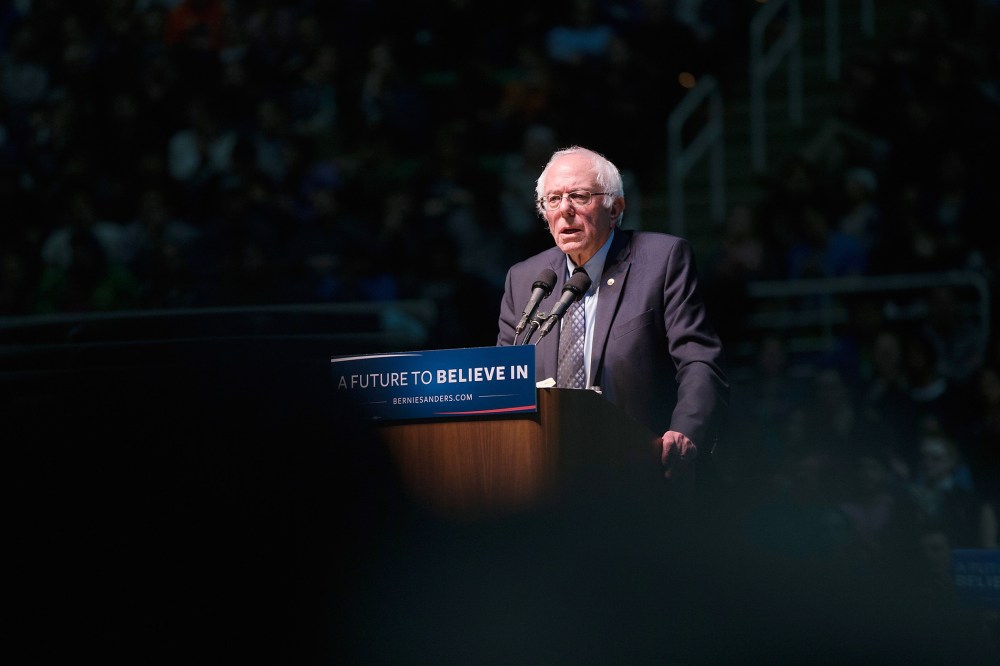
NEW YORK — A presidential candidate wouldn’t go to Iowa and trash corn farmers, nor would they go to Michigan and rag on the auto industry. But what happens when the anti-Wall Street candidate campaigns in the home of hedge funds?

Bernie Sanders has won millions of votes and tens of millions of dollars off his populist message, which calls for jailing bankers involved in the financial crisis and breaking up the biggest financial institutions.
Even while speaking to an ecumenical assembly at the Vatican Friday, Sanders took aim at the banking industry. “We have seen on Wall Street that financial fraud became not only the norm but in many ways the new business model,” he said.
Bill Clinton, who as president signed major legislation to deregulate the industry, joked Friday that Sanders’ supporters want to “just shoot every third person on Wall Street and everything will be fine.”
But in New York, Wall Street isn’t an abstraction.
It’s a place downtown that employs lots of people and generates a ton of wealth, for better or worse.
One out of every in nine jobs in the New York City — and one in 15 jobs in the state — are either directly or indirectly associated with the securities industry, according to the New York State comptroller’s office. The financial industry contributes $12.5 billion in tax revenues statewide.
RELATED: Bill Clinton jabs Bernie Sanders, makes joke at Wall Street’s expense
Regardless of whether one feels the industry is evil, that’s a lot of people and a major sector of the state’s economy, which translates into political power.
After all, New Yorkers fell in love with “Hamilton,” the heroic portrayal of the grandfather of the Federal Reserve (Alexander Hamilton is buried less a block away from the New York Stock Exchange). They also elected Mayor Michael Bloomberg — who made billions selling information on proprietary terminals used by every trader in New York — three times in a row, even after he changed the rules to do it.
“[Sanders is] attacking our homegrown industry. It’s one of the things that make New York function,” said Hank Sheinkopf, a New York Democratic strategist.
Politically, many in the finance industry are liberal on social issues and support Democratic candidates.
Sheinkopf said New York City voters tend to, despite their liberal slant, view the finance industry less negatively than ideological compatriots in other states. “People in the bottom don’t like Wall Street much,” he said, “but people in the middle like it and hate it at same time, and people at the top don’t hate it at all.”
RELATED: Sparks fly between Clinton and Sanders at heated debate
But Sanders’ appeal is exactly that: He is willing to take on powerful interests, especially when it’s not be politically expedient.
New York politicians — including Hillary Clinton — who represent the industry and its workers tend to be friendlier to Wall Street than their fellow liberal Democrats, a fact Sanders has made a centerpiece of his campaign.
Employees of major banks have opened their wallets to help both Clinton’s political and charitable endeavors, and she’s been personally friendly with people like Goldman Sachs CEO Lloyd Blankfein, who has been a vocal supporter her presidential aspirations. CitiGroup and Goldman Sachs were the two largest donors to Clinton’s 2006 Senate reelection campaign, according to the Center for Responsive Politics. The Huffington Post was able to find only 34 people employed by big banks in New York City who had contributed $200 or more to Sanders’ campaign. They found 245 for Clinton. The financiers who do support Sanders tend to be iconoclasts, like Asher Edelman, one of the inspirations for Gordon Gekko, the character portrayed by Michael Douglas in Oliver Stone’s “Wall Street.” Robert Wolf, the former President and COO of UBS Investment Bank and a large donor to Barack Obama, said Sanders is wrong to assume people who work in finance make political decisions based solely on what’s good for business. “I think that where Senator Sanders is missing the point is his labeling voters as Wall Street,” said Wolf, who now runs a Midtown consultancy called 32 Advisors and supports Clinton. “Yes, that’s our job, but when people who work in financial services think about the election and who he or she votes for the presidency, it’s much more than about our job.” “We don’t vote based on where the candidate is on reg reform,” he added, explaining that issues like gun control or immigration are more important to Democrats in the finance industry. “But the Senator tries to stereotype this whole industry and his views are just not accurate.” RELATED: Clinton and her controversial Wall Street speeches Clinton tried to make the point — inartfully – in a Democratic debate in Iowa back in November that she’s is just doing the job of any good politician by representing the finance industry in New York. “I represented New York on 9/11 when we were attacked. Where were we attacked? We were attacked in downtown Manhattan where Wall Street is,” she said. “I did spend a whole lot of time and effort helping them rebuild. That was good for New York.” During a townhall last week on NBC’s TODAY, Sanders didn’t dispute that his plan to crack down on financial institutions could kill thousands of jobs at mega-banks, but suggested they could work for community banks and credit unions. “What I think happens in any transition is that people find different jobs,” he said, “because the economy becomes transformed.”
Alex Seitz-Wald Recommended


