








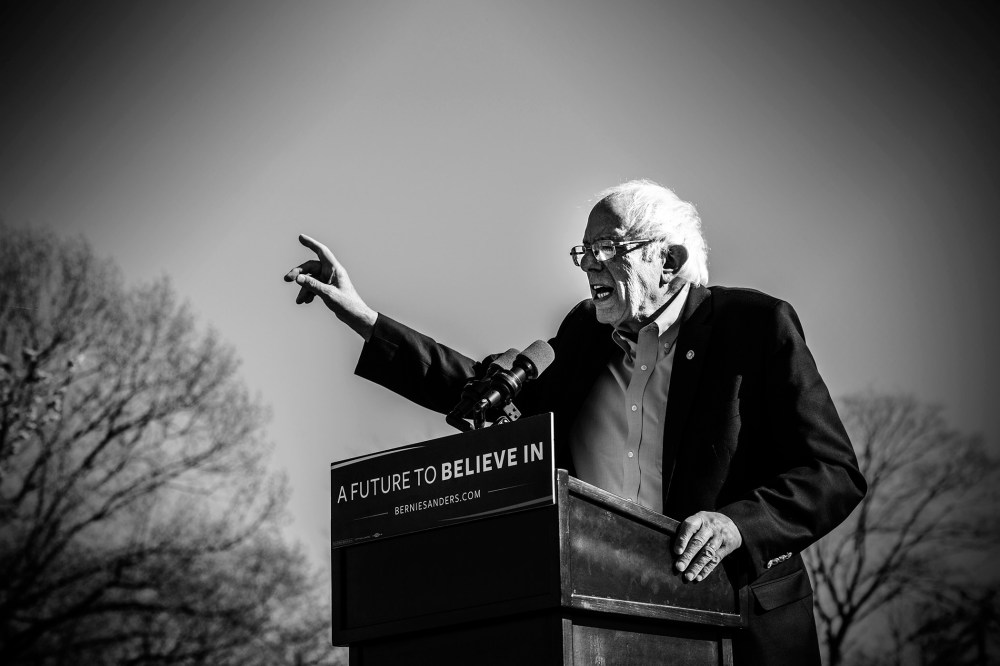
The 25-year-marriage of convenience between Bernie Sanders and the Democratic Party is on the rocks, as the Vermont independent senator is threatening to take his millions of supporters with him in the separation.

Sanders has made it clear he will his lead his army of committed activists into battle against presumptive Republican nominee Donald Trump, but that doesn’t mean he’ll do it under the Democratic Party’s banner. That should give Democrats reason to worry about the long term implications of his political revolution on their party.
This week, Sanders supporters booed his mention of the Democratic Party at a rally in California, while the party’s chairwoman accused the senator of “excus[ing]” death threats made by his fans against another party leader.
Amid the tension Tuesday night, Sanders’ policy director announced on Twitter that he had donated money to DNC Chairwoman Debbie Wasserman Schultz’ congressional primary opponent. “[A]fter tonight, it’s way too late for establishment politics,” he explained.
As the controversy over a raucous state convention in Nevada stretched into its fourth day, Democrats across the country are increasingly worried about about a tumultuous national convention in July and a lasting fissure in the party.
“We have a multi-faceted, multi-layered concern,” said New Hampshire Democratic Party Chairman Ray Buckley, shortly after landing in Philadelphia for a meeting of state party chairs, at which the Nevada convention chaos is sure to come up.
RELATED: Biden: ‘There’s no fundamental split in the Democratic Party’
Buckley was there when Sanders officially became a Democrat in November. The chairman personally accompanied Sanders to the secretary of state’s office to make sure the independent senator had no issue getting on the Democratic ballot in the first-in-the nation primary state.
While Buckley said he’s confident the issue can be resolved ahead of the National Convention in Philadelphia with greater education of the process to Sanders supporters, he acknowledged that the potential for trouble is unusually high.
“This is my ninth convention and I’ve never even had to contemplate” ejecting disruptive delegates from the convention, Buckley said. “I’ve never even witnessed that kind of thing. We are entering an entirely new level of discussion and preparation.”
Meanwhile, Sanders supporters increasingly view the institutional Democratic Party as conspiring against them.
“When you lose a fair fight, then you’re sad and disappointed. When you lose rigged fight, then you’re angry and you hit the streets,” said Charles Chamberlain, the executive director of the liberal group Democracy for America, which supports Sanders.
Even if party agrees to Sanders supporters’ pre-convention demands, which include greater representation on the committees that write the party’s platform and rules, there may still be trouble.
RELATED: Bernie Sanders’ campaign manager calls DNC chair a ‘divider’
“I think a little bit of disruption is exciting. That’s democracy,” Chamberlain said. “The reality is without that, all you have is boring parliamentary procedure and everyone falls asleep. So I think it’s exciting and it’s actually healthy.”
Still, Chamberlain said concerns about an unbreachable rift are overblown, and that the party will heal, just like it does after every contentious primary. “We’ll see the democratic establishment and the political revolution working together to defeat the Republican billionaire bigot in November,” he said, referring to Trump.
Presidential primaries are always contentious. The 2016 Democratic primary probably doesn’t rank anywhere near the top in terms of vitriol. Typically, primaries end with the losing candidate and their supporters falling in line to be a good partisan soldier in the end. The vast majority of Sanders supporters, who are liberal Democrats, will come into the fold this year, as well.

The difference, however, is that Sanders and many of his hardestcore revolutionaries are not loyal to the Democratic Party.
“Generally, there’s so-called unity because the candidates are not really that far apart. This time, there’s a fundamental difference,” said Jonathan Tasini, who ran unsuccessful primary challenge against then-Sen. Hillary Clinton in 2006. He now supports Sanders. “While people seem to think it’s just a slogan, there is really a political revolution going on and this revolt is not going to stop after this election.”
Afterall, Sanders’ first successful political campaign came at expense of the incumbent Democratic mayor of Burlington, Vermont, whom he unseated in 1980. Democrats on the city council vociferously opposed the new mayor’s agenda, until his allies defeated many of them, too.
Tensions were so high between Sanders and Vermont Democrats that when in 1984 he attended “a formal Democratic Party function for the first and last time time in my life,” a woman slapped him across his face, he wrote to his autobiography.
Sanders continued running against Democrats until 1988, when he came in second in a three-way congressional race ahead of the Democrat. Two years later, he and the party struck a truce. Democrats cleared the way for him to win a congressional seat, and later one in the Senate, where he caucuses with and votes with the party to this day.
RELATED: Bernie Sanders has strong words for Democratic Party leadership
But that relationship seems to be fraying now amid acrimony over process concerns, which have sometimes eclipsed Sanders’ policy agenda.
On Tuesday night, after splitting the Kentucky and Oregon primaries with Clinton, Sanders said the party had to meet his demands, not the other way around. “The Democratic Party is going to have to make a very, very profound and important decision. It can do the right thing and open its doors,” he said. “Or, the other option, the other for the Democratic Party which I see as a very sad and tragic option is to, is to choose to maintain its status quo structure, remain dependent on big money campaign contributions and be a party with limited participation and limited energy.” Many of Sanders strongest supporters come from outside the ranks of registered Democrats, which explains explain why, until Tuesday night, he had only won primaries that allow independent voters to participate. Sanders brought many of these people into the Democratic political process, but the concern is that he will help push them out if they’re led to believe the party is a hopelessly corrupt machine. Even if the so-called “Bernie or Bust” voters hold their nose and vote for Clinton to stop Trump in November, it may be harder to make them the kind of reliable Democratic voters the party needs to help elect its candidates at every level, up and down the ballot, in every election. The latest flare up came after Sanders supporters disrupted the Nevada Democratic Party Convention Saturday, threatened the state party chair, and vandalized the party’s headquarters. The party accused the Sanders campaign of having a “penchant for extra-parliamentary behavior — indeed, actual violence” and called on him to strongly speak out against it. RELATED: Bernie Sanders under fire after Nevada convention chaos Sanders issued a statement Tuesday that condemned “any and all forms of violence,” but Democrats say that wasn’t enough, noting it was not specifically addressed to his supporters and was buried with a caveat in the third paragraph of an otherwise defiant statement. Wasserman Schultz told MSNBC that the statement “seems to excuse their supporters’ actions, which is unacceptable.” The Nevada Democratic Party added that Sanders is “failing to adequately denounce the threats of violence of his supporters.” Senate Minority Leader Harry Reid, who said he had a good conversation with Sanders about the convention, told reporters he was “surprised” and disappointed by Sanders’ “silly” response. “Bernie is better than that. He should say something about this, not have some statement someone else prepared for him,” Reid said. Reid’s comment about “someone else” reflects the view of many Democrats, generally expressed only privately, that Sanders is being led astray by his campaign manager, who seems to constantly want to escalate fights with the party. Sen. Barbara Boxer, a Clinton supporter who was booed at the Nevada convention, spoke with Sanders Tuesday night to explain what happened, in part because she was concerned the information was not getting to him, according to a source. Democrats are baffled as to why Sanders has been reluctant to speak out more forcefully against his supporters’ actions. Some Sanders surrogates doubted the death threats against the Nevada party chair actually came from Sanders supporters, despite the evidence. Two months ago, when Trump rallies turned violent, Sanders called on the candidate to be “loud and clear and tell his supporters that violence at rallies is not what America is about, and to end it.” “No one in America should ever fear for their safety at a political rally,” Sanders said in a statement. “Mr. Trump should take responsibility for addressing his supporters’ violent actions.”
Alex Seitz-Wald Recommended


