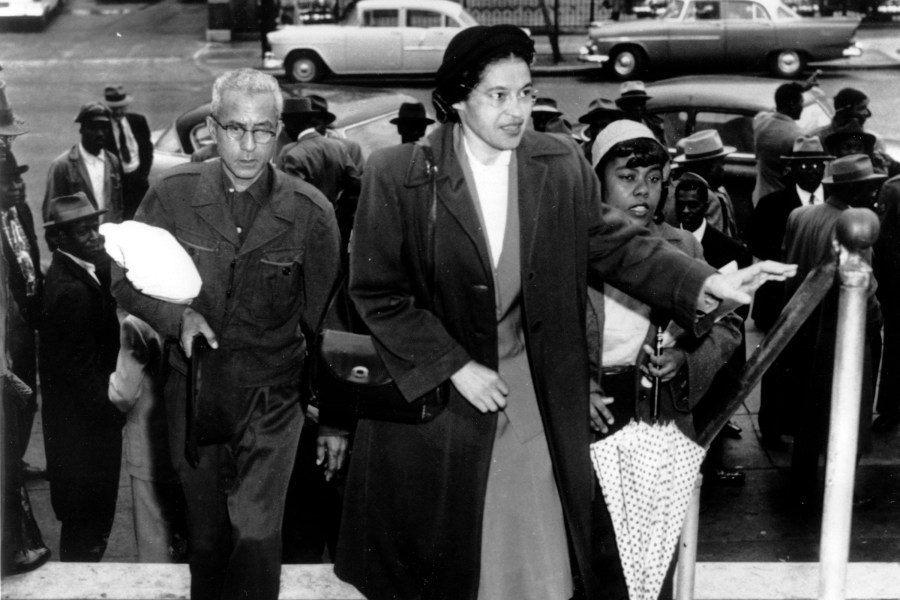
Rosa Parks had a nightmare the night after the Selma-to-Montgomery march.
Living in Detroit, Parks had answered the call when marchers were brutalized by police on the Edmund Pettus Bridge in Selma to come down to Alabama to march again. She joined the last leg of the march from Selma to Montgomery, her trip financed by the United Automobile Workers (UAW) union because she could not afford to come herself. The Parks family had been forced to leave Montgomery in 1957: Having lost their jobs shortly after the boycott began and still facing repeated death threats, they moved to Detroit eight months after the boycott’s successful end.
As the march entered its final stretch into Montgomery, White Citizens’ Council members had plastered the roads with huge billboards of a 1957 picture of her and Martin Luther King at Highlander Folk School, calling them Communists. At the rally at the march’s culmination, Parks was introduced as the “first lady of the movement” and coaxed to the podium by thunderous applause and calls of “Tell! Tell! Tell!” from the huge crowd — “the most enthusiastic” response received of all the speakers, according to one reporter.
In her remarks, she spoke about her personal history growing up under racism and her fear of Ku Klux Klan attacks: “My family was deprived of the land they owned.” Telling the crowd, “I am handicapped in every way,” she refused to be cowed by the billboards and publicly affirmed her connection to Highlander and all she learned there, refuting the “propaganda” about the school’s Communist ties.
That evening, despite the power of the day’s events, she was deeply unsettled. She had a nightmare in which she was standing in a field with a large billboard, saw a man with a gun, and was trying to warn her husband when the man with the gun aimed at her. Waking up shaken, she was horrified to learn about the murder of Viola Liuzzo the night before. A white Detroiter who had also journeyed south to join the march, Liuzzo was killed by members of the Klan, including an FBI informant, as she drove marchers home. Back in Detroit, profoundly outraged, Parks attended a mass meeting on the killing as well as the memorial service for Liuzzo.
While she took that nightmare to be a premonition of Liuzzo’s murder, in a larger sense, Rosa Parks’ premonition and her decades of political activism after the signing of the 1965 Voting Rights Act offer a sober challenge to the 50th anniversary Selma commemorations this week. Filled with soaring speeches, moving commemorations, and host of other festivities (from funnel cakes to a BET concert), the events honored the civil rights movement in epic fashion.
RELATED: Selma 50 years later: More bridges to cross
Along with Ava DuVernay’s groundbreaking movie, “Selma,” this week’s events have opened up important conversations about the history of racial injustice this country. But such commemorations ask little of the nation in the present. Even as they acknowledge that the struggle is not over, they make us feel uplifted and redeemed—a powerful elixir of long-ago grit, gumption, sacrifice and American heroism. And the history they tell seems to end with Selma and the passage of the Voting Rights Act, missing the long history of the movement after 1965 in the South and the North and the lessons that lifelong freedom fighters like Parks offer for the struggle ahead.
%22Such%20commemorations%20ask%20little%20of%20the%20nation%20in%20the%20present.%20Even%20as%20they%20acknowledge%20that%20the%20struggle%20is%20not%20over%2C%20they%20make%20us%20feel%20uplifted%20and%20redeemed.%22′
Rosa Parks’ post-Voting Rights Act work is a caution against the seductions of these types of national celebrations and a reminder of our responsibility to the significant work ahead. Rosa Parks saw the passage of the VRA as a signal achievement, having worked for more than two decades to press for black voting rights.
According to many accounts, she attended President Lyndon Johnson’s signing of the Act on August 6, 1965 (though interestingly she does not mention the ceremony in her autobiography). But her activism only increased after the signing of the VRA, in part enabled by an end to the deep economic suffering she experienced after her 1955 bus stand when newly-elected Rep. John Conyers hired her to work in his Detroit office in March 1965.
Injustice was rampant in Detroit — the “promised land that wasn’t” as she termed it — widespread black poverty, school and housing segregation, lack of Black political power, job discrimination, and police brutality. “This was no time to be dormant,” Parks affirmed.
From her job in Conyers office and as part of struggles in the city and across the nation, she pressed forward. Understanding that laws are only as effective as how they are enacted, she returned to Alabama in 1966 to support the movement being waged by local residents and SNCC activists in Lowndes County for black voting rights and an independent black political party. Stokely Carmichael called her his hero.
The ongoing resistance to racial and social justice in the North as well as the South angered her. She questioned the silences and hypocrisies of Northern liberalism, seeing Detroit’s 1967 riot as “the result of resistance to change that was needed long beforehand” and calling out the ways that “the establishment of white people … will antagonize and provoke violence. When the young people want to present themselves as human beings and come into their own as men, there is always something to cut them down.” The movement was not over. And so even after decades of political work, when no one would have begrudged her for resting on her decades of activism and long after the milestones we celebrate today, Rosa Parks continued on — working on behalf of black candidates, opposing U.S. involvement in Vietnam and policy in Central America, while pushing to open opportunities for people to secure housing and welfare and jobs. She remained deeply concerned about poverty and social justice, and dedicated to young people, the teaching of black history, desegregated education and access to college. Systemic bias in the criminal justice was another lifelong concern: Parks wrote to individual prisoners, served on a people’s tribunal and other organizing efforts around police brutality, organized with numerous prisoner defense committees, and opposed the death penalty. In the 1980s and 1990s, Parks was increasingly dismayed by the widespread persistence of racial injustice. This was evident in a September 1991 statement she issued against the appointment of Clarence Thomas to the Supreme Court, found in the newly-opened Rosa Parks Archive at the Library of Congress. Parks was troubled by the ways the Supreme Court “now appears to be turning its back on the undeniable fact of discrimination and exclusion” and felt Thomas’ poor record on civil and voting rights “would not represent a step forward in the road to racial progress but a U-turn on that road.” What would she be saying now? With the Department of Justice’s searing report on the systematic injustices perpetrated by the Ferguson Police Department, it is clear that the work is yet undone. With one of every 13 African Americans unable to vote because of felon disfranchisement laws and African Americans incarcerated at six times the rates of whites, the work is yet undone. With 22% of all American children including 38% of black children living in poverty, the work is yet undone. With an unarmed black teenager killed by a police officer in Madison, Wisconsin less than 24 hours before the president’s speech in Selma, the work is yet undone. Celebrating the courage and tenacity of the civil rights movement is not the same as the difficult and tedious work of summoning that courage and organizing tradition in ourselves. In one of her writings found in the Archive, Rosa Parks underlined the “need to take a critical honest look at ourselves in regards to the contribution we are making.” That is the question we must be asking — not simply how we commemorate this history but how we contribute to it today. Jeanne Theoharis is Distinguished Professor of Political Science at Brooklyn College of CUNY and the author of the award-winning The Rebellious Life of Mrs. Rosa Parks.
Jeanne Theoharis Recommended